
The Literary Review of Canada

Happy anniversary to us! This past December, the LRC turned 20.

Get free email updates!

Magazine Issue ›› April 2009

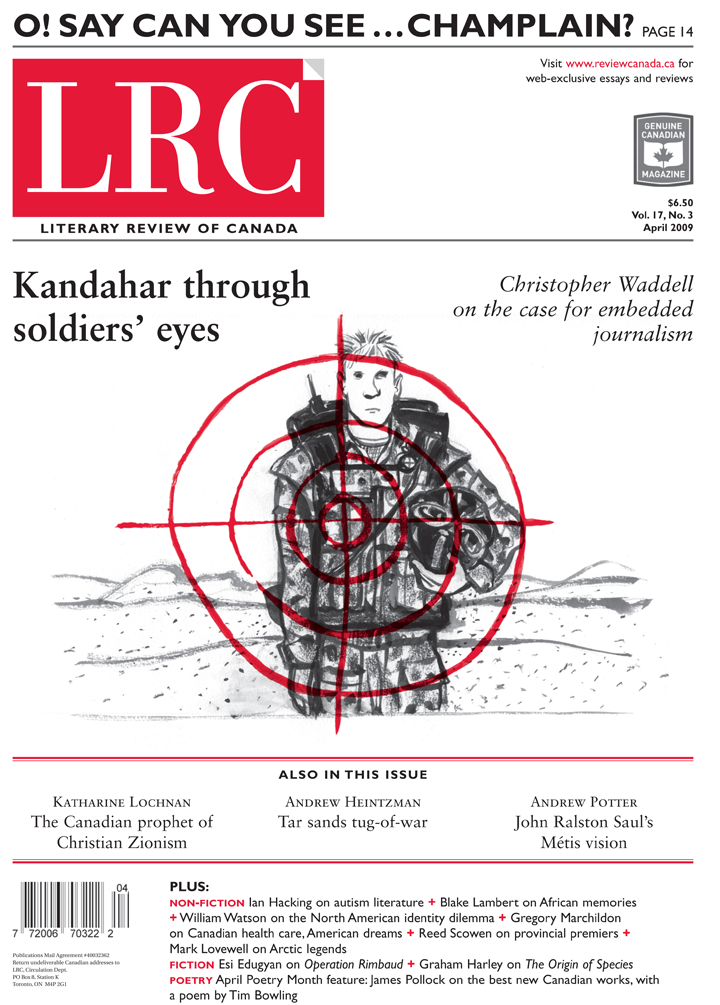
cover image

In the April 2009 Issue

  • Inside the Wire

    A review of Outside the Wire: The War in Afghanistan in the Words of Its Participants, edited by Kevin Patterson and Jane Warren; Fifteen Days: Stories of Bravery, Friendship, Life and Death from Inside the New Canadian Army by Christie Blatchford; Kandahar Tour: The Turning Point in Canada’s Afghan Mission by Lee Windsor, David Charters and Brent Wilson; On Assignment in Afghanistan: Maritimers at War by Chris Lambie (text) and Christian Laforce (photography); Contact Charlie: The Canadian Army, the Taliban and the Battle That Saved Afghanistan by Chris Wattie; and The Long Walk Home: Paul Franklin’s Journey from Afghanistan by Liane Faulder

    Christopher Waddell
  • Are We a Métis Nation?

    A review of A Fair Country: Telling Truths about Canada, by John Ralston Saul

    Andrew Potter
  • Private Thoughts in Public Language

    A review of JPod by Douglas Coupland, The Language of Others by Clare Morrall, Daniel Isn’t Talking by Marti Leimbach, Eye Contact by Cammie McGovern, and So Odd a Mixture: Along the Autistic Spectrum in “Pride and Prejudice” by Phyllis Ferguson Bottomer

    Ian Hacking
  • What’s Race Got to Do with It?

    A review of Gerard W. Boychuk's National Health Insurance in the United States and Canada: Race, Territory and the Roots of Difference

    Gregory P. Marchildon
  • Frozen Moments

    A review of Encounters on the Passage: Inuit Meet the Explorers, by Dorothy Harley Eber, and Race to the Polar Sea: The Heroic Adventures of Elisha Kent Kane, by Ken McGoogan.

    Mark Lovewell
  • A Very American Champlain

    A review of David Hackett Fischer’s Champlain’s Dream: The Visionary Adventurer Who Made a New World in Canada

    Ronald Rudin
  • Choosing the Best Canadian Poetry

    James Pollock
  • The Book Collector

    Tim Bowling
  • A Canadian Visionary

    Katharine Lochnan
  • Bitumen: Boon or Blight?

    A review of Tar Sands: Dirty Oil and the Future of a Continent, by Andrew Nikiforuk, and Tar Sands Showdown: Canada and the New Politics of Oil in an Age of Climate Change, by Tony Clarke

    Andrew Heintzman
  • An Exercise in Opposites

    A review ofFrank Moores: The Time of His Life, by Janice Wells, and An Honourable Calling: Political Memoirs, by Allan Blakeney

    Reed Scowen
  • Torrents of Vitriol

    A review of Joan Baxter’s Dust from Our Eyes: An Unblinkered Look at Africa.

    Blake Lambert
  • The Continental Quickstep

    A review of Stephen Clarkson’s Does North America Exist? Governing the Continent after NAFTA and 9/11

    William Watson
  • Cover art and pictures throughout the issue by Barbara Klunder

    Barbara Klunder has been illustrating and designing for many years. She has won numerous awards in Canada and the United States, and has had museum shows of her textile work. Her first book, Other Goose, illustrates “recycled” rhymes and was published by Groundwood/House of Anansi in 2007.

Letters for April 2009

  • “Private Thoughts in Public Language,” by Ian Hacking (April 2009)

    Ian Hacking may be on to something, but he seems a tad off-centre and obsessive in attributing “autism” to Douglas Coupland’s JPod. Coupland’s laid-back, West Coast characters give a damn about one another, from Ethan’s ethereally earthy parents on down, as when two podsters fly to Hong Kong to rescue an errant third from a heroin-assisted addiction to an assembly line. The pod itself may at times appear autistic but never nihilistic, and most visionary works portray a self-referential world inside the author’s mind, like the distant bubble-world in Charles Heavysege’s The Revolt of Tartarus, whose inhabitants do not revolt because they have not been programmed to, something like Canada vis-à-vis the United States.

    ln Coupland’s hastily rewritten last episode of the first version of JPod—cancelled by the CBC just when it was beginning to develop a cult following (circa March 2008)—the pod breaks up and Ethan accepts a job offer from San Francisco. This unforeseen and undesired development must have brought about a belated change of heart in the Mother Corp., as there followed a summer-long rerun with its Joycean-cum-McLuhanesque apotheosis of the robot that hugs you to death (a pity Hacking missed it).

    Hail and farewell to JPod, that whale of a pod with its genially satiric aura, vivifying Asian faces of both sexes and futuristic outlook. Whales do it.

    Warren Stevenson
    White Rock, British Columbia

The LRC welcomes letters. We reserve the right to publish such letters and edit them for length, clarity and accuracy. E-mail editor[at]lrcreview[dot]com.

Online Originals