
After the doctor implanted three embryos into my uterus twenty-two years ago, which took only minutes and unceremoniously concluded months of in vitro fertilization procedures, I asked, Now what? He told me to avoid sunbathing and hot tubs, and in ten days, I should know if I was pregnant. That’s it? Shouldn’t I lie down with my legs up a wall? Stay away from trampolines? He shrugged and shook his head. Just relax and wait.
Although we lived in Edmonton, we had been patients of the Regional Fertility Program in Calgary, one of the oldest assisted reproduction clinics in Canada and one recommended by our Edmonton infertility doctor, whose name, no lie, was Dr. Cumming. At thirty-seven, I was told if I transferred three embryos, my chances were 30 to 40 percent. If all three started growing and it was too much for my five-foot-two frame, I could undergo “selective reduction,” a risky procedure where a fetus is aborted. We agreed to three and prayed we wouldn’t have to face the unthinkable decision of ending a life we’d worked so hard to make.
It was a warm April day when my husband and I left the clinic with three multi-celled blobs assessing my uterus for real estate. We headed to the breezy grasslands of Nose Hill Park to distract ourselves. I walked in a binary dream state: now wonder, now fear. What was happening? Was it working? Was it already over? We made a pact then, Dan and I: we would try implantation twice — once with these fresh embryos and, if unsuccessful, once more with the remaining two frozen at the clinic. The IVF process had been gruelling: the drugs, the daily needles, the ungovernable hormones, the crying and insomnia, the swollen, aching ovaries overproducing dozens of eggs, the painful retrieval during which a doctor pierced my cervical canal with a huge needle to aspirate the eggs. The $20,000 price tag. Thankfully, we didn’t have to test our pact or consider selective reduction. By a miraculous fusion of science and good fortune, our twin girls were born later that year, the third embryo, thank God, having not survived implantation.
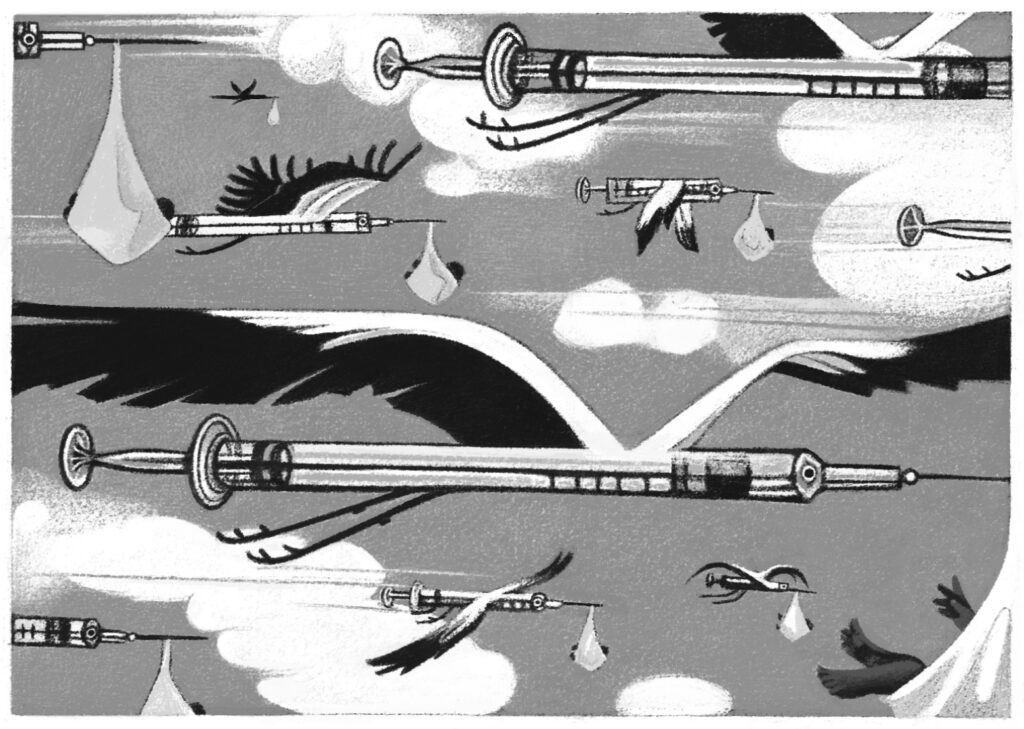
Sometimes the stork needs an assist.
Sarah Farquhar
The award-winning Globe and Mail journalist Kathryn Blaze Baum had no such luck and none of my pre‑set limitations during most of her four-year, $200,000 quest to give her daughter a homegrown sibling during the pandemic. Her sincere, heartbreaking story of repeated IVF cycles, miscarriages, clinical egg retrievals, and surrogacy — leaving her fainting and bloody on the bathroom floor at one point — is recounted in In Fertility: The Story of a Miracle and the Big Business Behind It. As the title suggests, there is a happy ending but likely one you won’t expect.
Baum uses her investigative acumen to expose the scientific, historical, medical, legal, ethical, and regulatory scaffolding that surrounds Canada’s baby-making business and then directs that spirit of inquiry toward herself, describing the breadth and depth of personal and financial sacrifice she and others make to have a “baby in arms.” As a contemporary reference point for the state of assisted reproduction in Canada, In Fertility is comprehensive, educational, cautionary, and long overdue.
Make no mistake: assisted reproduction is big business — from the brokers and agencies that help to pair infertile couples with surrogates to the often dubious IVF extras like pre-implantation genetic testing and immunological treatments, proffered to desperate couples. “As a consumer, you’re not told that most of the add‑ons that are being offered are useless,” said the reproductive endocrinologist Arthur Leader, who had also undergone IVF with his wife. “Where the clinics make their money is on the add‑ons, just like a car dealership.” Baum and her husband spent $25,000 on such offerings. “Nowhere did I feel more like a guinea pig grasping at straws than when I was lying in a dimly lit room with electro-acupuncture needles in my stomach, legs and feet, hoping the stimulation of the fascia and muscles would cause my uterine lining to become fluffy and receptive,” she writes. “What the hell was I doing.”
Louise Joy Brown, of Oldham, England, was the first baby born of IVF, in 1978, ushering in political, religious, and ethical debates, grand hopes for infertile and same-sex couples, and a Nobel Prize in 2010 for Robert Edwards, the sole member of a pioneering team who lived long enough to receive the award. Presently, upwards of 100,000 live births result annually in the United States from assisted reproductive technologies. In 2024, there were 8,870 Canadian babies born through ART, up from about 6,000 a decade prior. Globally, Baum reports, at least twelve million have been born via ART since baby Louise. Imagine a large metropolitan city of people who otherwise would never have existed, my precious daughters included.
Despite these numbers, laws and regulations remain outdated and inadequate. In Canada, the Assisted Human Reproduction Act — which became law in 2004, when I underwent IVF — is meant to protect those who use or are born from ART. It prohibits, for example, making a human clone or allowing an embryo to grow outside of a human body beyond fourteen days of development. Selling or purchasing sperm or eggs is prohibited, as is paying a surrogate to carry a baby. But it’s perfectly legal to reimburse a surrogate’s expenses, which offers ripe opportunity for affluent couples and savvy surrogates to exploit. The act, Baum argues, is too narrowly focused. Combined with an uneven patchwork of provincial, federal, and private sector oversight, it leaves vulnerable couples at the mercy of inconsistent and sometimes unknowable systems. “Right now in Canada, it’s a free-for-all,” Leader told her.
Many things have changed since I had IVF. Doctors don’t implant three embryos willy-nilly anymore. Single transfer is the standard — maybe two if you’re over thirty-five. This shift has drastically reduced high-risk multiple pregnancies and complications from premature birth. In many provinces, at least part of the cost of the first round of IVF is now publicly covered. But despite technological and scientific advances, success rates haven’t really improved much. Depending on her type of infertility, a woman in her thirties has roughly the same chances of pregnancy as I did.
About half of Baum’s book is devoted to IVF and the other half to surrogacy. Her exploration of surrogacy is particularly fascinating. Because women here can’t be paid to have someone’s baby, most Canadian surrogates do it because they want to help people, at least according to a 2004 study. That same study suggested that 50 percent of Canadian surrogates carry for international clients. This is partly because of Canada’s altruistic model — the women aren’t motivated solely by money — and high-quality universal health care. But, Baum says, the main reason is simple: it’s legal here. Surrogacy is outlawed or extremely limited in many countries, including throughout much of Europe. Her surrogacy research takes us through case law, regulatory ambiguities, and complex scenarios. Imagine, for example, navigating the legality of a surrogate mother on life support with someone else’s baby growing inside her. It happens.
Some women feel compelled to have children, and some do not. Each standpoint is valid and must be respected. I read In Fertility with an open mind, knowing it diverged from my own experiences. But one quote stuck with me: “Fertility has become a privatized commodity for the wealthy,” declares Carolynn Dubé, the executive director of Fertility Matters Canada. “It has become health care for those who can afford it.” Baum’s writing skills are beyond reproach, and the depth and breadth of her research — more than 100 interviews — is astounding. However, her personal narrative is, at times, exasperating, especially considering that the agonies she describes were endured by choice and prolonged by affluence. By her admission, the endless procedures and disappointments took an enormous toll on her body and mind, on her relationships, on her career and finances, and on the daughter she already had. Yet she continued — for four years. As a woman, I kept shouting, “Enough already!”
A book must begin and end and therefore cannot contain everything. Still, I wish Baum had helped me to understand her compulsion by probing more deeply the personal, social, biological, and religious imperatives that drove her, and women like her, to bear extreme suffering and indignity for pregnancy. Without that context — and despite my own infertility, which ought to have aroused sympathy for her — I felt bewildered and sad. In the end, it’s perhaps moot to question the price she paid. She got what she wanted: a baby in arms. I wonder what kind of book she’d have written if she hadn’t.
Lisa Gregoire has written for newspapers and magazines for thirty-five years. She has twice won gold at the National Magazine Awards.
Advertisement

Advertisement