
As a child of the 1960s, with a diehard tie‑dye dependency, I’ll never be mistaken for a fashion plate. Still, I recently found myself inside a shop in downtown Halifax that sells “refined European garments with an authentic Canadian sensibility.” There, on the boutique’s austere, cream-coloured walls, I noticed a framed black and white photograph of Toni Morrison.
Intrigued, I asked a clerk about the image of the Nobel laureate — resplendent in a black jacket and white blouse, with a dark scarf draped like a man’s tie around her collar. “Our clothes are designed for independent, working women who take charge of their lives and accomplish great things,” she told me. “Ms. Morrison epitomized the message.”
The shop’s tailored tuxedo dresses, linen jackets, and tapered pants were beyond my budget. There was no tie‑dye in the mix. But, bedazzled by the photo, I later leafed through Morrison’s Language as Liberation, published posthumously earlier this year. The copyright line —“The Estate of Chloe A. Morrison”— brought to mind an old New York Times Magazine article, in which Morrison lamented the name that appeared on the cover of her 1970 debut, The Bluest Eye. “I was upset,” she said. “My name is Chloe Wofford. Toni’s a nickname.”
Derived from ancient Greek, Chloe translates to “blooming” or “fertility.” At the time of the author’s birth, on February 18, 1931, Mary was the most popular name for girls in the United States, Chloe a rarity. A middle name, Ardelia, nodded to her maternal grandmother.
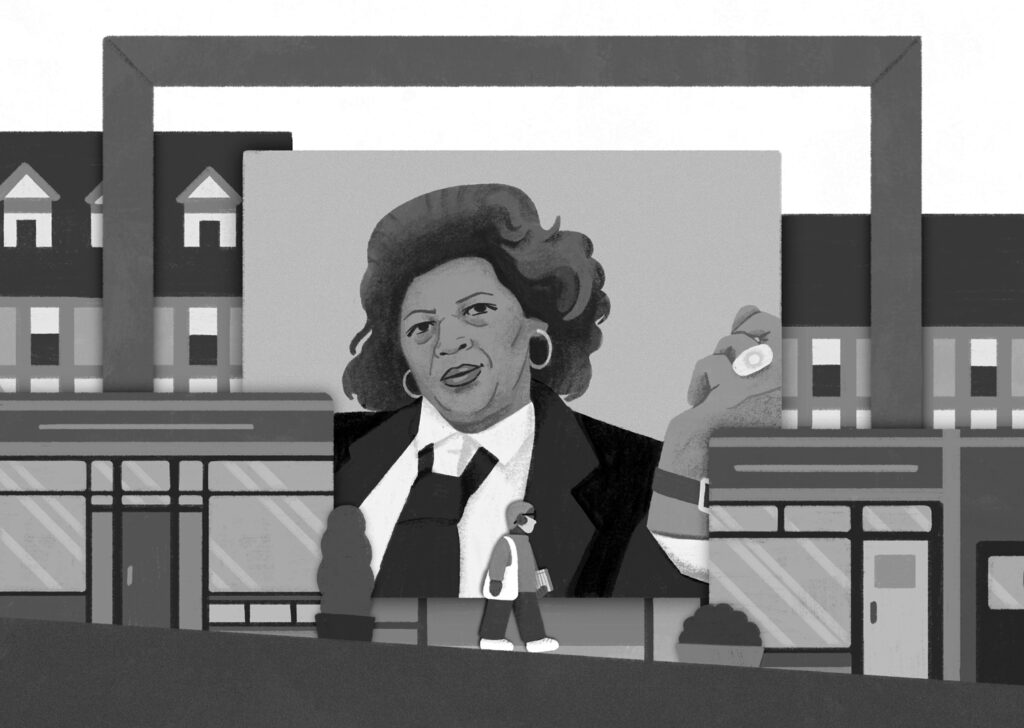
Much more than a framed photograph in Halifax.
Paige Stampatori
I suspect that Morrison’s mother, a devout member of the African Methodist Episcopal Church, named her daughter after a woman referenced in 1 Corinthians: “For it hath been declared unto me of you, my brethren, by them which are of the house of Chloe, that there are contentions among you.” The scripture addresses ethical issues in the early Christian church, and Morrison would later bestow the name First Corinthians on an embattled character in Song of Solomon, from 1977. In any event, Alan Rinzler, who edited The Bluest Eye at Holt, Rinehart and Winston, knew the writer as Toni Morrison, because of her position as an editor at Random House.
In the Times Magazine article, Morrison allowed that she’d submitted the manuscript “in a daze,” with her professional name. Apparently it was too late to change the cover design when she realized her “mistake.” Asked if she’d “achieved fame misnamed,” Morrison replied, “Tell me about it! I write all the time about being misnamed. How you got your name is very special. My mother, my sister, all my family call me Chloe. It was Chloe, by the way, who went to Stockholm last year to get the Nobel Prize.”
Morrison converted to Catholicism at the age of twelve and chose Anthony as her baptismal name, after Saint Anthony of Padua. At Howard University, her peers struggled to pronounce Chloe. Weary of correcting them, she adopted the hassle-free, short form of Anthony: Toni. Then in 1958, Morrison took the surname of her new husband. She divorced the Jamaican-born architect six years later. Perhaps their love was “thin,” a term Morrison used, to pointed effect, in Beloved, which won a Pulitzer Prize in 1988.
Musing on the name Chloe, I wondered if the writer who once told the Guardian that she’d always felt “like an aristocrat” had ever dabbed her wrists or the nape of her neck with the eponymous perfume launched by the French fashion house Chloé in 1975. Back then, mass-market scents such as Charlie sold for about $5, compared with $30 for a flacon of Chloé. A designer of Egyptian and Jewish ancestry, Gaby Aghion founded the luxury brand in 1952, naming it after a friend. She was reportedly enthralled by the roundness of the letters and the sound of the word. The closing passage of Sula, from 1973, reminds us how much Morrison liked the sound of words too: “O Lord, Sula, girl, girl, girlgirlgirl.”
When Morrison died on August 5, 2019, at the age of eighty-eight, literary scholars and everyday readers around the world (like me) mourned her. Literary Hub quickly posted seventy-five different covers of Beloved. The artwork included a stark image of a tree (Estonia), a Black woman with cherries and hummingbirds above her head (Norway), a stalk of cotton bolls (France), a tombstone (Romania), and a clasped pair of Black hands (Vietnam).
Months later, during COVID‑19, I watched a short documentary from 1978, in which Morrison discussed her artistic practice against the backdrop of her life as a working single mother. She recalled the day when she was seated on her couch, yellow legal pad in hand, crafting passages to share with her writing group. Her son, then less than a year old, was beside her, pulling on her earrings and crawling on and off her lap. “While I was in the middle of an extremely important sentence, he spit up — he threw up all over my paper,” Morrison said laughing. “The funny part is that I wrote around it. Every woman knows that they spit up all the time. That I could take care of. But I might not get that sentence again.”
The next afternoon, I made my way up a steep hill to a Halifax office supply shop. Pandemic restrictions had eased somewhat, and I was cheered to find an Open sign on the door. I put on a pale blue surgical mask, entered the store, and told a clerk (similarly masked) that I was in need of a yellow legal pad. Noting that the shop didn’t sell them individually, he directed me to a bundle on a shelf. The packet of ten was affordable and didn’t weigh much. Added bonus? My return home was straight downhill.
I imagine Morrison, ever stylish, smiling at the discovery that I wrote the first draft of this piece on a “commemorative Chloe” tablet.
Evelyn C. White is the author of Alice Walker: A Life. She lives in Halifax.
Advertisement
Advertisement