
Assuming that the traditional order of pagination has been followed and that you have gone to the trouble of reading my new novel™ before getting to these, my heartfelt acknowledgments, you will not be surprised to learn that the book clubs of Dubai and the marketing agencies throughout the United Arab Emirates are my first embedded links of gratitude. They both noticed and liked my new novel™ when traditional publicists did not.
If, unlike authors’ festival impresarios, arts section editors, and chain store product buyers, you have actually opened my new novel™ (an executive summary is provided to premium Substack subscribers), you will already be aware, by virtue of the dynamic footnotes, dedicated inserts, and book club discussion points, that my pot of creativity has been stirred by the digits of many cooks. The list of branding initializers, digital strategists, and influencers to whom I owe my thanks and 40 percent is appended.
My first novel™, as its modest but astute readership will recall, was a roman à clef in which the protagonist is referred to as “I” until (spoiler alert) an unexpected change of person transforms the narrative conjugation. He/him was born into the arid suburbs of the middle class. Like the author, the narrator of my new novel™ has no abrupt rises or sudden falls in his storyline. In fact, it isn’t a story. Nothing happens. To him. Or to me. Which is why I decided to become a writer who writes about writing.
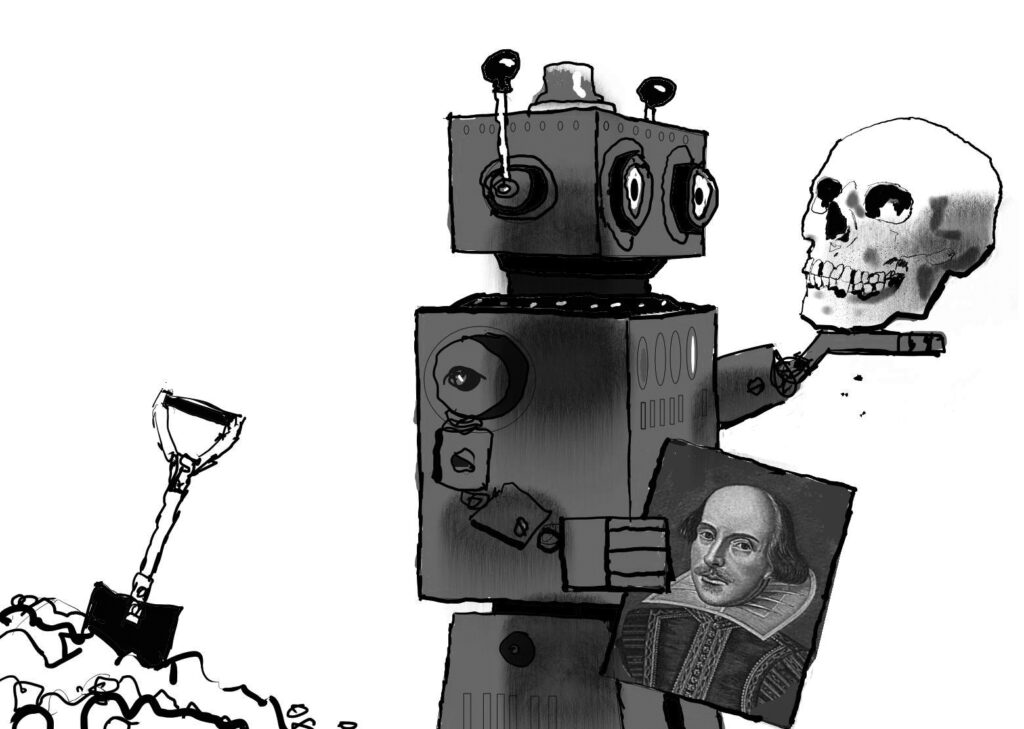
Doubt that the ideal reader doth read.
Brian Gable
That’s no walk in the park, let me tell you. A literary novel about a writer of literary novels is not an easy sell at the best of times, blurbs from several friends notwithstanding, but it is a very tough row to hoe in a fractured media landscape.
My first novel™ was my last as far as my first publisher was concerned. “Heartfelt and poignant” did nothing for its bottom line, apparently. (An ad might have helped, but let’s not get into that. And it wouldn’t have killed Bed, Bath, and Books to move a few scented lifestyle products to give me some shelf space among the silk flowers, but never mind.) I was cast adrift by glamorous editors and intimidating receptionists alike, with nothing more than an early draft of what was then called Blank Verse for an Overcast Dawn. As I am now aware, no multi-platform search engine, no matter how artificial or intelligent, was going to spit out that Amazon link.
I didn’t know there were book clubs in Dubai until the site placement aggregator of a database in the surprisingly robust literary community of the U.A.E. proposed a more Google-friendly title. That changed everything. A Survivor’s Journey of Grief, Gardening, and Sex Addiction had not even been published when a keen reader named Djuka texted to say how much she liked it. Adored it, actually — to quote Djuka’s effusive e‑blasts and Reddit posts. (One bracing characteristic of my new readership is its disarming non-use of surnames. Another is its refreshing disregard for publication dates.) Of course, we writers must be wary. Being inherently unemployed, we are vulnerable to scams. Indeed, I’d have been much more suspicious were Djuka’s literary observations not so on the money. References to Chekhovian balance made it obvious that she was someone with a post-secondary education. Possibly an English degree. She was exactly the highly intelligent, intensely observant reader I’d always imagined having. And by a stroke of the greatest good fortune, Djuka was also a social media consultant, concerned about my low profile on Instagram and Facebook. Djuka felt it was imperative for independent content providers like me to refresh regularly on TikTok.
At a modest monthly charge, I added a marketing strategy consultant and a driver optimizer to my creative process. They suggested a further refinement to my title. Grief, Gardening, and Sex was subsequently excerpted in an influential e-blast to their registered book club members, and in no time I was hearing from enthusiastic readers who were devoting entire Zooms to the Hamlet quotes I’d found on Goodreads.
The book clubs of Dubai were an unexpected oasis in a desert of literary indifference. More than a few members texted to say how deeply touched they were by my gravedigger’s scene and wondered why my new novel™ wasn’t already an international bestseller with a much higher site exposure quota than my brand was currently experiencing.
I can’t exactly say what made me click Pay for those services. A flash of intuition? The stars aligning? Whatever it was, it worked, and it worked because writers want to be read. Once in a while. Every now and then. An odd compulsion, I realize, but who among us has not harboured unrealistic dreams?
I was undeterred by hopelessness when I chose a career in literature, but according to Djuka, that wasn’t as stupid a mistake as my parents thought it was. Things have changed. There are now new revenue streams to consider. Online exposure and the increased visibility of organic word of mouth could be game changers for literary providers like myself.
So you want to write a novel? Well, the advice I give on my (guess what?) podcast is this: it takes a village. Profile positioners. Access initializers. Social media impact multipliers. No man is an island, as the best-selling author of The Collected Short Stories of Ernest Hemingway once observed. But, of course, he was a famous American celebrity. I had no such advantage.
Unliked and unlinked, my novel™ Sex would have remained landlocked in the literary back of beyond were it not for the book clubs of Dubai. Their countless likes showed me the benefits of direct exposure to an engaged reading community. To my algorithm and to my GoFundMe donors, I am eternally grateful. Any errors are my own.
David Macfarlane is the award-winning author of The Danger Tree. His new book is On Sports.
Advertisement
Advertisement