
Thélyson Orélien’s debut novel opens with a devastating portrait of gang warfare: “Carrefour-Feuilles had already stopped being a neighbourhood. It was a giant ashtray, a cemetery without tombs, an absurd theatre where roles changed with each burst of gunfire.” Jonas Dorléon, a schoolteacher living in Port-au-Prince’s impoverished outskirts, is drinking his morning coffee when the shooting begins. A stray bullet hits a gas tank, starting a fire that consumes his one-room home. When he finally decides to run, he comes across a former student, now with a gun on his knees, who lets him pass. “In this messed-up country, you still have enough heart not to kill your history teacher,” he thinks. Jonas keeps fleeing for the next 200 pages, leaving Haiti for the Dominican Republic, then reaching Brazil, and finally taking the overland route to Quebec through Roxham Road.
C’était ça ou mourir (It was that or die) was a smash hit even before it arrived on bookshelves. After Boréal pulled Orélien’s manuscript out of the slush pile, it generated so much buzz that the press sold the rights in more than twenty countries, an unprecedented feat in its sixty-plus-year history. Rave reviews followed, and the novel was nominated for major prizes in France. Now it’s at the centre of a scandal about AI use.
Part of the initial success can be attributed to ambition. Much of Quebec’s most lauded work about refugees — the melancholy fragments of Kim Thúy’s Ru, the careful autofiction of Caroline Dawson’s As the Andes Disappeared — reflects personal experience. That strength is also a constraint, leading to subtle narratives about trauma and adaptation. Orélien came to Quebec from Haiti as an international student. His novel draws on interviews with migrants and his own imagination. His plot feels ripped from the headlines, including gang executions, a perilous journey across Panama’s Darién Gap, and U.S. border agents decked out in MAGA hats. The result is an action-packed tale that lands squarely in the overlap between prestige and mass-market fiction. Think American Dirt with more poetic flair and no cultural appropriation controversy.
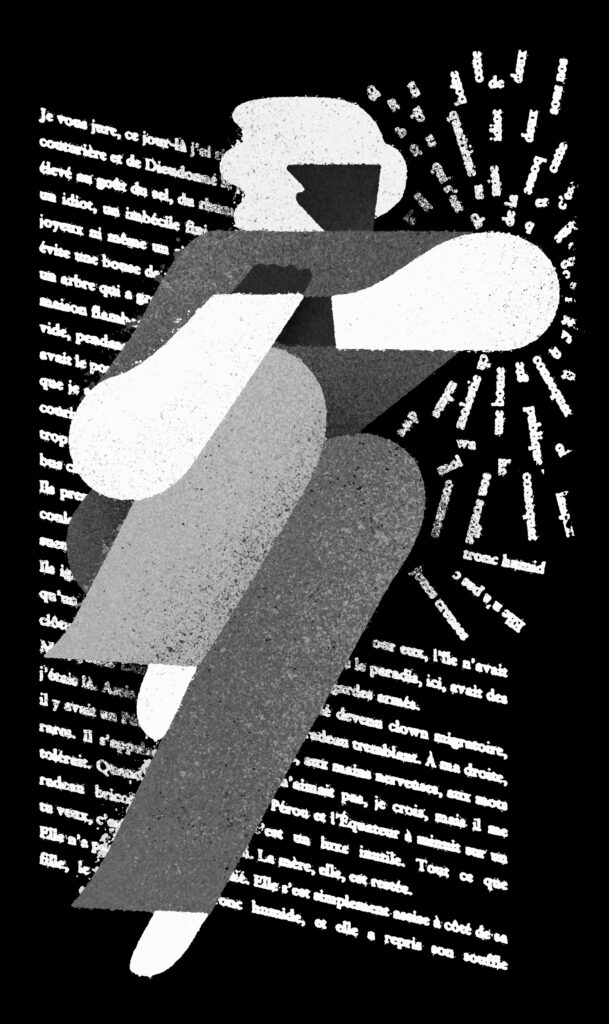
Authentic obstacles but artificial words?
Karsten Petrat
Orélien keeps things simple for his protagonist. Jonas’s mother is dead, his father absent, and he has no close family or romantic relationships to complicate his journey. His background as a teacher and would‑be poet makes the novel’s metaphorical flourishes plausible in the first person. A Dominican migrant centre becomes a “thousand-headed animal with zero patience,” and the Mexican border city of Tapachula is “the cemetery of maybes.” Jonas also knows his Haitian literature. Among the few belongings that he carries in a plastic bag is a poetry collection by René Depestre, who spent most of his life in exile. The choice underscores Jonas’s conclusion that Haiti is past the point of saving. “The country is dead,” he announces, reduced to “an illusion on a torn banknote.”
Jonas’s constant movement generates an episodic structure, with explosive chapters that rarely last more than ten pages. Secondary characters don’t stick around long, though some — a blind Venezuelan who buys Jonas’s socks, a fleeting Colombian love interest — remain memorable. The pace allows Orélien to cover a remarkable amount of ground. He tracks the complexity of anti-Blackness in Santo Domingo, where a well-dressed woman tips a light-skinned shoe shiner only to recoil in fear when she notices Jonas. In Honduras, Jonas rebaptizes himself José Gonzalez and bemoans the psychological toll of being “son of nothing, brother of no one, universal migrant.” Although his trek through the Panamanian jungle is horrific enough, Orélien layers on the experiences of others, with stories of rape, suicide, and the bodies of loved ones reluctantly abandoned.
As Jonas travels north, the threat of death gives way to the humiliations of bureaucracy. His entry into the United States requires booking a meeting through the CBP One app: “three letters, four syllables, and a screen that becomes your God, your judge, your executioner.” He spends weeks hitting the refresh button and panicking about keeping his phone charged before he can secure a slot. In Canada, he becomes number 7423B during the months he spends in limbo while his asylum claim is processed. He struggles to learn “the motionless patience of a house plant.”
Ultimately, Montreal comes in for kinder treatment than other locations. In contrast to “the Brazilian dream”— caricatured as a McDonald’s burger with a fried cockroach inside — Canada’s asylum procedures appear slow but essentially fair. There are obligatory references to winter alongside charming interactions with roommates from China, Eritrea, and Venezuela. At one point, a barista stuns Jonas by asking if he wants oat, almond, or cow milk. “I’m old school,” he answers, labelling such normality “an endlessly repeating miracle.”
The most polarizing aspect of this novel may be its style. Orélien’s prose is thick with metaphors and lines relying on the rule of three. He also overuses negative parallelism, repeating statements like “The control post was not a border. It was a theatre.” Unfortunately, these same techniques are beloved by Claude and ChatGPT. In late September, an anonymous social media account accused Orélien of using artificial intelligence to write the novel, claiming the detection software Pangram had flagged multiple passages as AI generated. The media picked up on the allegations, and Orélien categorically denied them while saying he had received a torrent of racial hatred. The situation is depressing but not surprising.
When I first read C’était ça ou mourir, the stylistic tics were enough to make me suspicious. It didn’t help to know that Boréal received the manuscript in the summer of 2025, after AI plagiarism had gone mainstream among my students. So I exercised what I saw as due diligence and went hunting for earlier work by Orélien. To my relief, I found blog posts dated to 2014 that used the same type of sentence structures.
That blog is now offline, and the Canadian publisher has suspended promotion of the book amid new plagiarism allegations. For now, the novel, like its protagonist, exists in a state of suspension. Should the allegations prove false, Orélien will have penned an odyssey that balances horror with humanity as it sweeps across the hemisphere. If they’re true, he’ll be an Icarus, undone by his meteoric ascent. I’m hoping for the former.
Amanda Perry teaches literature at Champlain College Saint-Lambert and Concordia University, in Montreal.
Advertisement

Advertisement