
William Henry Nelson was one of the thousand or so Canadians who travelled to the United Kingdom to join the Royal Air Force before the outbreak of the Second World War. Canada’s tiny air force was underfunded, with few modern aircraft, and was recruiting few potential pilots. Where else could he go to fly?
But Willie Nelson was not typical of those Canadians who crossed the Atlantic to fly with the RAF. He was Jewish, born in Montreal to eastern European parents who anglicized their surname from Katznelson soon after their arrival in Canada. His first year of secondary education was at the heavily Jewish and lower-class Baron Byng High School on St. Urbain Street, and he completed high school at the middle-class but still heavily Jewish Strathcona Academy in Outremont. He was good-looking in an Anglo way, had a Gentile girlfriend for a time, and was athletic, playing rugby and hockey for his school as well as lacrosse and baseball. Above all, as Peter Usher explains in Battle of Britain Spitfire Ace, he was obsessed with flying: building model airplanes, founding a gliding club, securing a gliding licence, and making solo flights.
Nelson’s parents were leftist in their politics. His mother was an attractive but troubled soul, his father a drinker, and their difficult marriage had dissolved in bitterness by the time he finished high school. He had no interest in going to university, even if there had been enough money for him to do so. Instead, he hung around airfields, scrounging flights when he could and taking lessons. By the spring of 1936, when he was nineteen, he had passed ground examinations in meteorology and navigation and logged hours of flying time.
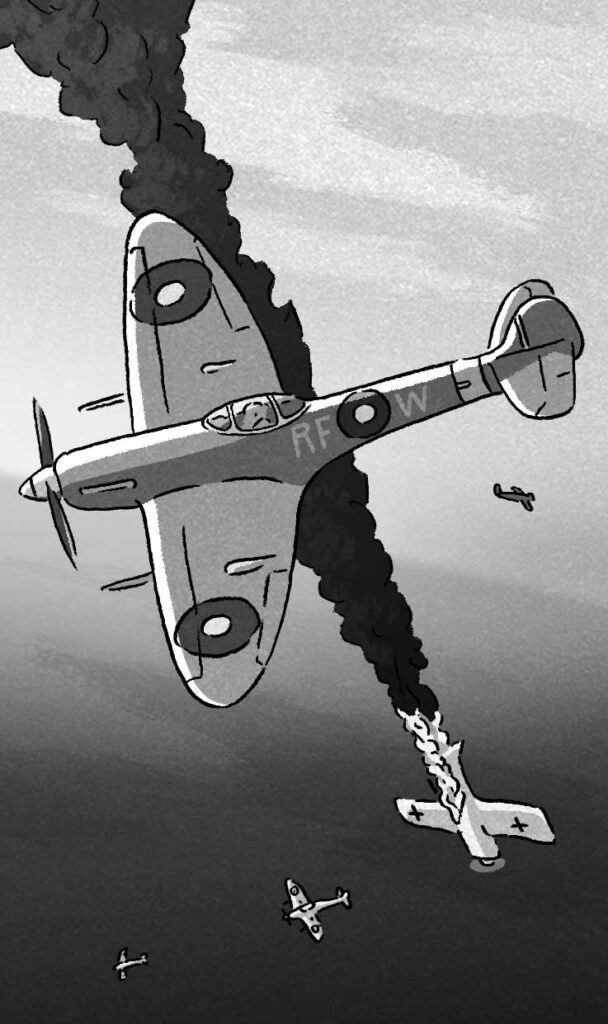
Downed over the English Channel.
Tim Bouckley
In 1937, Nelson signed up for a four-year stint with the Royal Air Force. There were few Jews in the RAF. The documentation Nelson provided when he enlisted showed his religion, but apparently it mattered little to him. He did his training, qualified as a pilot, and was assigned to a bomber squadron. He dated local girls and was “instantly smitten” with Marjorie McIntyre. The McIntyres were well off, the father a doctor, and Mim, as Willie called her, had attended a Swiss finishing school. In late August 1939, with war about to break out, they married in the Church of England. Mim later recalled, “What did my Mother think? Events moved very quickly in those days, we lived in a very homogeneous society — to her Willie was a Canadian — He was just Willie nobody asked him his religious or racial background — I don’t think it would have mattered if they had.” In any case, Nelson’s RAF records listed him as Anglican from that point on. A week after the wedding, Britain went to war. Soon Mim was pregnant, and their son was born on August 30, 1940.
Nelson’s war lasted fourteen months. His squadron dropped leaflets over Germany in the early days of the conflict. Then, in April 1940, he went to Norway in the abortive campaign against the Nazis, and he earned a Distinguished Flying Cross primarily for his role in spotting a barrage balloon that could have knocked down his mates’ aircraft. In May and June 1940, his bomber squadron attacked targets in Germany with limited success and many losses. The land campaign in France was a debacle, and British forces were driven from the Continent.
With Britain itself now in grave danger, Nelson volunteered to retrain as a fighter pilot. In four weeks, he learned to fly a Hurricane, and then he spent a week in a Spitfire. Quickly he was in the thick of the Blitz. On August 11, in his first encounter with the Luftwaffe, he shot down two aircraft and damaged a third. Two days later, he damaged another, but his next successes did not come until October, when he downed three more. Five kills made him an ace, but he had little time to enjoy this status. On November 1, a German fighter shot him down over the English Channel. Willie Nelson was twenty-three.
Nelson might not have been considered very Jewish in the Royal Air Force, but he was in Canada. Faced with antisemitism and the public belief that Jews were reluctant to fight, the Canadian Jewish Congress had undertaken an effort to press Jews to enlist. The congress was looking for a hero to encourage recruitment, and Willie Nelson, DFC, was the first Canadian Jew to get a decoration. Here, Usher writes, “was a first-generation Canadian who could appeal to the very sector of Jewish youth that Congress was so anxious should enlist.” Beginning in June 1940, there were ceremonial dinners in Montreal, at which Nelson’s mother, Sarafina, spoke, as well as a publicity campaign that reached media across the country. After his death, Nelson’s exploits were used repeatedly by the congress, even in a comic book series titled Jewish War Heroes.
Willie Nelson was a hero, but the last part of Usher’s book oddly and unnecessarily focuses on his widow and son. Mim had been writing to Sarafina, and after Willie’s death she went to Montreal with her son, Bill, to live with her. This did not turn out well. She found Montreal’s antisemitism very unpleasant, and her “youthful idealism . . . faded in those early years in Canada.” Nor was her relationship with Willie’s mother any better. As she wrote to a friend, “My life in Canada seems like one of those hideous over-dramatic melodramas — & I realise now I should have been warned when you told me — that mother-in-law was just a courtesy title!” She found Sarafina living in a primitive rural farmhouse with her lover, described by Mim as “a revolting old man of 60.”
As quickly as she could, Mim decamped, left Bill in care in Toronto, and found work for a time with a touring show advertising Rinso soap. Somewhere in northern Ontario, she met Ted McAlister, a journalist born in Ireland, and promptly married him. They lived in Canada for fifteen years, then returned to Britain. Bill took his stepfather’s name and had a long, successful career in the arts.
Until the Royal Air Force Museum in London mounted a “Hidden Heroes” exhibit on Jewish airmen in 2021, Willie Nelson “was unrecognised as a Jew in Britain’s public memory.” But even since then, as Usher notes, “his name is found on a cemetery cenotaph and on an Anglican church roll of honour in Teesdale, but not in any synagogue or Jewish war memorial in England.”
J.L. Granatstein writes on Canadian political and military history. His many books include Canada’s Army: Waging War and Keeping the Peace.
Advertisement

Advertisement