
The opening chapter of Anaïs Barbeau-Lavalette’s When Water Became Blue offers an abrupt assertion: “I didn’t need you, and yet you came.” The unnamed female narrator, a writer attending a summertime retreat on an island in the St. Lawrence River, is taking time away from her partner and her daughter to find the space to work. There she meets a “strange” and “magnificent” painter who stokes her desire immediately. Their affair unspools in sensual, poetic detail.
Setting up on the shoreline, the artist has made it his mission to accurately capture the blue of the water. While the writer watches him work, conversations flow about art history, colour, and depiction. The book segues into the narrator’s intense longing for this man, often by her speaking directly to him but also by her sharing her thoughts on literary portrayals of female yearning: “At the end of the nineteenth century, voices of women authors emerge undercover. Tired of being denied part of themselves, they take up their pens to reclaim desire.” The river that the painter tries so hard to represent becomes a central symbolic force: the power of nature to inspire and destroy mimics the power of attraction to do the same.
“We can’t resist becoming entangled,” the writer admits. “From now on, the days exist just for the two of us.”
The fulfillment of need, however unexpected that need may be, is Barbeau-Lavalette’s focal point, as she deftly explores the conflict between individual passions and responsibility to one’s family. There is an inevitability to the union of these two artists, an ease in which it begins and a lack of inner turmoil about the engagement itself. The writer appears to convince herself that, at the retreat and with her paramour, her old life simply does not exist — or at the very least cannot be harmed by this new and vital connection. She has compartmentalized the affair and severed herself from the satisfying yet mundane realities back home. Peppered with simple and searing revelations about temptation, the novel avoids condemning or punishing her for her wanting. “I learned to be desired too young,” she says. “I learned to desire too late.”
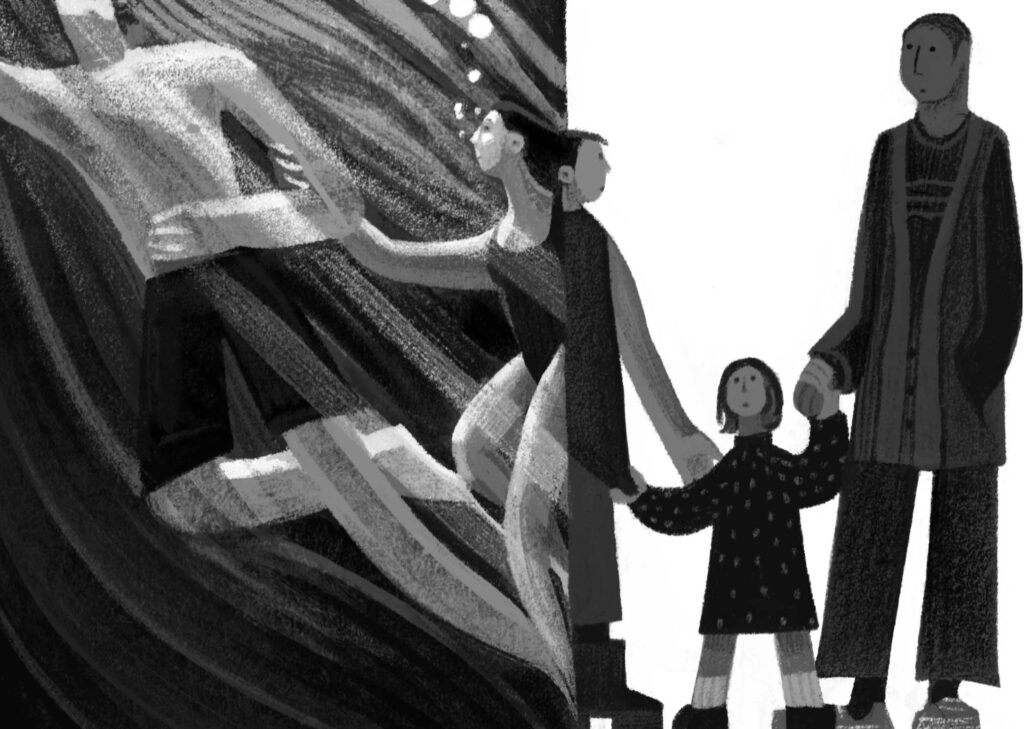
A summer of irresistible entanglement.
Sarah Farquhar
From the writer’s perspective, the tryst is depicted as both transformative and fleeting, intense and fragile, not following the traditional infidelity narratives familiar to most readers. She does not engage with the painter as a solution to her broken or subpar marriage, nor is she using him as a juvenile, ill-advised escape. Instead, she believes she can keep the two experiences separate, that her creative and domestic selves exist on two different planes. And while the romance, like the island, is protected by the emotional and physical boundaries of the retreat, the writer comes to acknowledge that their infatuation cannot withstand the genuine satisfactions of her “regular life.”
“This happiness is unique and profound,” she thinks, referring to a past afternoon spent with her family. “I wouldn’t want to risk it for anything in the world.”
She is, of course, risking it. Tension builds between the couple, a strain that becomes even more apparent when the painter joins the writer on a trip into Montreal. “I don’t know what will be left of us there,” she says. “Our love is an islander. It doesn’t mix with the earth.” When they walk together in public, he refuses her invitation to hold hands, instead walking two steps apart. After they sleep in each other’s arms in his car, he wants to stop at his house to pick up a tube of indigo paint. It is the writer who is reluctant. “There was a tacit agreement,” she says, “a silent wish: we won’t get close to our regular lives.”
Here the narrator seems to genuinely understand the broader cruelty and impossibility of their situation. “I don’t want to be near the people who love you,” she says, imagining being that close to his wife. “I don’t want to know the neighbourhood or street where you live. I want to believe we exist in two parallel worlds, where I’m not taking anything from her.” This realization forces her to confront her own delusion and notice that the way the two have become bound together, however inevitable, can never be reconciled with the reality in which they both live. “I know it’s a lie,” she admits. “I know that what I have with you I’ve stolen from my partner, I’ve snatched from my daughter.”
Her unwavering devotion to her child is the bittersweet note the story concludes on, leaving us with poignant images of the little girl biting into a fresh lemon fallen from a tree, mourning the death of a beloved kitten, shouting hello to a flock of geese in the sky. “She summons me back to the emergence of the world,” the writer says of her daughter. “She teaches me to read again.”
Translated by Rhonda Mullins, When Water Became Blue is a sparse yet powerful exploration of the complexity of female desire and how it is articulated in art and nature. It beautifully and cautiously relates the entrapments of contemporary life, the necessity of escape, and the enduring tensions between practicality and passion. In doing so, the novel asks the reader difficult questions about how avoiding the betrayal of another can mean betraying the needs of the self.
“I learned to desire too late,” the writer repeats, “but now I’m wise, and I’m making up for lost time. I wield my desire, and it makes me stronger. Wanting you is my most beautiful living posture.”
Stacey May Fowles has published five books. Her new memoir, The Lost Season, will hit bookstores in early June.
Advertisement
Advertisement