
Jean Chrétien is not remembered for his foreign policy chops as prime minister. One reason is his leadership style, which was to pick capable ministers and give them broad autonomy. Another is his character. Chrétien was not a grand visionary but an intuitive leader focused on building relationships. He was at heart a troubleshooter and admitted as much. “I solve problems,” he once said. Bring him one, and he’d fix it.
Yet it was Chrétien who made the call on a range of thorny issues — joining the Kyoto Protocol, pushing NATO to intervene in Kosovo, sitting out the second Gulf War — that gave Canadian foreign policy its particular contours during his decade in power. It would be a big stretch to call this a doctrine, but it was not improvisation either. Underneath Chrétien’s approach lay a clear set of beliefs.
It is these beliefs that twenty-odd former cabinet ministers, retired civil servants, and academics parse in Chrétien and the World. The leader they describe was a free trader, a liberal internationalist, and an enthusiastic supporter of multilateral organizations. However, notes the book’s co-editor Jack Cunningham, these principles were balanced “by an eye to the national interest, a cautious temperament, a preference for keeping his options open . . . , and a skepticism towards visionary but overambitious schemes.”
Chrétien came to power in November 1993, two years after the collapse of the Soviet Union. Globalization was in full swing — the World Trade Organization would soon come into being — and the outlook on foreign affairs was generally upbeat. Many hoped that the end of the Cold War would at last lead to significant progress on human rights. At home, however, the mood was bleak. The economy was facing headwinds, debt was near an all-time high, and public finances were under strain. In 1995, the Liberal government announced punishing budget cuts, while pinning its hopes on international trade to spur growth.
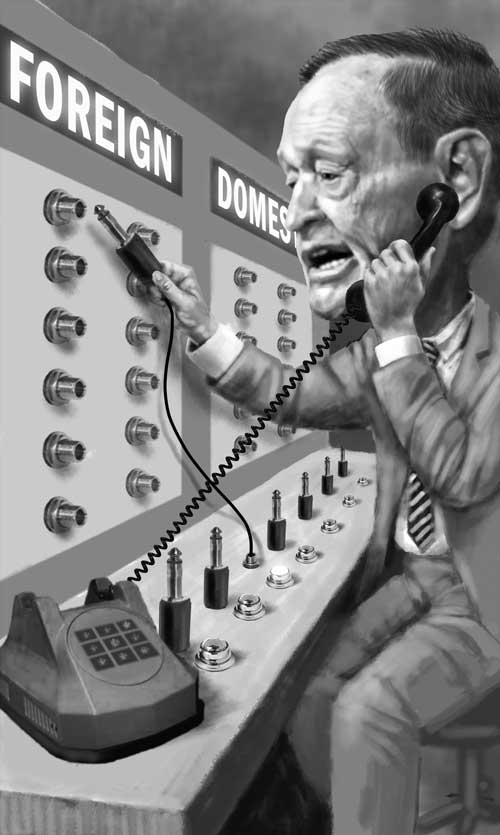
Making the call on a range of thorny issues.
John Fraser
Ties with the United States were central to these efforts, and that meant ratifying the North American Free Trade Agreement quickly. The deal had been negotiated by Brian Mulroney’s Progressive Conservatives, but Chrétien was supportive overall and eventually pushed it through, despite public ambivalence. He never regretted it: by the end of the 1990s, trade with the U.S. had doubled, while that with Mexico had tripled.
For Chrétien, “globalization was not a political choice but a destiny that no one could stop,” write Dimitry Anastakis and Ryan Hamilton. (Anastakis sits on this magazine’s board of directors.) Stephen Harper and Justin Trudeau would sign more trade deals, but the “ploughing, the planting, and much of the watering for those harvests was done in the Chrétien years,” Roy MacLaren, a former minister of international trade, told Anastakis and Hamilton. But it was not all smooth sailing. To be sure, trade with the world’s largest economy was a driver of growth, but it was also, says Michael Cotey Morgan, a source of “political obligation.” To maintain security guarantees and continued market access, “Canada periodically had to make concessions to American demands and serve American interests.”
The balancing act was most challenging in the aftermath of 9/11, when Washington zeroed in on our shared border. In response, Ottawa spent $8 billion to improve security and infrastructure. Not everyone was happy: some feared an erosion of Canadian sovereignty; others lamented the diversion of public funds away from social programs. John Manley, then chair of the Cabinet Committee on Public Security and Anti-Terrorism, was unperturbed. “When one customer buys 87 per cent of your product, if that customer has a concern, whether you think it’s real or not, it’s your concern,” he told the media.
From trade negotiations to the fight against terrorism, Chrétien’s successes owed much to his strong rapport with his counterparts in the White House. He was chummy with Bill Clinton, with whom he often golfed. He had less in common with George W. Bush, but they still developed a good working relationship, which cushioned the blow when Chrétien refused to join the invasion of Iraq, arguably his most important foreign policy decision.
Even when the U.S. was still a reliable ally, Chrétien appreciated the value of having more options, so he courted other commercial partners. Beijing topped the list. In 1994, he led the first Team Canada mission to China, with more than 400 business executives in tow. He supported several other missions over the years, though not all were branded as such or personally led by him. Chrétien also pursued loftier goals: he believed it was possible to transform China into a more responsible stakeholder. As a middle power with no imperial baggage, he thought, Canada was ideally suited to the task. He was not the first — nor the last — to harbour such illusions, which stem from a misunderstanding of the nature and goals of the Chinese Communist Party. In short, the CCP’s overriding objective is to perpetuate its rule. It had no desire, and still has none under Xi Jinping, to accept any constraints on its power, let alone evolve into a more tolerant polity.
It is impossible to review the Chrétien government’s foreign policy record without discussing the legacy of Lloyd Axworthy. Although he served as foreign minister for less than five years, his influence proved significant. Unlike his boss, Axworthy had a crystal-clear foreign policy vision. He is most closely associated with the convention banning anti-personnel mines, which was signed in Ottawa in 1997, but that was only one example of his expansive agenda of human security, which aimed to shift the focus of international protection from the state to the individual. It drove, for instance, the movement that led to the 1998 Rome Treaty and the creation of the International Criminal Court.
Today Axworthy’s legacy is under threat. Concerned about Russian aggression, Finland, Poland, and the three Baltic states have announced their withdrawal from the Ottawa Treaty, while Donald Trump’s administration is wielding sanctions to cow the ICC. With hindsight, Cunningham writes, “human security looks like a product of post–Cold War euphoria.” That is a tempting conclusion, but there is another: the growing predatory behaviour of autocrats makes the tools of human security more relevant than ever. With Chrétien’s full support, Axworthy fought and won the first battles. What comes next is up to us.
Martin Laflamme is a Canadian diplomat, currently posted to Tokyo. The views presented in the magazine are his own.
Advertisement

Advertisement