
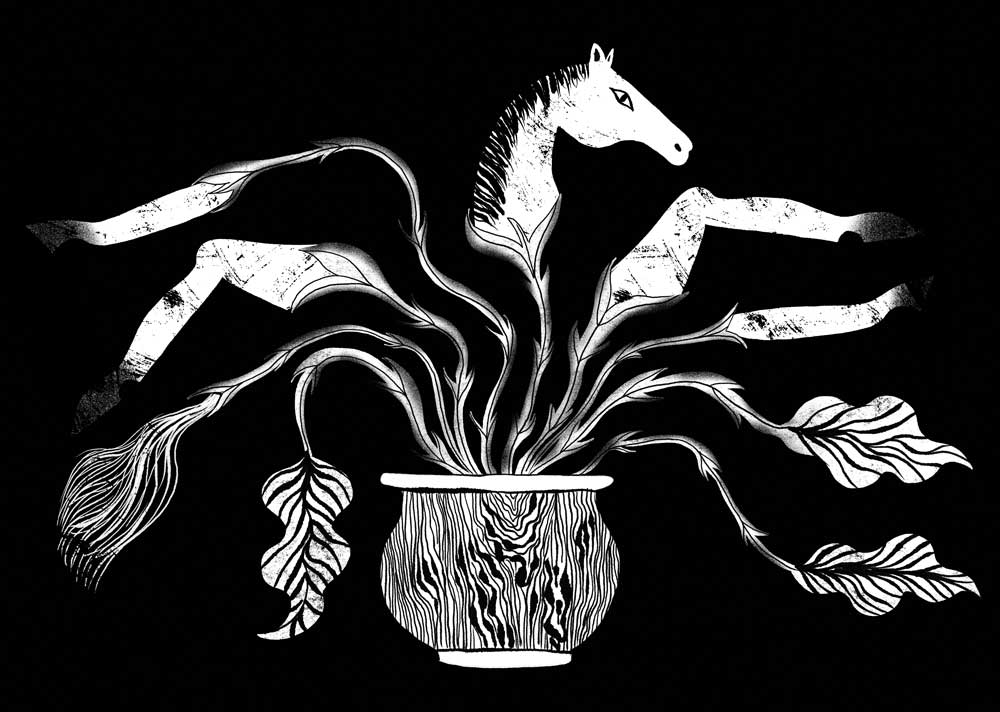
A horse growing out of a flowerpot. A man unbound by gravity holding his wife in mid-air, their “weight balanced.” Another horse, this time rotting on the front lawn of a ranch. These are just a few of the mesmerizing images that Tomás Downey includes in Diving Board, the first collection of his enigmatic, nerve-racking, and profound short stories to appear in English.
Writing firmly in the tradition of fellow Argentines Julio Cortázar and Adolfo Bioy Casares, Downey blends fantasy into everyday life. He focuses on the eerie and disquieting, the distorted and refracted, the revelations that come in whispers, and the transformations that emerge in the shadows. He does so with a cinematic eye — his origins are as a screenwriter — and an inquisitive and unflinching mind. Some of his contemporaries, like Samanta Schweblin and Mariana Enríquez, have been widely translated in recent years. One hopes that Diving Board paves the way for the Buenos Aires writer to receive the same treatment.
Downey’s stories unnerve through imagery — the starting point, he says, for much of his work — and through their stillness. His prose, expertly handled by the Canadian translator and writer Sarah Moses, is clinical and deceptively simple, both elliptical and dense. No single sentence stands out, but over time, palpable tension grows. Sometimes the tight first-person narrative heightens the uncertainty by keeping readers in a fog, closed off from the coming misfortune that we can feel in our bones. At other times, third-person narration explicitly feeds the suspense. “The cottage was perfectly pleasant, almost too pleasant,” Downey writes in “A Love Story,” after two characters arrive at a vacation home. “Though at this point they still didn’t know there was a problem with the water.”
With a satisfying mix of the quotidian and the fantastical.
Natàlia Pàmies Lluís
Like a Jenga puzzle rising or a bubble forming, the risks and stakes in Downey’s fiction increase with time, accentuated by the slow burn of the plots. In “Variables,” a workaholic mother ignores her young son to better focus on her deliverables, eventually locking him on the balcony for entire afternoons. “The Island with No Shore” begins with a man waking up next to his dead wife. Without any explanation, he leaves the corpse in the bed and takes his son to a remote new home. Throughout, remarkable decisions skate by with little consideration. “One action and then another; stopping to think meant letting things get out of hand,” Downey writes, providing an apt description of many of his characters’ behaviour. And even as consequences emerge, the result is not so much change as revelation. People don’t transform; they find out, as the narrator of “Miguel’s Eyes” puts it, “who we were, who we had evidently always been.”
Downey fixates on a primal question: “Who are we?” At times, his gaze is drawn to the animal in us. Scenes of shocking violence — often experienced by children — are narrated in an unsettling, matter-of-fact tone. Sadistic acts are neither dismissed nor rationalized. They sit uncomfortably as instinctive behaviour, both thoughtless and natural. “He was awake and to some degree aware that between desire and action there should have been a step, one he’d skipped,” says the narrator of “Alejo,” after the main character’s attack on a fellow student. “He’d followed a different logic and that made everything seem more unreal.”
This collection is suffused with the notion of the surreal. Sometimes it takes a psychological form, as people come face to face with something unspeakable in themselves. Elsewhere, it is expressed by a more subtle mood. “Lobos,” for example, is a seemingly realist story about a university student helping his mother move back to their small hometown. By the end, it feels out of time, as if the firm connection between past and present has been loosened. Downey’s stories often emerge from or build toward moments that bridge the physical and the spiritual, the earthly and the supernatural. These events are rarely salutary. The world is as wondrous as it is menacing. It can mesmerize, and it can swallow us whole. And its distortions mirror our own anxieties, so much so that, in something like “A Cemetery with Palm Trees,” about a woman who gets too caught up in her telenovelas, it’s fair to wonder if reality manifests from our behaviour or if it’s all in our heads.
Moses and Downey worked together to choose the pieces in the collection. They co-translated one story (Downey is himself a translator of authors such as Kelly Link and Jamel Brinkley) and made substantive edits to others in the process. The collaborative process pays off, as Diving Board coheres beautifully. There is a propulsive flow from one piece to the next, with connecting strands emerging to draw out common themes. “The First Saturday of Every Month,” a realist tale about a boy taken for a haircut by his paternal grandfather, is followed by “The Men Go to War,” a fantastical story that nevertheless explores similar themes of masculinity.
Diving Board culminates with the standout “A Bouquet of Thistles.” Alonso and María live in the country. One day a mysterious visitor asks Alonso to take care of his tired horse while he attends a nearby slaughter. He promises chorizos in return. Alonso accepts. And waits. The animal perishes. “Everything dies here except you,” María spits out. A rot sets in. Decrepitude. Still, the earth keeps turning. In Downey’s world, it always does, even if it feels slightly off-kilter.
Tomas Hachard wrote the novel City in Flames.
Advertisement

Advertisement