
To attempt to surf Dessert, a standing wave in the middle of the Ottawa River, I must first drive from my home on the south side of Ottawa through downtown and across a bridge to Gatineau, Quebec. The trip can take more than an hour if I get snagged by traffic or construction. I say “must” because often — unable to think about anything else, stories left half finished on my laptop, domestic chores hastily completed, family and friends forsaken — I cannot not do this. After parking on a residential street near a riverside park, I remove my stand‑up paddleboard from the roof rack, where the eight-foot-five-inch SUP frequently resides. Then I discreetly change into a dry suit, wetsuit, or bathing suit (as discreetly as one can disrobe beside their vehicle), depending on the season; put on a personal flotation device, helmet, and neoprene booties; leash myself to the board; snap together a three-piece paddle; chit-chat with any other surfers who are getting onto or off the water; and descend a natural stone staircase toward transcendence.
Last year, until mid-December, when much of the shoreline became blocked by ice, this was my routine four or five times a week. Maybe six. Once, I’m pretty sure, seven. After work and on weekends, I would single-mindedly string together shortcuts through gridlock and desk-job ennui and emerge on the edge of the half-kilometre-wide Ottawa, whose Algonquin name, Kitchissippi, means “great river.”
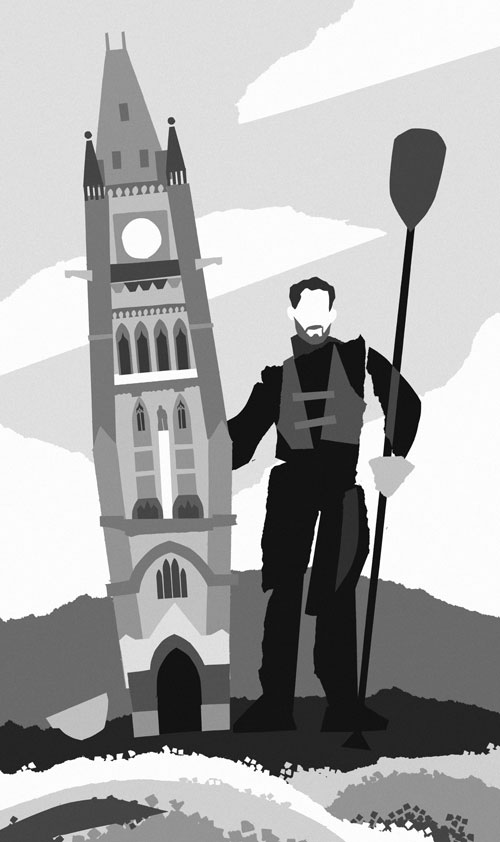
In exhilarating conversation with water.
Dave Murray
Wading into the shallows, I do some cursory stretches, step onto my SUP, and paddle to the centre of the channel, where I start to feel the pull of the current — and hear the roar from a set of rapids that I’m now quickly approaching. Frothing with foam, one wave is bigger than the rest. To ensure my approach to Dessert is precise, I line up the tip of the tallest tree on a downstream island with the weathervane atop the Library of Parliament, which presides over the water from a bluff farther downstream. Then, entering a wave train, buffeted by wind, I must remain balanced while pivoting my board 180 degrees at just the right moment, so that I am now facing upriver. Slowing my speed with a burst of power strokes, I try to slide onto the shoulder of a metre-high wave formed by a drop in the riverbed. If I miss this “hydraulic jump,” wipe out, or get flushed, I have to haul myself back onto my board, paddle to shore, and walk to the put‑in for another attempt, lugging my SUP and thinking about what went wrong, a procedure that can take half an hour. Or if the water is low enough, I can head to a mid-river eddy and walk upstream on a limestone shelf, splashing carefully through the swift, knee-deep flow.
Before the frequency of my excursions to Dessert spiked from every few months to practically every day, I failed on every single attempt. I’d corral my gear and drive and change and paddle and float past the wave or fall immediately. Slogging back upstream, I’d take another run, sometimes a third, and then go home, defeated.
“Any luck?” my wife, Lisa, would ask.
“No.”
“Are you going to keep going?”
“I think so.”
Dessert is not the only standing wave one can ride in this city. It got this name, in fact, because it’s a treat that local river surfers enjoy after the main course is finished. So, to explain its gravitational hold on me, I should probably mention Bate Island.
Lisa had just left town for a writing retreat the first time I tried to surf a river wave. Our preteen daughters were with me in our old van, as was a SUP and a thin, fraying wetsuit handed down by my younger brother. It was a sunny, brisk morning in early May. Five weeks of solo parenting lay ahead. “Girls, let’s go to a park I know for a picnic,” I had casually suggested, grasping for ways to keep us entertained. “It’s on an island in the middle of the river, but you can get there by bridge.”
Over the previous few years, I had become a proficient flatwater paddleboarder and then discovered the euphoria of catching small waves on Lake Ontario on a SUP when the wind was right. I remember the rush of my first ride. More than anything else — intensity, acceleration, dopamine — it felt like flying. Instantly, it clicked why some people dedicate their lives to chasing what the Irish social ecologist Easkey Britton describes, in Saltwater in the Blood, as “a wordless, improvised dance” between her body and the wave. If you’re competent and comfortable in the ocean, which Britton certainly is, surfing can slingshot you to awe and humility. It is “an embodied mindfulness practice,” she writes, “the act of doing something with your whole being.”
My practice progressed haltingly, like trying to assemble a puzzle without seeing the complete picture: Blustery, fun but frustrating SUP surf sessions a couple hours from Ottawa at Sandbanks Provincial Park, near the eastern end of Lake Ontario. The occasional exhilarating (and frustrating) trip to Canada’s east or west coast. Southern Maine, March 2020, tossed around by the Atlantic just before the border closed. These whistle stops were nothing like the education the American journalist William Finnegan received while growing up in California and Hawaii and dirtbagging around the globe in pursuit of waves, an arc chronicled in Barbarian Days, which won him a Pulitzer Prize. I hadn’t considered river surfing yet, but I had a taste of something, and my parallel voyage into surf lit deepened my coastally bereft yearning for what Finnegan came to see as a “consuming, physically exhausting, joy-drenched reason to live.”
A couple dozen people were on shore and in the water when the girls and I arrived at Bate Island: kayakers and paddle surfers clad in colourful dry suits; traditional, prone surfers in thick black neoprene. I approached a guy with a SUP and asked for advice. “First thing,” he said, nodding toward the parking lot, “is go get my extra helmet.”
The waves form in a set of rapids on the northern side of Bate, just off a concrete wall, and are surfable for only a few weeks when the river surges with snowmelt. There’s an eddy along that wall, a small gyre of calm shielded by the tip of the island from the thunderous current. A patch of grass edged by a chain-link fence, which we leaned against, provided a perfect vantage. The man (middle-aged, like me) dispensed a few terse tips. “Get in line,” he said, pointing to the queue of paddlers and surfers bobbing below us in the eddy, watching two of their peers carve back and forth on short, snub-nosed kayaks. Whenever somebody peeled off the wave, they paddled out of the current and up the eddy to the back of the pack. “When it’s your turn,” my no-nonsense teacher continued, “paddle across the eddy line and get on the wave.” (Later I discovered this man was a former Olympic canoeist and medical doctor who knew I had to learn by doing but didn’t want me to end up in the emergency room.)
Heart pounding, I tried to follow his instructions, but the moment my SUP entered the churn, I lost my balance and flew sideways, grateful for the helmet as the board and I whipped through the roiling whitewater. It was terrifying, yet I tried repeatedly. I fell again and again. It was the same each time I returned to Bate that spring. Some wipeouts were worse than others: bonked on the head by my fin, foot ricocheting off a riverbed rock. But because it was easy to circle back, and because the regulars didn’t seem to mind a rookie who wasn’t snaking long rides, I figured out how to remain upright for a second or two by the end of that season. I swam exponentially more than I surfed, bloodstream and cells permeated by icy spring runoff, and recovered with marathon hot showers.
To stay on the wave, I pieced together the next spring, I had to inch my weight forward after I slid onto it. Not too far forward: that makes the SUP’s nose “pearl” into the water and catapults me over the board (and can fling it toward my helmet as I wash through the rest of the rapids on its tail). But stepping too far backward to compensate wasn’t right either: that kicks the SUP ahead and also sends me flying. To move left or right, I needed to shift subtly in that direction. The paddle helped: extra propulsion and stability. Also, already standing, I didn’t have to “pop up” like a prone surfer, which flattened the learning curve.
Surfing has a comprehensive vocabulary: barrels, cleanup sets, duck diving. Wave anatomy also has its own lexicon: crest, face, shoulder, pocket. Through error and error, I was starting to decipher these words. By my third year, I was on the wave consistently, and the movement, while not graceful, was instinctive, as if my muscles knew what to do. Back home afterwards, a serenity lingered, the glow of a “profoundly egocentric and selfless” ritual that, to Finnegan, is “radical in its rejection of the values of duty and conventional achievement.”
Then, inevitably, the water level drops and the waves vanish. The eddy is gone, too, and rocks lurking beneath the surface can break your bones or board. The season at Bate Island might last for a week, a month, maybe two, reliant on precipitation throughout a vast watershed. When it’s over, it could be a year until I return. A period of mourning ensues.
Slipping into depression during the pandemic, the former Barack Obama speechwriter David Litt began surfing. A “grom” (or newbie), he had a place on the Jersey shore and a blue-collar, politically opposite brother-in-law who agreed to serve as coach and protector. Common wisdom holds that you won’t become adept in the waves unless you start young. Like me, Litt found a seam that “paused the spin cycle in my mind,” he writes in It’s Only Drowning, in which picking up surfing becomes a path to healing in a troubled, polarized world. Near the end of his first lesson, Litt caught a wave: “For a few timeless seconds, the chaos around me — the crash of waves and the world in perpetual crisis and the sense that time was not just passing me by but dragging me by the ankles when it passed — ceased to matter. I was part of the universe and propelled by the universe, floating high above a sea of troubles as I rocketed toward shore.”
I don’t live near the ocean. I’ll never get enough reps to crack this code. But there’s a river in my backyard with a wave that works almost year-round.
The spiritual art of “wave sliding” was part of Polynesian culture as far back as the twelfth century. Cave paintings from that period suggest we’ve been telling stories about surfing for just as long. The first written record is believed to be in James Cook’s A Voyage to the Pacific Ocean, an account of a near-rapturous local riding a small wave in a canoe, apparently unperturbed by the three British ships that had just dropped anchor in a Tahitian bay in 1777. “I could not help concluding,” Cook wrote, “that this man felt the most supreme pleasure, while he was driven on, so fast and so smoothly, by the sea.”
The roots of river surfing extend only to the 1970s, when a standing wave on the Eisbach in Munich — an engineered arm of the Isar River — began to draw attention. At first, riders stood on wooden planks and held on to ropes attached to a nearby bridge. Then they realized they didn’t need the ropes. From Germany, river surfing spread throughout Europe and eventually jumped to North America and around the globe. (Unsurfed Afghanistan, a 2020 documentary, follows a small crew looking for river waves in the landlocked country.) Kayaks and canoes were initially the vessels of choice in my part of the world, with SUP surfers joining the mix in the early 2000s. In Canada, the former Olympic kayaker Corran Addison reportedly surfed Montreal’s Habitat 67 standing wave on the St. Lawrence River in 2002, prompting people across the country to scout local rapids.
The community at Bate Island is part of the appeal for me. A real-time, online hydrometric data graph from a gauge just upstream keeps us apprised of the river’s flow. When it tops fifty-nine metres above sea level, there are generally surfers in the water from sun‑up to sundown. “When the streetlights on the bridge turn on,” a veteran kayaker said to me one evening, “I should probably go home.” The vibe is that of a secret stumbled upon, as if we’re getting away with something, a hidden-in-plain-sight portal to another realm. I’ve seen surfers join virtual work meetings in their cars — wetsuits on, cameras off — and check email during brief breaks.
Good ocean waves are scarce, produced by a constellation of fickle factors: swell, tide, wind. The limited access can spawn territoriality, a pecking order. Standing waves are perpetual and in one spot, so the scene tends to be welcoming and social. Congregating beside the fence, we talk about the wind and whether there are any chunks of ice drifting downstream. If someone’s leash snaps and their board floats away, or if a kayaker ends up in the water, everybody rushes to the rescue. When the Ottawa River floods low-lying neighbourhoods, a neoprene-garbed squad of surfers stacks sandbags. Seasonal friendships resume on the island; at least one romantic relationship has started. But when you’re in the rapids, with all voices drowned out by that cascading, deafening whitewater, you’re alone.
Last August, I finally connected the dots and got the hang of Dessert. I had to tune out all distractions and, bearing down on the whitewater, commit. Sequentially, I fine-tuned each step. My approach had to be laser sharp — the top of that tall tree overlaid dead centre on the parliamentary library — and my pivot turn steady. Then, after paddling hard, I had to crouch and lean forward and left to glide down the wave and absorb its initial kick. I began to catch it regularly, and within a few weeks I could stay on for as long as I wanted, or until my turns became too aggressive. Standing in a parallel surf stance, I could cut left or right by pushing down with either my toes or my heels and twisting my torso in that direction, and then I’d quickly zip the other way. I wasn’t exactly in control, just responding to the river’s force, enveloped by an ineffable giddiness.
Technical precision may have brought me here, but I was no longer consciously deciding what to do: my body and the wave were in direct, exhilarating conversation. I could remain more or less in place in the turbulent foam pile, making tiny adjustments with my feet to maintain my position. I could propel myself laterally off the face and paddle like hell to get back. By myself, a couple hundred metres from either shore on summer evenings, nothing but gulls and soft pink sky above, the river raced beneath my board, its thrum ringing in my ears. Time seemed to speed up and slow down simultaneously. Action and perception were entwined. I settled into a cadence with the river, attuned to a world much bigger than me. Tentatively at first, I danced with the wave.
In mid-August, on my birthday, I bought a football-sized sandwich at an Italian deli and spent hours at Dessert. Sitting in the shade while eating lunch, I felt a rapturous contentment. Problems morphed into possibilities. Small stuff was not sweated. It was a clarity akin to what people experience, I imagine, after undergoing psychedelic therapy for mental illness: they travel to another plane and return with new-found connectedness and compassion. “I sit at confession,” sings the Gatineau musician and river surfer Mia Kelly, “my riverbed sessions.” Après surf, it’s as if I’m still floating, poised for whatever lies ahead.
All of the surf books I was reading revolved around ocean waves. I never saw that language applied to rivers, planetary veins that unleash a raw energy similar to that of the sea. So, to further understand my particular obsession, I reached out to a few psychology researchers who study such things. Michael Inzlicht, at the University of Toronto, said that in a culture of instant gratification, if it’s a struggle to do something, the outcome can feel more rewarding. “Despite these oversized brains,” he told me, “we’re still embodied creatures.” Susan Houge Mackenzie, at New Zealand’s University of Otago, a former river surfing guide, attributed the high, in part, to the tension between anxiety and excitement when you’re speeding toward a wave — to the emotional sweep from nervous anticipation to stimulation, creativity, confidence, and peace. “The skills required to navigate rapids,” she explained, “help you tune out other aspects of your life and focus on what’s right in front of you.”
I tuned out other aspects of my life at Dessert so frequently last summer and fall that, beyond my solitary whoops of joy on the wave, I fell in with a small club of regulars. Guilty grins are exchanged when we meet one another yet again. Observations and wisdom are shared beside our cars as we suit up. A Québécois surfer I saw almost daily was working at a tall building under construction nearby; from the eleventh floor, he would look at the hydro dam below Dessert to see whether the spillway gates were open, which could impact the river’s depth and speed. All winter, from his exposed perch, he sent me photos showing how much ice spanned the river below the wave. A guy who lives a block away from the put‑in park was one of the OGs here two decades ago. An excellent surfer with wise eyes and a killer man bun, he sometimes walked over just to look at the river and stretch, exuding calm and taking on a mythical quality in my mind. “Don’t think about trying to catch the wave,” he said sagely one night when I was still floundering. “Just enjoy being in this beautiful place, and if you do any surfing, that’s a bonus.”
Suddenly the pressure was gone. My relationship to the river sintered into sync. Eric Brymer, a sports psychology researcher at Australia’s Southern Cross University, interpreted this experience for me. Scanning and exploring and trying to make sense of the natural world with our bodies is not necessarily an “augmented process” in the brain, he said about activities such as surfing. We’re bombarded by rapid-fire physical stimuli and powerful emotions, playing at the edge of our comfort zones in a dynamic outdoor environment. To Brymer, this is nothing less than “a fundamental way to be human.”
There’s a unique etiquette at Dessert. We’re cognizant of each other’s safety and “stoke” (a term coined in 1950s California for the fired-up ecstasy of surfing). If somebody is drifting into view upriver while we’re riding, we don’t wait too long to slide off and give them a turn. Large whitewater rafts full of tourists run the rapids throughout the summer; it’s customary to get out of their way so they can enjoy the thrill. I’ve had to duck a goose that buzzed low over the wave and was almost goosed by a duck that flew past me from the rear. I’ve seen snow squalls blow in from the west while I’m on Dessert, enveloping me in a sea of white and then clearing to reveal a crimson sun dipping low on the horizon. In warmer weather, small birds flit around, hunting bugs. Watching them from the wave is mesmerizing. Maybe we’re not all that different.
It’s summer now. A long, cold winter tapered away, the water level rose, and for seven weeks, I surfed almost every day at Bate Island, immersed in blue space. Mine was a fantastic spring. Books and bars, vacuuming and groceries were neglected. But those waves are gone, and the butterflies are migrating back to my stomach. I’m steeling myself for Dessert. An ancient song beckons.
Dan Rubinstein wrote Born to Walk and Water Borne: A 1,200-Mile Paddleboarding Pilgrimage.
Advertisement
Advertisement