
Two months before giving birth to her son, Wiley Wei-Chiun Ho saw a therapist for the first time, hoping for reassurance that she’d make a good mother. “I’m here for you to tell me how normal I am,” she said, only half jokingly. However, by degrees, she admitted to an unusual childhood: her family came to Canada when she was nine, but three years later, her parents decided to move back to Taiwan, leaving Ho and her four older siblings to fend for themselves. “I believe that you are here because you have a need — conscious or otherwise — to untangle your childhood,” her therapist explained in the silence that followed. “To come to grips with why you were abandoned.” After crying uncontrollably, Ho fled the office and didn’t return for years.
This scene captures the emotional core of Ho’s moving and perceptive memoir: her deep-seated need to grapple with the anger, shame, and confusion of having been left behind. The Astronaut Children of Dunbar Street begins near the end, when she received frantic texts from her siblings, urging her to fly to Taiwan to see their aging parents. This was at the height of the pandemic, when visitors to the country had to submit to two weeks of quarantine. Through precise, unaffected prose, Ho proceeds to excavate her family’s complex history and the subterranean feelings that made a return to her homeland so fraught.
The family arrived in Vancouver in 1980. Like many at the time, Ho’s parents had chosen to emigrate so that their oldest child and only son could avoid mandatory military service and the prospect of war with Mainland China. Despite being a second-generation physician, her father couldn’t secure a licence to practise in Canada without completing another medical degree and residency. By 1983, the family had earned citizenship but had drained most of their savings. That’s when her father and mother made the difficult decision to go back to Chutung, near Taipei, and resume their lives as a doctor and a hospital administrator, instead of being “nobodies” abroad.
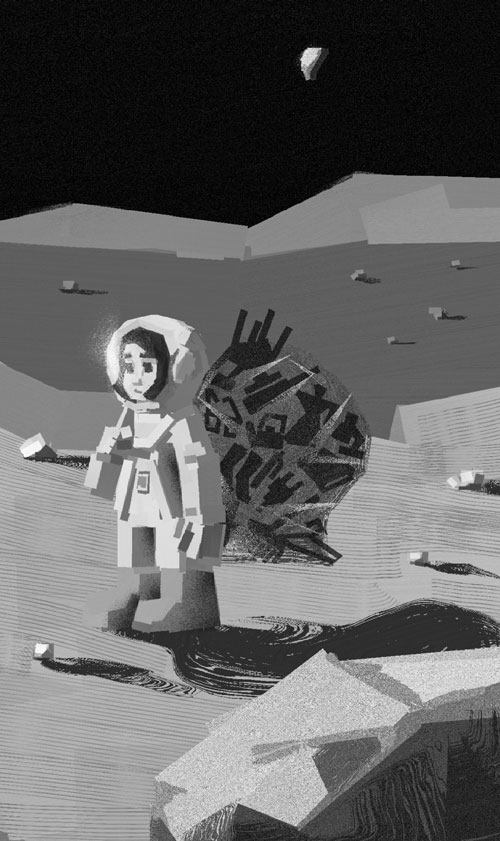
As a child untethered from her parents.
YQ Huang
Chinese Canadians have long been sojourners. Men who came to seek their fortune on “Gold Mountain” or to help build the Canadian Pacific Railway left their families in China with dreams of one day returning. A century later, the phenomenon played out in reverse: with economies booming in Taiwan and Hong Kong, wives and children started emigrating to North America, Australia, and elsewhere while husbands stayed to work. In her seminal anthropological study, Flexible Citizenship: The Cultural Logics of Transnationality, Aihwa Ong coined the term “astronaut family” to describe such arrangements. Ho’s astronaut family took the rarest form, one in which both parents were absent.
From the outside, immigrant children who live on their own are often envied for their fancy cars, expensive houses, and absolute freedom. From the inside, though, the story is much more complicated. Ho and her siblings were safely ensconced in a spacious home in the leafy Dunbar neighbourhood on Vancouver’s west side, but the four girls chafed under the strictures of their twenty-one-year-old brother, who was left in charge. They bickered over chores and let the mess accumulate. (Visiting a fellow astronaut kid’s place one day, Ho found a kitchen filled with “dirty dishes, takeout containers, and food stains” and the smell of “rotting garbage and spilled beer.”) Worse, the siblings started retreating to their own rooms and nursing secrets, to the point where Ho developed an eating disorder. Yet once a month, during expensive long-distance phone calls, all five children put on a brave collective face, unable to acknowledge the pain and anxiety of trying to cope by themselves or the biting jealousy of watching others just being families.
This is what Ho does so well: she pulls back the curtain on the contradictions and complexities of growing up alone in a new country. As the youngest, she was the least attached to her Taiwanese roots. Consequently, she “floated in the in‑between — between languages, between cultures, between homes, between identities.” On one of her parents’ visits to Vancouver, they were shocked to see her room plastered with posters of Simon Le Bon: shocked, that is, by how westernized their daughter had become. In time, all of her siblings left, first her brother, for Winnipeg, then all three sisters, for marriage in Taiwan, until only she remained — the last one still tethered to her adoptive city.
Ultimately, The Astronaut Children of Dunbar Street is about the emotional vacuum and long-simmering tensions created by the absence of the author’s parents. Even as she understood their sacrifice, Ho couldn’t help but feel resentful, which led to continual disagreements. She is especially adept at capturing the paternalistic and critical nature of the quintessential Chinese parent, especially through dialogue with her mother, who needled her youngest daughter for marrying a “foreigner” only to get divorced. In these exchanges, the guilt and shame of filial piety and the alternating cycles of silence and eruption will be painfully recognizable to many Canadians of Asian immigrant parents — whether or not they were astronaut children — and to anyone who has ever had a difficult relationship with family.
With clarity and emotional honesty, Ho seeks to understand her past without blame or self-pity. Her tone is earnest and measured and leavened by a gentle sense of humour. Divided into three parts that span decades, Ho’s recollections move effortlessly through the years, from one meaningful episode to the next, giving the memoir a brisk pace. There are a number of hair-raising scenes, including one that begins, innocently enough, at the kitchen sink. There are also plenty of Canadian touchstones from the 1980s, from Wok with Yan to Good Rockin’ Tonite. For readers of a certain vintage, The Astronaut Children of Dunbar Street is a poignant time capsule.
In the end, Ho resists easy answers. She and her parents never reached a point of perfect reconciliation, so she sought solace elsewhere. From her earliest days in Vancouver, when her grade 3 teacher took her under her wing and helped her with English, Ho has found refuge in books. By writing one of her own, she gives us the sense that the woman who rushed out of that therapist’s office years ago has finally untangled her childhood and found the love and self-knowledge she has always yearned for.
Jack Wang is the author of The Riveter, one of The New Yorker’s best books of 2025.
Advertisement
Advertisement