
Vanilla is anything but boring. The story behind the world’s second most expensive spice is one of peril and intrigue, of ingenious discoveries and booms and busts. Over the course of five centuries, the only edible orchid has been heralded as an aphrodisiac and a treatment for stomach issues, viscous humours, depression, even plague. The beans have been embroiled in the soft-power manoeuvrings of empires and were at one point so valuable they could be used as currency. That signature sweet taste has enriched cacao drinks, savoury dishes, and countless desserts — from Icelandic vínarterta torte and Italian panettone to Japanese purin custard. Louis XV’s mistress Madame de Pompadour consumed the fruit as part of a “heating diet” to offset her “cold temperament” and reignite her relationship with the king. Yet despite this eclectic profile, the word “vanilla” has become synonymous with blandness.
Eric T. Jennings is here to set the record straight about a much-maligned ingredient. As he traces the plant’s path from its Central American roots to its pivotal place on the global culinary scene, he leaves no leaf unturned. Vanilla: The History of an Extraordinary Bean plots the flavouring’s journey across several distinct stages: First, a pre-colonial era when it was an Aztec delicacy used in the drink chocolatl. Then, the Spanish export monopoly, in which conquistadors seized upon the spice’s delicious potential for profit. In the nineteenth century, the game-changing manual pollination method (independent of Mexican bees) that led to a production surge under French colonial control. Finally, the rise of synthetic substitutes and attempts to fight back against chemical alternatives to real vanilla. As Jennings says, “Let’s dig in.”
It was thanks to the dual breakthroughs of a Belgian botanist and an enslaved teenager on Île Bourbon that this delicate flower grew so prolific. In 1836, Charles Morren was technically the first to achieve manual “fecundation” on a plant in Liège, but his approach “proved cumbersome, confusing, and time-consuming.” Five years later, a young gardener named Edmond, on an island in the Indian Ocean, independently devised a simpler technique to bring the orchid’s male and female parts together. This method is still used today.
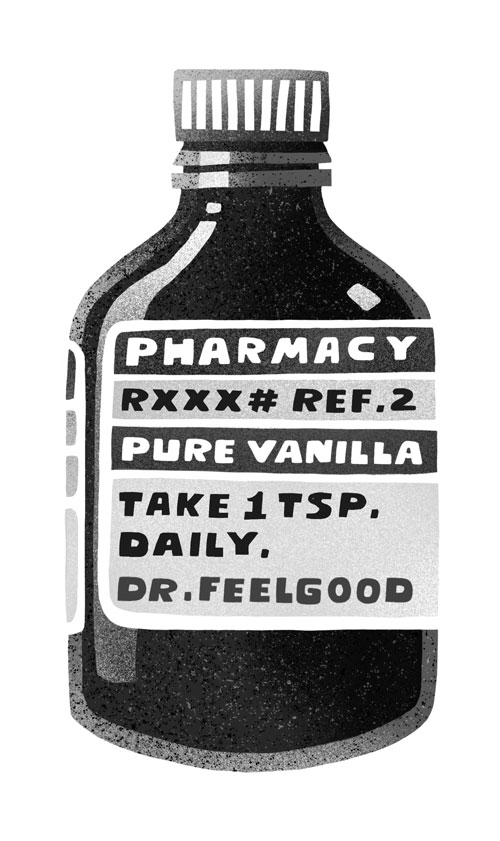
The unequalled flavour of very cool beans.
Sandi Falconer
Vanilla is a fussy fruit. Vines grow up host trees and require daily tending so that they don’t become overrun with weeds, climb too high, or strangle one another. The plants need heat to thrive but also consecutive cool nights to flower (though absolutely no frost). Blooms appear and fade within a single morning, and each one must be hand pollinated in a delicate operation — à la Edmond — that involves a toothpick or a needle. The pods take nine months to mature and demand a Goldilocks ratio of sunshine and shade. They can’t be picked too early or too late and have to be boiled and then dried for precisely the right amount of time. Barely any stage of preparation can be mechanized. “Artisanal meticulousness,” the phrase Jennings employs to describe the process, puts it lightly.
Of the three kinds of edible vanilla — planifolia, tahitensis, and pompona — each has had its day in the sun, but planifolia is the species that typically ends up on our plates. Jennings makes for a sprightly guide to the regional and individual struggles for glory and fortune. While the book is dense with facts and footnotes, the University of Toronto professor’s style is light and pacy, and he’s not afraid to sprinkle in the odd pun. As he details how production shifted between Réunion, Madagascar, and later Tahiti, he delights in telling us who climbed “to the top of the pod‑ium.” When the vanilla boom was in full swing and piracy and theft were rampant, stealing “was literally picking low‑hanging fruit.”
By the early 1900s, the appetite for all things vanilla had only grown more voracious, especially in America, where the beans became a mainstay of frozen desserts, syrups, and Coca-Cola. During the Second World War, as USS Lexington sank after a Japanese submarine attack, sailors scrambled to save the ship’s ice cream. But just as “vanillamania” reached a fever pitch, pod sales fell. There was a rival player on the scene in the form of synthetic vanillin.
Despite the efforts of producer lobby groups, a staggering 99 percent of vanilla-flavoured foods now use artificial vanillin. The molecule contained in the authentic fruit has been very successfully synthesized from a variety of strange sources. In the 1980s, for instance, a company in Thorold, Ontario, was the leading manufacturer of vanillin from papermaking waste. Check your labels, Jennings warns. Unless you spot “natural, pods, beans, Madagascar, Mexican, Tahitian, Réunion, Indonesian,” it’s likely that the “vanilla” you are ingesting is in fact “a substance composed of cloves and alcohol in the best of cases.” The worst? Beaver secretions (historically) and cow dung. I’ll have two scoops of the castoreum, please.
While real vanilla provides “countless variations in grade, quality, nose, texture, and size,” synthetics achieve that irresistible combo of uniformity and convenience. What’s more, they’re cheap. Because of the strictures of production, the natural ingredient remains “an unstable luxury good”— one that can spoil, dry up, crack, mould, or be ravaged by the fungus fusarium. Jennings points out that few palates can tell the difference. So, he asks, does it matter? The answer is a resounding yes.
Vanilla’s story differs from that of other consumables like sugar, cacao, coffee, tobacco, and cotton. It didn’t reshape global capitalism or drive slavery. Vines build on existing woodlands and strengthen them — functioning as the opposite of the banana, which has wreaked havoc on Central American ecosystems. The bean’s cultural interpretation has zigzagged from deluxe to dull, from a “passion-exciting” threat to morality to the paradoxical term “vanilla sex,” suggesting a lack of spice. (Jennings points out the irony that this usage originated in the United States, the world’s largest consumer of the chemical substitute.) In another odd twist, the pod with its black seeds, whose pollination method was discovered by a Black teenager, has become associated with whiteness. So vanilla has always been rich in meaning.
The bean remains at risk from climate shifts, high prices, and ever-cheaper alternatives. But next time my humours are off or my stomach is sick, bring me that most diverse, that most exciting of spices: vanilla!
Rose Hendrie is working on a novel.
Advertisement
Advertisement