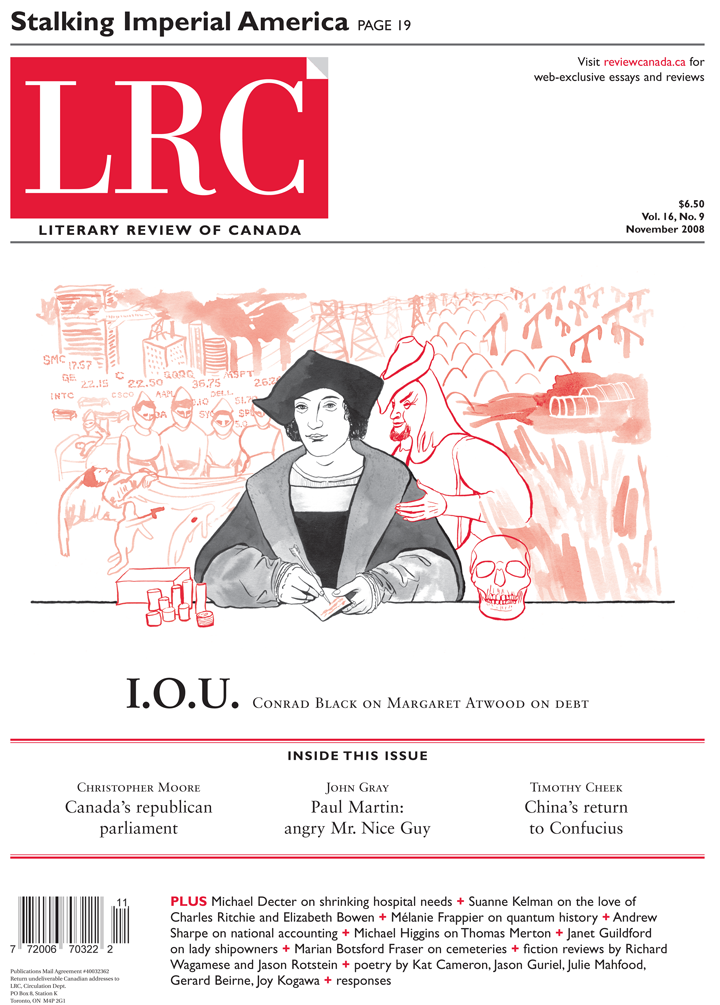
Magazine Issue ›› November 2008
In the November 2008 Issue
-
Our Canadian Republic
Do we display too much deference to authority ... or not enough?
-
What Do We Owe?
A review of Margaret Atwood’s Payback: Debt and the Shadow Side of Wealth
-
The Karaoke Classics
A review of Daniel A. Bell's China’s New Confucianism: Politics and Everyday Life in a Changing Society
-
An Informed Citizenry?
An online review of Communication in China: Political Economy, Power and Conflict, by Yuezhi Zhao
-
Spiritual Dissent
An online review of Falun Gong and the Future of China, by David Ownby
Love-Making through Word-Making
A review of Love’s Civil War: Elizabeth Bowen and Charles Ritchie, edited by Victoria Glendinning
History Etched in Stone
A review of Old Canadian Cemeteries: Places of Memory, by Jane Irwin, photographs by John de Visser
Eliminating the Caboose
A review of Who Killed the Queen? The Story of a Community Hospital and How to Fix Public Health Care, by Holly Dressel, and Critical to Care: The Invisible Women in Health Services, by Pat Armstrong, Hugh Armstrong and Krista Scott-Dixon
Tabloid Science
A review of The Quantum Ten: A Story of Passion, Tragedy, Ambition and Science, by Sheilla Jones
The Cree in Crisis
A review of Through Black Spruce, by Joseph Boyden
Angry Mister Nice Guy
A review of Paul Martin's Hell or High Water: My Life In and Out of Politics
Imperial America
A review of The Perils of Empire: America and Its Imperial Predecessors, by James Laxer, and What Is America? A Short History of the New World Order, by Ronald Wright
Swiftian Wit and Zen Insight
A review of Thomas Merton: Hermit at the Heart of Things, by J.S. Porter
Women on the High Seas
A review of Silk Sails: Women of Newfoundland and Their Ships, by Calvin Evans
Regret: For Joaquin
A poem
Conscience
A poem
Camille
A poem
as apology does
A poem
Cover art and pictures throughout the issue by Sylvia Nickerson
Since graduating from art school in 2001, Sylvia Nickerson has designed books, illustrated for magazines, tutored mathematics, worked as an arts administrator in the Canadian book publishing industry and completed an M.A. in the history of science. Her illustrations have been published in The Coast, The New Quarterly, Carousel Magazine, Briarpatch Magazine, The Dominion and The Globe and Mail. To see more of her art go to www.sylvianickerson.com.
Letters for November 2008
Re: "Our Canadian Republic" by Christopher Moore
Christopher Moore’s review/essay (“Our Canadian Republic,” November 2008) echoes the lament heard a century ago: Why can’t Canada be more like Great Britain? The new world country always falls short of the old. Then, the flaw lay in its provincial culture or primitive economy; now, it is a deficient republican sensibility, measured by government tolerance for public opinion as mediated through Parliament.
Virtue lies in respect for independence, vice in enforcing party discipline. The unexamined assumption in this analysis is that Canadian voters hold the same order of values. Why then do they demand that members of Parliament who cross the floor of the House of Commons be required to seek constituency approval in a by-election?
Moore is much taken by demonstrations of MP independence at Westminster. He is less impressed by arguments I offer in The People’s House of Commons: Theories of Democracy in Contention as explanation for the phenomenon: the British chamber twice the size of the Canadian, the greater autonomy of constituencies there than here in the selection and re-selection of candidates, and the contribution these factors make in sustaining political careers for some individual MPs at Westminster. By contrast, backbench careerism in Ottawa is almost an oxymoron.
Leadership conventions are the work of the prince of darkness. Introduced as democratic mechanisms, in Moore’s view they actually weaken Cabinet and caucus control of leaders. Canada is the only Westminster parliamentary system where parties use conventions, and it is worth a moment’s reflection to consider why this innovation happened when it did, after the First World War.
Rather than pursue that thought, the Parliament of a unitary, comparatively homogeneous, island realm is offered as a democratic standard for Canada—a transcontinental country that is federal, bilingual and still sparsely populated.
It is quite right to say that republicanism is about more than abolishing the monarchy. Then too, popular sovereignty is about more than weak party discipline. Moore is unhappy with the emphasis I give to the Crown as keystone in Canada’s constitutional architecture. Still, it is not enough to say that power derives from the people. As long as the Crown’s prerogative continues to be a source of governmental authority, even when in conflict with statute law, as happened with the dissolution of the last Parliament; as long as its patronage power is exercised on advice of the first minister, with only the promise of parliamentary participation, then it is misleading to conclude that the end of the three-line whip is the Canadian equivalent of storming the Bastille.
David E. Smith
Saskatoon, SaskatchewanResponse to Our Canadian Republic
Re: "Our Canadian Republic" by Christopher Moore
Three cheers for Christopher Moore’s “Our Canadian Republic.”
Too much “obsession with the monarchy “ is no doubt a “depressingly thin, diluted account of what the republican alternative has to offer”—in Canada as elsewhere. Yet, as Mr. Moore also notes, “Tomkins recommends several steps to reform parliamentary democracy … One is, yes, abolition of the monarchy.”
In fact, there is some popular Canadian stir¬ring along these lines nowadays, to which our politicians ought to be paying more attention. A February 2008 Angus Reid survey, for example, suggested that 55 percent of Canadians sup¬port ending our current formal ties to the British monarchy (or, as Mr. Moore so nicely puts it, the Crown’s current status as no more than “a ritual formula devoid of significance”), while only 34 percent are opposed, and 11 percent “not sure.”
Similarly, before the Ontario courts right now is an aspiring class action urging that the pres¬ent mandatory oath of allegiance to the British monarch for new Canadian citizens violates the Canadian Charter of Rights and Freedoms. (And the noble senator and admitted monarchist Hugh Segal is apparently concerned enough to have introduced a private member’s bill in the Senate, providing that if the courts do finally smile on this argument, the present old monarchical oath of allegiance will nonetheless be retained for at least five more years, via the notwithstanding clause in the Charter of Rights.)
Finally, it is no doubt altogether correct, as the republican and democratic Mr. Moore urges in his concluding remarks, that it is the major¬ity in Parliament, and not the governor general, who decides whether any government of the day stands or falls. But a directly or indirectly elected governor general (as in the present republican parliamentary democracies of Ireland or India, for example) could make it considerably easier for the will of the majority in a minority government parliament to find its voice. And in Canada today such a reform would seem quite possible without any thorny constitutional debate, using the same model of “consultative elections” that Mr. Harper wants to put in place to help him with his Senate appointments.
If we the Canadian people, that is to say, really do want to let our members of Parliament know that we are seriously concerned about strengthening our parliamentary democracy, there are already a few potentially serviceable instruments at hand. Meanwhile, how refreshing and stimulating to hear Christopher Moore’s clear and firm Canadian republican voice in the LRC.
Randall White
Toronto, OntarioResponse to Our Canadian Republic
The LRC welcomes letters. We reserve the right to publish such letters and edit them for length, clarity and accuracy. E-mail editor[at]lrcreview[dot]com.
Online Originals
Lincoln’s Prophet
A review of George Fetherling's Walt Whitman’s Secret: A Novel
Untying the Knot
A review of A History of Marriage by Elizabeth Abbott
The Winter of a Hundred Books
- More Online Originals »