
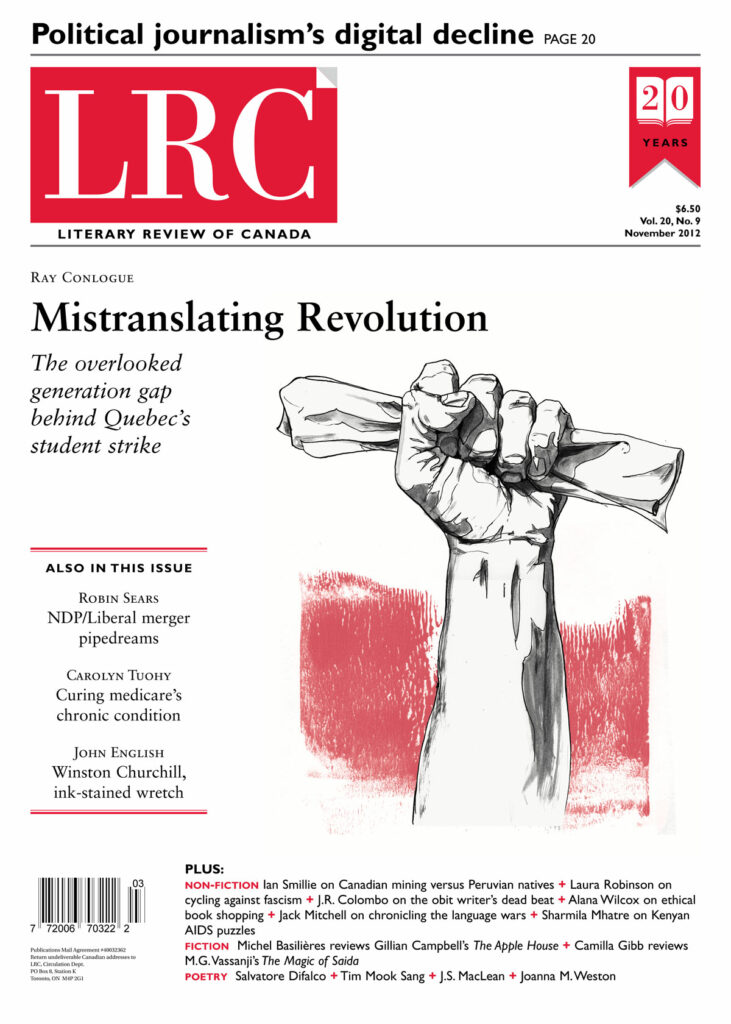
Magazine Issue ›› November 2012
Editor's Note
The rest of Canada watched the Quebec student strikes earlier this year with a combination of bewilderment and amazement, especially when other swaths of the province's citizenry began joining the academic cohort on the streets. According to our November essayist, Ray Conlogue, what was happening signaled a deep generational disconnect in Quebec, one that is likely to have consequences down the line for the future of Confederation.
Political reporting in Canada has changed dramatically since the advent of the Blackberry and not for the better, writes media analyst Christopher Waddell. Such an elite method of communication allows journalists and party strategists to talk to each other more quickly and intimately than ever before, but the conversation no longer includes us, the democratic public.
Finally, in the wake of the Lance Armstrong revelations, sports commentator Laura Robinson shares the story of Gino Bartali, an Italian cyclist from the mid-20th century whose life eloquently demonstrates the difference between winning at any cost and the nature of true heroism.
Happy reading!
Bronwyn Drainie
Editor
In the November 2012 Issue
-
Why Did They Strike?
A political generation gap—invisible to most Anglos—separates Quebec students and parents.
-
Berry'd Alive
How the Canadian media have used new technologies to shut out the public.
-
A Real Sports Hero
A review of Road to Valour, by Aili and Andres McConnon.
-
You Can't Get There from Here
A review of Power Trap: How Fear and Loathing Between New Democrats and Liberals Keep Stephen Harper in Power—and What Can Be Done About It, by Paul Adams
-
A Profitable Pen
A review of Mr. Churchill’s Profession: The Statesman as Author and the Book That Defined the “Special Relationship,” by Peter Clarke
-
Posthumous Portraits
A review of Working the Dead Beat: 50 Lives that Changed Canada, by Sandra Martin
-
The Houses CanLit Built
A review of Ultra Libris: Policy, Technology and the Creative Economy of Book Publishing in Canada, by Rowland Lorimer
-
War of Words
A review of Speaking Up: A History of Language and Politics in Canada and Quebec, by Marcel Martel and Martin Pâquet, translated by Patricia Dumas.
-
Ostrich
-
Instructions to a Speaker
-
The Old Map
-
Skin
-
An Unerring Eye for the Ordinary
A review of The Apple House, by Gillian Campbell.
-
Chasing History
A review of The Magic of Saida, by M.G. Vassanji.
-
Changing Prescriptions
A review of Chronic Condition: Why Canada’s Health Care System Needs to Be Dragged into the 21st Century, by Jeffrey Simpson.
-
A Medical Detective Story
A review of Piecing the Puzzle: The Genesis of AIDS Research in Africa, by Larry Krotz.
-
Resource Fever
A review of The Devil’s Curve: A Journey into Power and Profit at the Amazon’s Edge, by Arno Kopecky.
Cover art and pictures throughout the issue by Dave Barnes.
Dave Barnes is an illustrator and artist living on Vancouver Island. He is currently working on new pieces for a group show at MOHS exhibit in Copenhagen, a children’s book written by Feet Banks and designed by Kristen Dillon, and illustrations for Mountain Life. More of his work is available at www.davebarnes.ca.
Letters for November 2012
Re: “You Can’t Get There From Here,” by Robin Sears (November 2012)
There may be no one better or worse situated than Robin Sears to review my book Power Trap: How Fear and Loathing Between New Democrats and Liberals Keep Stephen Harper in Power—and What Can Be Done About It on the future of the federal Liberals and NDP. No one better because Sears has spent a lifetime in the higher echelons of party politics and played a role in the abortive Liberal-NDP coalition talks in 2008.
No one worse because Sears is a charter member of the party professional class whose tribal rivalries are the obstacle to a united progressive effort to replace the Harper Conservatives.
Strangely, if you leave aside Sears’s patented condescending sneer and several misstatements about my views, he seems to agree with the thesis of my book. That is, the Liberals and NDP are now competing largely for the same voters. Under our first-past-the-post system that gives the Conservatives an unearned advantage.
Indeed, in his review Sears adds further chapter and verse to the subtitle of my book.
Our main point of disagreement seems to be how progressive Canadians will find unity. He recasts himself and his backroom friends as the heroes of the story, working behind the scenes to mend rifts and build bridges—in perfect obscurity except when, well, Sears writes a book review.
I agree that men and women like him may eventually be the midwives of a new party. Still, at various times Sears, Brian Topp, Jamie Heath, Eddie Goldenberg, Nathan Cullen, Ed Broadbent, Bob Rae and Jean Chrétien have all advocated party collaboration. Yet nothing much has happened. Public debate about party merger has been desultory in the NDP, and non-existent among Liberals.
Meanwhile, a recent Ipsos Reid poll suggested that more than half of NDP supporters and nearly two thirds of Liberal supporters favour a merger.
It may be that when the history of the coming years is written, we will learn that the Harper government was defeated by a progressive political force crafted entirely by political insiders, and perhaps the book will be entitled The House That Robin Built.
But in the meantime, I don’t think that the rest of us should be told that this is none of our business. Sears says leave it to the party pros. I say that citizens and supporters of the opposition parties should also have a voice. Parties are not the sole property of those who run them; the voters they purport to represent also deserve a voice.
Paul Adams
Ottawa, OntarioResponse to You Can't Get There from Here
Re: “The Houses Canlit Built,” by Alana Wilcox (November 2012)
In her review of Rowland Lorimer’s Ultra Libris: Technology and the Creative Economy of Book Publishing in Canada, Alana Wilcox makes the important point that if Canadians want to keep the book alive in our country, we must understand the publishing business. It’s an eccentric and convoluted industry, prone to much misunderstanding, yet absolutely vital to our culture, and we need books like Lorimer’s to help unravel its conundrums.
My book The Perilous Trade: Publishing Canada’s Writers, reviewed in these pages when it first appeared in 2003 and later reissued in an updated edition, has a similar motive. And so I ºmust challenge Wilcox’s characterization of it, when contrasting it with Lorimer’s more academic study, as simply “anecdotal, even gossipy”—although it’s both those things, in places—and overly concerned with parties.
As a fine publisher herself at Coach House Books, Wilcox must know what an indispensable role parties play in the publishing process. Aside from that, The Perilous Trade was written out of a conviction that the most influential and original Canadian publishing has been driven by individuals—mavericks with a unique sensibility, vision and sense of mission. The diversity of these characters, some of them mad as hatters, accounts for the tremendous diversity of Canadian publishing itself. In writing my history of the industry, therefore, it was natural to focus on the individuals who built it. To take that approach is not to dwell on trivia, but to relate the human story of an all-too-human profession.
Response to The Houses CanLit Built
The LRC welcomes letters. We reserve the right to publish such letters and edit them for length, clarity and accuracy. E-mail editor[at]lrcreview[dot]com.
Online Originals
Buying up the Free Press
A review of Cross-Media Ownership and Democratic Practice in Canada: Content-Sharing and the Impact of New Media by Walter C. Soderlund, Colette Brin, Lydia Miljan and Kai Hildebrandt
A Beltway Education
A review of Patriots by David Frum
Looking for Marshall McLuhan in Afghanistan
- More Online Originals »