
In 2017, during the early days of Donald Trump’s first term, the world was riveted both by his reality TV presidency and by the salacious rumours about the way he had obtained it. Insistent tales circulated about how Vladimir Putin’s troll army had engineered the Republican candidate’s victory by hacking into the Democratic Party’s servers and then releasing thousands of embarrassing emails on the eve of Hillary Clinton’s nomination. What followed was a stormy season of investigations and counter-accusations about Trump’s Russian proclivities.
“Foreign interference,” particularly social media disinformation campaigns, rapidly became a DEFCON 1 political concern, and many Western governments, including Canada’s, responded. Justin Trudeau’s Liberals passed the National Security and Intelligence Committee of Parliamentarians Act, which allowed a group of MPs and senators to vet the government’s spook operations, with a couple of caveats.
One was a proviso that all the MPs and senators on a newly formed committee had to get a security clearance. The other was that the committee members had to swear an oath to not reveal what they would learn during high-level briefings in Parliament.
The law’s provisions got the attention of Ryan Alford, a Lakehead University law professor and constitutional history scholar as well as a self-described expert on the short preamble to the Constitution Act that created Canada in 1867. Those 131 words, stating that our constitution is “similar in Principle to that of the United Kingdom,” have helped courts interpret “unwritten constitutional principles” of British common law as precedents in Canada.
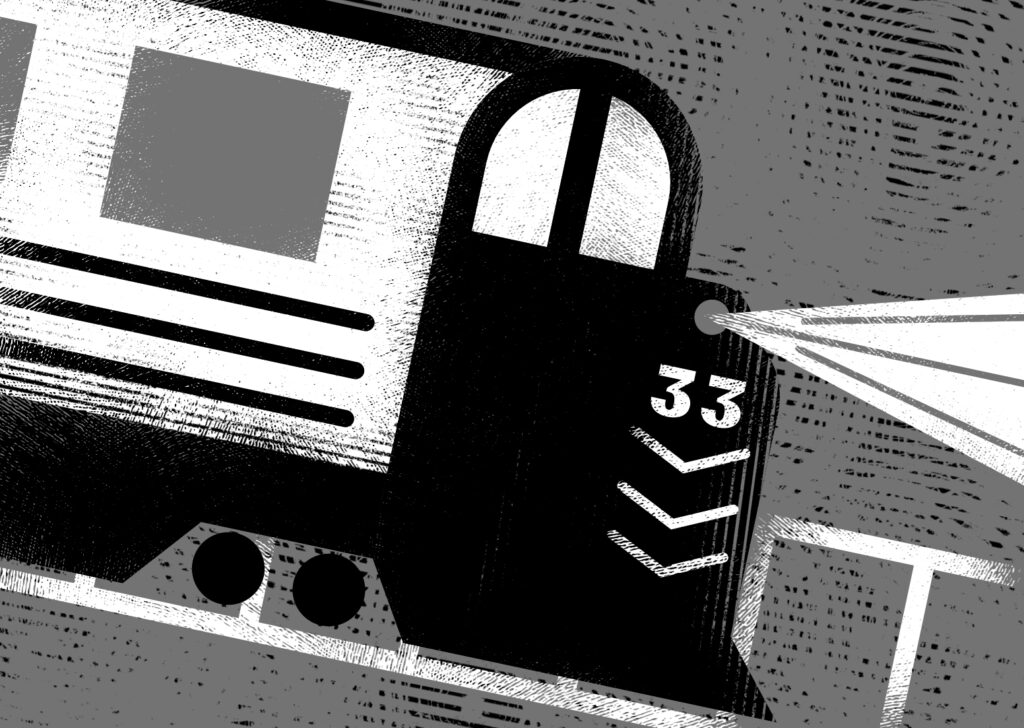
Wrong way on a constitutional track?
Matthew Daley
Alford, who has a string of degrees and practised corporate law before going into academia, is the author of By Authority of Parliament: The Constitutional Boundaries of Legislative Power in Canada, the second in a planned trilogy about Canada’s constitutional framework. In 2018, he initiated an esoteric legal challenge to that new national security law, in the Ontario Superior Court of Justice, arguing that its restrictions on the ability of parliamentarians to speak freely in the House or the Senate ran afoul of the long-standing “privileges” accorded them — privileges, he held, that were imported into the Dominion of Canada via that preamble.
Over the next seven years, Alford pursued what seemed like a quixotic legal quest, representing himself at trial, then through an appeal, and finally at the Supreme Court of Canada last fall. Bespectacled, with a lumberjack’s beard, he stood alone in front of the nine justices, parrying with them about why ancient British legal conventions still matter. He lost eight to one, with only Suzanne Côté, the court’s resident contrarian, dissenting.
Alford’s scholarly preoccupation with the foundations of Canada’s constitutional order reaches directly into another Supreme Court case that has far more purchase on the public imagination. This is the politically charged Charter challenge to Bill 21, Quebec’s laicity or state secularism law, which mandates that public sector employees (teachers, government lawyers, and the like) must refrain from wearing religious symbols on the job, including hijabs, Sikh turbans, and Stars of David.
François Legault’s Coalition Avenir Québec passed Bill 21 in 2019 and invoked section 33 of the Charter of Rights and Freedoms, the notwithstanding clause, to shield it from lawsuits by individuals claiming the legislation infringes on their freedom of religion. Two lower courts in Quebec upheld a challenge to Bill 21 from the English Montreal School Board, and the case is before the Supreme Court of Canada. Following last fall’s epic hearing featuring dozens of intervenors, the court is expected to hand down a ruling later this year or early next.
The decision is widely expected to be seismic. The judges have been essentially tasked with determining whether the notwithstanding clause, which has been used with increasing regularity, is eroding the Charter rights that Canadians thought they’d enshrined in April 1982, when Pierre Trudeau presided over the historic patriation of the Constitution. They’re also aiming to interpret a contentious provision of the Constitution that has not, to date, been shaped by much in the way of legal precedent.
None of this is abstract. Bill 21 prevents observant Muslim women from pursuing careers as teachers or Crown prosecutors, for example, if they happen to live in Quebec — a restriction not forced on them anywhere else in the country. At the same time, the law’s proponents argue that it protects the collective rights of Quebecers to receive public services in a secular setting — a cultural demand that emerged in the 1960s during the Quiet Revolution and the backlash against the dominance of the Catholic Church.
In the early 1980s, the signatories to the Charter — nine of the ten provincial premiers and Trudeau, the Liberal prime minister — assured Canadians that section 33 would seldom be invoked because of the extreme political consequences of doing so. “Justice Gérard LaForest, prior to his appointment to the Supreme Court, predicted that the political unpopularity of making section 33 declarations would result in the clause rarely being used,” the former Alberta premier Peter Lougheed, who first proposed a notwithstanding clause, recalled in 1998. Jean Chrétien, Trudeau’s justice minister at the time of patriation, expected the same. “What the Premiers and Prime Minister agreed to is a safety valve which is unlikely ever to be used except in non-controversial circumstances by Parliament or legislatures,” he promised in a 1981 speech.
Ironically, Quebec, whose first separatist premier, René Lévesque, refused to sign the new constitution, has been the main backer of section 33, applying it, for example, to cover its laws requiring French-only signs as well as a raft of other legislation. More recently, conservative governments in other provinces — Alberta, Saskatchewan, and Ontario — have begun invoking (or threatening to invoke) it to shield all sorts of policies that violate Charter rights, including back-to-work legislation (right of assembly), laws limiting third-party political advertising (expression), and rules compelling teachers to seek parental consent when trans children choose to use pronouns other than those assigned at birth (equality).
For many critics, including Alford, section 33 now looks more like a runaway train than a rarely used corrective. The notwithstanding clause, according to some observers, will topple the entire Charter if provincial legislatures normalize its use to suppress politically inconvenient rights and then renew those limits every five years, which the Charter allows and Quebec has done on numerous occasions.
The lawyer and constitutional law scholar Peter Biro, who edited a fascinating and timely 2024 anthology, The Notwithstanding Clause and the Canadian Charter: Rights, Reforms, and Controversies, likens section 33 to Chekhov’s gun. “If in Act 1 you have a pistol hanging on the wall, then it must fire in the last act,” Biro writes about the Russian dramatist’s advice. “Otherwise, don’t put it there.”
Section 33 contains just 146 words and has five subsections. It applies only to a handful of Charter provisions: section 2, which covers all the fundamental freedoms (expression, assembly, and so forth); sections 7 through 14, which assert foundational legal rights (including the right to be protected from unreasonable search and seizure, the right to not be arbitrarily detained, the right to counsel, and habeas corpus); and section 15, which lists equality rights (equal protection of the law without discrimination based on race, national or ethnic origin, colour, religion, sex, age, or mental or physical disability). Section 33 can’t be used to quash democratic rights, though it can be deployed to override press freedoms.
Any legislature can invoke section 33 to pass a law that trumps those rights, but that get-out-of-jail-free card expires if not renewed after five years. There are, however, no limits on how many times it can be renewed. In recent years, this rider has raised the spectre of a de facto permanent override of the rights listed in section 33, which points toward the worst-case scenario for the Charter’s legitimacy as a constitutional guarantor. It’s a critique that comes up a lot in the Bill 21 case.
In By Authority of Parliament, Alford tells a story that is extremely technical and oftentimes obscure, yet also interestingly accessible as he develops its central thesis and its relevance to the laicity case.
In the long-running tug-of-war over the locus of political power in the United Kingdom — the monarchy, Parliament, the Magna Carta, the courts — there is plenty of evidence, he says, to show that British judges have traditionally sought to restrain Westminster’s attempts to undermine bedrock constitutional principles, especially habeas corpus, in the name of “parliamentary sovereignty” or “parliamentary supremacy.” The idea that democratically elected legislatures have the final word came into legal vogue in the latter part of the nineteenth century, at the height of the country’s imperial reach, thanks to a few influential legal scholars with ideological axes to grind. Alford rejects that premise and dedicates the bulk of By Authority of Parliament to tracing the historical evidence that illustrates why constitutional principles, rather than legislative actions, sit at the apex of Britain’s system of government.
These core ideas — including the right to not be detained indefinitely without charge — derive from the 1297 Magna Carta and the 1689 Bill of Rights, a compromise deal adopted after the British Parliament allowed the Stuart monarchy to retake the throne following Oliver Cromwell’s no-kings rule. Among other things, the British constitutional framework, which Alford says was imported into Canada in 1867, rejected the premise that legislatures get the final word.
He adds that Britain’s management of its vast empire is relevant. Governors and plenipotentiaries who presided over the colonies often resorted to draconian measures to suppress political uprisings. To provide the necessary legal backup, Westminster passed laws that restricted the legal rights of colonials and their subjugated populations, thereby allowing torture and arbitrary detention.
Why all of this matters in the Canada of 2026 — or the Canada of 1982 — is that section 33 explicitly gives legislatures (so far, only provincial ones) the final word when it comes to quashing Charter rights. When Lougheed proposed a notwithstanding clause during the constitutional negotiations of the early 1980s, he said it was all about ensuring parliamentary sovereignty. For Alford, the idea behind Lougheed’s assertion is fundamentally flawed because it rejects almost 400 years of judicial reasoning that limited what parliaments could do.
Confronted by the existential dilemma posed by the Bill 21 case, Alford argues, the Supreme Court of Canada needs to place guardrails around section 33: “It is obvious that parliamentary supremacy is no longer fit for purpose in Canada, but a historically grounded jurisprudence that defines all the boundaries of parliamentary sovereignty has yet to be elaborated. Unfortunately, the judiciary may not have the luxury of time.”
By Authority of Parliament, Alford continues, is “an attempt to demonstrate that the knowledge and appreciation of Canadian constitutional history and its antecedents is essential not only to the preservation of our liberties but to safeguarding the legitimacy of the institutions that protect them.” What’s needed now, he maintains, is a Canadian version of “originalism.”
Since Alford’s topic is history, it’s worth asking: How did we land on section 33’s specific list of overrides, sections 2 and 7 to 15? The answer is buried in the complicated negotiations to patriate the Constitution that took place in the late 1970s and early 1980s, especially after Pierre Trudeau returned to power, determined to cement his legacy.
The use of notwithstanding language in legislation predates the Charter. Such provisions were tucked into John Diefenbaker’s 1960 Canadian Bill of Rights — which was just an act of Parliament, and therefore not part of the Constitution — as well as provincial charters of rights.
Going into the negotiations, Trudeau wasn’t interested in exemptions to a proposed charter. Three of his provincial counterparts — Alberta’s Lougheed, Saskatchewan’s NDP premier Allan Blakeney, and Manitoba’s Progressive Conservative premier Sterling Lyon — felt otherwise. Lougheed saw a rights-based charter as undermining Alberta’s sovereignty and wanted something to counterbalance the power of federal judges to strike down its laws. Blakeney felt such a charter could impede provincial attempts to advance legislation that sought to correct social and economic inequities. (Lyon was a crank.) They therefore made common cause in opposing absolute guarantees of fundamental freedoms (section 2) and equality rights.
Alford situates sections 7 to 14 — which cover the most basic legal rights accorded to people who find themselves in trouble with the law, including habeas corpus — at the heart of the constitutional order that evolved in response to the tyrannical conduct of despotic kings like Charles I. The British Parliament passed the first Habeas Corpus Act in 1679, and this principle of fairness has propagated to all functioning democracies. How is it that Canada would tolerate a provision in the highest law of the land that allows a provincial government to suspend those core legal rights for five years?
According to PrimaryDocuments.ca, which has published all public domain documents about the constitutional negotiations, the notion of including an override first surfaced in a draft circulated on January 8, 1979:
In time of serious public emergency, the existence of which is officially proclaimed through the invocation of the War Measures Act or by specific reference to this subsection, the rights mentioned in this section other than the right to life [and certain other legal rights] may be derogated from to the extent strictly required by the circumstances of the emergency.
The reference to the War Measures Act should come as no surprise. These talks took place less than a decade after the FLQ crisis of October 1970, during which Trudeau infamously invoked the act. Crises sometimes demand emergency powers, including the suspension of civil liberties, as we saw during the 2022 convoy occupation in Ottawa. Alford, in fact, cites numerous instances in British history where the government gave itself the right to detain individuals during emergencies, on the condition that such measures be time limited.
Yet none of the negotiators thought to add the Charter’s democratic and political rights protections to the list of overrides in section 33. Perhaps the prospect of provincial governments declaring martial law seemed like a stretch. Similarly, Trudeau drew a red line at sacrificing minority-language rights, so that provision was also excluded from section 33’s reach.
However, early drafts of the notwithstanding clause included an override of the proposed section 28, which was to guarantee gender equality. When that idea surfaced in Parliament, the backlash came swiftly. “Essentially what happened is that women were very skeptical about both the courts and politicians,” the University of New Brunswick law professor and constitutional expert Kerri Froc recently told me. “They didn’t trust either of them for various reasons.” Women’s groups across the country mobilized, both to ensure that the new text would include gender equality rights and to make certain these couldn’t be quashed by a provincial legislature invoking section 33.
The campaign culminated in a public conference in Ottawa in the spring of 1981. But by that fall, Parliament had approved an updated draft of the Charter that made gender rights subject to section 33. “Women were outraged,” says Froc. After a massive letter-writing effort failed, senior women from all three parties — Trudeau’s minister for women, Judy Erola, along with the New Democrats’ Pauline Jewett and the Tories’ Flora MacDonald — fanned out across the country, arguing that already vulnerable individuals, such as Muslim and Indigenous women, would be further imperilled if the notwithstanding clause could set aside gender rights.
In the House of Commons, the Tory leader Joe Clark — whose wife Maureen McTeer, a lawyer, had strong views on these matters — pressed Trudeau to exclude the gender rights provision from the section 33 override. Clark eventually moved the amendment to that effect. “You couldn’t look at it as a partisan fight,” recalls Froc. “It was a fight for the women of Canada.”
In the end, Trudeau offered up a charter of rights with a notwithstanding clause in exchange for a rock-solid amending formula (constitutional changes could be enacted only with majority votes in both the House and the Senate, plus agreement from seven of the ten provinces, representing over 50 percent of Canada’s population). The final compromise, known as the Kitchen Accord, was finalized in early November 1981. Chrétien, the Saskatchewan attorney general Roy Romanow, and the Ontario attorney general Roy McMurtry signed a three-page handwritten memo that had buy‑in from all the premiers except Lévesque, who was absent and immediately branded the betrayal of Quebec as “the night of the long knives.”
For all the political drama baked into the notwithstanding clause, our highest court, in the intervening decades, has produced little in the way of jurisprudence about how to contend with a provision that’s been characterized as Canada’s unique contribution to constitution making. There are a few precedents but many unanswered questions, such as what happens if a provincial law that’s been shielded by the invocation of section 33 ends up blocking another Charter right that isn’t on the section 33 hit list. Several intervenors in the Bill 21 case have made precisely this argument, citing, for example, the ways in which the laicity law impairs the gender equality rights of Muslim women.
“Does a formally compliant invocation of the notwithstanding clause oust the jurisdiction of the court to undertake judicial review?” Biro said to me over the phone. He runs a non-profit called Section 1, named for the Charter’s quintessentially Canadian first provision, which allows courts to place “reasonable limits” on rights claims. “Does the court still have the ability to inquire into the question of whether there are [other] rights in issue, whether those rights and freedoms have been infringed or restricted in some way, and the section 1 question, whether such restrictions would be demonstrably justified in a free and democratic society?”
From a structural perspective, the rule of law in Canada exists within a tight triangular configuration that consists of democratically elected legislatures, the courts, and the Constitution, which includes a provision known as the “supremacy clause,” stating that the whole document is the highest of Canadian laws. All three are constantly pulling and pushing against one another, which is a feature, not a bug. This unresolvable tension is, in theory, an equilibrium.
Some Charter experts, including Alford and Biro, have come to see section 33 as something akin to a worsening hairline fracture that threatens to undermine the integrity of the whole edifice. “The preservation of harmony between any version of the principle of parliamentary sovereignty and the rule of law within a system of constitutional supremacy,” Alford pointedly writes, “depends on a vigilant judiciary that remains alert to even the most indirect legislative means of dissolving the limits on its authority.”
Yet others, especially in provinces that have been making much more use of the override than anyone originally envisioned, regard section 33 as an institutional acknowledgment of their political autonomy or, to use Alford’s formulation, their parliamentary sovereignty. In Quebec, Guillaume Rousseau and François Côté, two of the legal scholars included in Biro’s anthology, argue that section 33 also functions as an enabler of cultural distinctiveness, because it permits the legislative assembly to go its own way instead of adapting to an Anglo Canadian rights framework. In other words, section 33 is the means by which a minority culture can ensure it remains maîtres chez nous, as per the cri de coeur of the Quiet Revolution that inspired Bill 21 and its guarantee of laicity. That section 33 is part of a document that Quebec refused to sign is nothing if not a paradoxical plot twist.
In fact, as constitutional experts know, charters of rights and so‑called unwritten constitutional principles are bona fide conundrums. Case in point: our legislatures can pass any law they wish, except laws that prevent future legislatures from rescinding them (courts, of course, can strike down those laws). Or take the problem of rights: one person’s right may be someone else’s restriction, and judges have to figure out how to make it all balance.
Alford acknowledges the infinite-loop quality of all this in an epigraph. “If Parliament is sovereign,” wrote Hamish R. Gray in the University of Toronto’s law journal in the 1950s, “then there is nothing it cannot do by legislation; if there is nothing it cannot do by legislation, it may bind itself hand and foot by legislation; if Parliament so binds itself by legislation there are things which it cannot do by legislation; and if there are such things Parliament is not sovereign.” These words were penned almost thirty years before Canada adopted a charter that contains what looks, increasingly, like a constitutional ouroboros.
A voice in the academic wilderness, Alford says the surest way to stop section 33 from swallowing the whole creature is to go back to first principles. That means travelling through time to rediscover the historical origins of the ideas that form the basis of our legal traditions and then to acknowledge the moments when we strayed from those lofty principles in the pursuit of grubby politics. After all, as any lawyer worthy of their robes well knows, an argument built on a false premise is bound to collapse.
John Lorinc is a journalist and the author of No Jews Live Here.
Advertisement
Advertisement