
One of the leitmotifs of the Second World War is deception: double agents, fake radio transmissions, a ghost army poised to go nowhere, inflatable tanks meant to mislead Axis strategists, a dead body handcuffed to phony plans detailing phantom troop movements to Greece and Sardinia. These are the elements of a parade of books and films that help keep the war from fading into a distant, murky past — even all these years later.
But one act of subterfuge is still virtually ignored by researchers, disregarded by ardent screenwriters, and consigned, if acknowledged at all, to footnotes rather than illuminated by footlights. The emergence of Operation Sparrow into general if not exactly mass-market attention is the result of an unlikely discovery at the archives of Mount Allison University, in Sackville, New Brunswick, and the dedication of a philosophy professor at the University of New Brunswick.
Jason Bell encountered the Sparrows of this dossier of deception while working on a separate topic. He then produced a narrative that sets out how — with grit, imagination, courage, and superhuman endurance — three Americans parachuted into Hungary; peddled a cockamamie story about how D‑Day would involve an Allied attack on the Balkans rather than the French seacoast; persuaded Adolf Hitler and the German high command to believe this wild tale well enough that they didn’t redirect substantial military assets (and 826,000 troops) from eastern Europe to the Normandy coast; tolerated abuse just short of torture; artfully employed the legalisms of Geneva Convention strictures; and made the true D‑Day landing, including the Canadian assault on Juno Beach, not only possible but also a triumph. When we reach the end of Bell’s account, unsparing of the Sparrows’ suffering and packed with details about their resourcefulness, one urgent unanswered question remains: Why isn’t this story on Netflix yet?
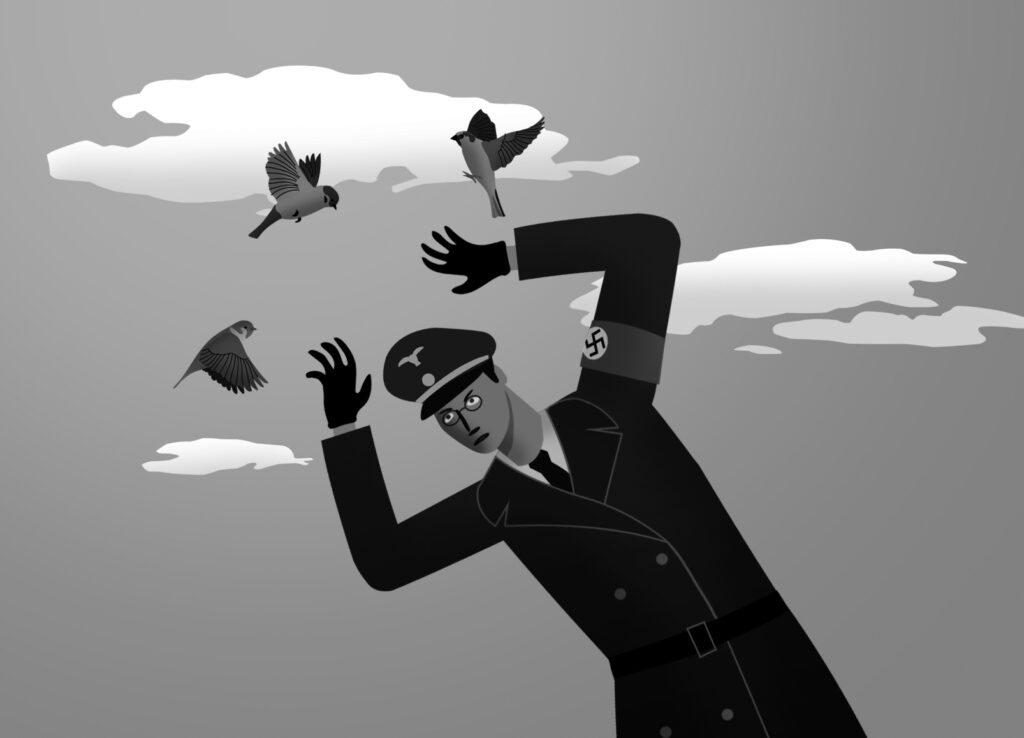
Through distraction, three brave men helped beat the Nazis.
Nick Lowndes
“The men who stormed Normandy won D‑Day,” Bell writes. “The spies who tricked Hitler gave them the chance.” Those two sentences appear near the close of Operation Sparrow. They would be the perfect tag line on a movie poster.
Bell describes the Sparrows’ effort as “a razor’s-edge campaign that diverted millions of Axis troops from the beaches of Normandy through cunning, espionage, and audacity.” It was, he writes, “a masterpiece of strategic deception” and, perhaps with a dash of hyperbole, “the highest-stakes commando deception since the Trojan Horse.” This story of boldness and daring — and, really, astonishing gullibility at the highest levels of Nazi leadership — now takes its place alongside Operation Mincemeat, the famous story of the corpse with the corpus of misleading documents that spawned several non-fiction accounts, at least two novels, a film, a play, three musicals, a miniseries, and plaudits that include a Tony Award, two Olivier Awards, and various other citations.
The ruse was designed to bolster Hitler’s conviction that the Allies were contemplating an eastern European offensive. The American plan called for three commandos to parachute into Hungary, which then was allied with the Nazis, and surrender, brazenly claiming that they were supposed to be in Yugoslavia assisting the anti-Axis resistance. This ruse within a ruse would permit them to claim that they were prisoners of war and not spies, and thus — more the logic of the courtroom than the battlefield, but what the heck — were entitled to Geneva Convention protections. Armed with Colt .45 pistols, shovels, a radio, $2,000 each in cash, and hundreds of gold coins, they carried one hope, a potent weapon in itself: that they’d be assisted by Hungarians who had grown disillusioned with their ties to Hitler, were horrified by the Nazi campaign against the Jews, and were eager to switch sides.
But their biggest asset was human — and a native of Rochester, New York. Born in 1895, Florimond Duke (originally Florimond DuSossoit) was a member of a Dartmouth College football team that beat Syracuse and tied West Virginia and that elected him captain. He was a combatant in a French unit in the First World War and later a stalwart on the New York Giants who lined up across from the gridiron star Jim Thorpe. Just how little has been known of Duke and his exploits? I have written five books on Dartmouth history and its sports tradition, two of them on football, and thus can reasonably claim to be something of an authority on the legends and lore of the Big Green. I had never heard of the guy. (Neither had the Dartmouth Alumni Magazine, beyond a brief, almost dismissive, review of his posthumous memoir fifty-seven years ago. The current editor, alerted to this book, recently commissioned Bell to write a profile of the lost alumnus who found quiet glory in, as his subtitle puts it, having “tricked Hitler and won the war.”)
Duke’s story is remarkable and well told by Bell. Before he was tapped for his assignment in Hungary, he was dispatched to Cape Town and Cairo and then seconded to a special operations team in the storied Office of Strategic Services, the precursor to the Central Intelligence Agency, where he coordinated covert missions into Czechoslovakia from bases in Africa. His work took him well beyond Psi Upsilon frat boy pranks and madcap undergraduate antics in leafy Hanover, New Hampshire. “Duke learned to blow up bridges, break and enter guarded buildings, and defeat attack dogs with his bare hands,” Bell tells us. “He even trained to resist torture, suffering electric shocks and baton hits.”
In these endeavours, Duke was both diplomat and combatant, feeding the thirst of Hungarians who, remembering how they were punished more severely than even Germany after being on the losing side in the First World War, wanted to break from Hitler. That hope wasn’t redeemed; German armoured divisions poured into Hungary in what Bell calls “Hitler’s last blitz of the war, to stop three American soldiers from teaming up with the Hungarian resistance.” Adolf Eichmann wasn’t far behind. Even so, the diversion of Axis troops was of major assistance to the Allies.
As captives, the Sparrows had a plan: tell their interrogators facts that had appeared in the New York Times weeks earlier but that would seem to the Germans, surely not subscribers of the Gray Lady, to be valuable fresh information. These three men boosted their captors’ spirits by speaking of crippling economic distress back home and personnel shortages among U.S. divisions, feeding hopes that the Axis forces had broken the will and diminished the power of their Allied adversaries. At the same time, the Nazis swallowed tales the Sparrows spun about phantom divisions in Italy and plans for air support from Yugoslav resistance forces, all buttressing the notion of an imminent Balkan invasion. Duke, Bell explains, “needed to convince the Germans that he had the product they couldn’t live without: D‑Day intel.”
Having succeeded in getting themselves arrested, they were moved from one venue of captivity to another, which in a way was a measure of how important the Nazi leadership considered them. These men were not simply shot or dispatched to slavery in work camps or to death in concentration camps. Their new places of imprisonment included separate cells in Belgrade without bed or toilet, solitary confinement units in Berlin, and a site in Budapest, where Duke continued to act as if he knew more than he was telling — a sure way to stay alive in an increasingly hostile environment. All this time, the Allies stepped up their bombing of the Balkans, a clear sign of — well, nothing.
“The supreme problem for the Nazis was that an Allied invasion loomed, but they didn’t know where,” Bell writes. “The Sparrows provided the solution — if the interrogators were clever enough to unlock their secrets.” It was a case of what Bell calls “three starving men spinning tales of attack while Allied bombs reinforced the lie.”
Meanwhile, double agents in London led the Nazis to think the invasion might actually occur in Calais, and eventually German officials came to believe that there would be more than one landing site. This assumption prompted Hitler to station his forces in multiple places, with the result that the defences in Normandy were substantially smaller than they might otherwise have been. Indeed, Hitler came to believe that the actual D‑Day invasion was but a feint to distract the Nazis from the real one in the Balkans, a notion fed by a separate Allied effort, Operation Chicken, designed to shore up the evidence that a fierce Balkan invasion was imminent. “In the Reich’s darkest hour,” Bell writes, “the dictator pointed his finger at the wrong places on his war map.”
Eventually, accompanied by seven men with submachine guns pointed at them, the Sparrows were passed from the Gestapo to the SS. They were ordered to strip and undergo an invasive inspection, all while Duke warned the interrogators that they would be prosecuted for war crimes after the eventual, inevitable Axis defeat.
As American forces bore down on Nazi strongholds in eastern Europe, Duke, then housed at Colditz Castle in Saxony, 200 kilometres south of Berlin, convinced the kommandant to surrender to the prisoners. Shortly thereafter, as battle raged outside the castle, a German security staff captain handed his Mauser .25 high-velocity pistol to Duke. The world, or at least the war, had been turned upside down at the call of a small group of Sparrows.
Duke went on to start an ad agency with offices in New York and Toronto and moved to the Dartmouth area, drawn back, like many alumni, by “the long white afternoons, the twilight glow,” as celebrated in one of the Ivy League college’s beloved anthems. He was elected to the state legislature in New Hampshire. He also grew close to Major General Horst Krüger, who had befriended the Sparrows, and worked to get the one-time enemy officer released from prison and into Harvard and MIT. Krüger later became West Germany’s air attaché in Washington. Following a heart attack in April 1969, Duke was buried near his alma mater, the story of his glory mostly buried with him — until now.
David Marks Shribman was the executive editor of the Pittsburgh Post-Gazette, which won a Pulitzer Prize in 2019 for breaking news reporting. In 1995, he also won a Pulitzer for beat reporting.
Advertisement

Advertisement