
Humans have made music with chordophones — which produce sound through the vibration of a plucked string — for thousands of years. Much has changed since the thirteenth century BCE, when the Hittites carved a figure playing a lute into stone, but through all the incarnations of what would one day become the guitar, no evolution has been so radical as the dawn of the pointy guitar. Now a defining symbol of rock, the instrument was first considered by many to be downright absurd.
In Battle Axes, the Juno-nominated musician Sean Kelly charts the history of these weapons of sonic destruction (and creation) with an archivist’s care, an aficionado’s zeal, and bubbly, irrepressible glee. Kelly — who founded the Canadian glam rock outfit Crash Kelly, performed with Helix, and played in Nelly Furtado’s globe-trotting road band — teaches music with the Toronto Catholic District School Board. His pedagogical pedigree and insider’s industry knowledge are on full display throughout this exhaustively researched work.
With their sharp angles, outrageous silhouettes, shocking colours, and futuristic designs, pointy guitars were (and are) the antithesis of your granddaddy’s six-string. Emerging during the space race — the radical Flying V was compared to the Soviets’ Sputnik 1 in Gibson’s promotional magazine, and some suspect the Explorer was named for the Americans’ first satellite, Explorer 1 — they heralded an era of unchecked experimentation. Battle Axes shows that this was a highly reciprocal chicken-and-egg relationship: as rock changed, so did the instruments used to play it, each pushing the other into ever weirder territory.
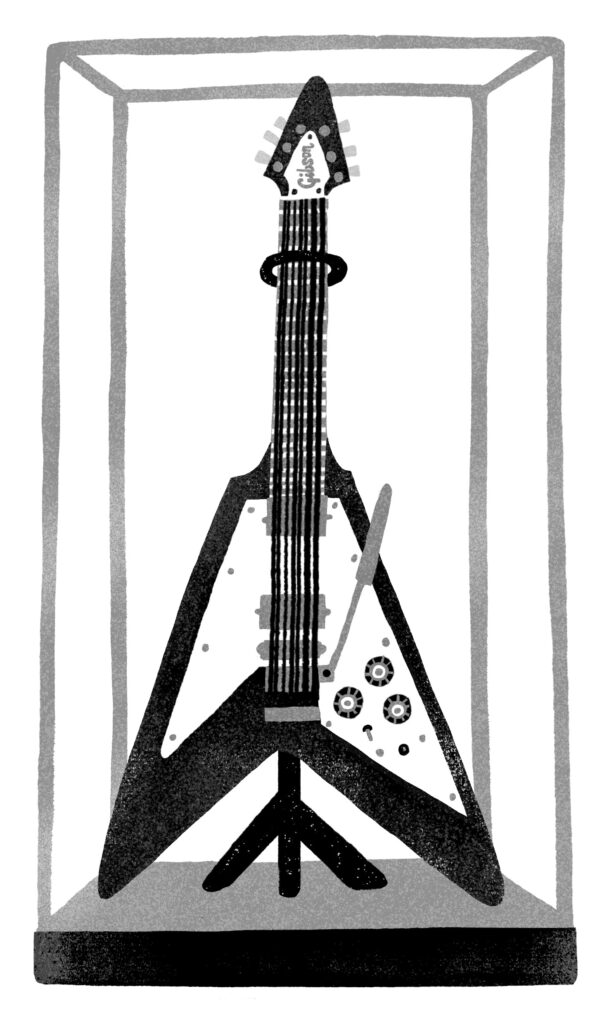
A shred of the curve.
Sandi Falconer
Hard rock and metal burst onto the scene in the 1970s in a blaze of spandex, pyrotechnics, extravagant costumes, and choreography. The music was bigger, the lights were brighter, and the performers demanded more from their instruments: louder pickups, faster necks, and custom-shop touches. They wanted greater precision and versatility and wished to wholly command the audience’s attention from the stage — a more challenging ask in the large arenas. They wanted Norse gods, intergalactic visitors, angels and demons, dragons and skulls, daggers and lasers, all wrapped up with a bow to make you say, “Hell yeah, brother.”
The guitar, in other words, was becoming more than its sonic function. “The idea that a player’s instrument could serve as an avatar for their personality and as a crucial part of their art would go on to have an incredible impact on the future of electric guitar marketing,” Kelly writes. As the music got wilder and the outfits more outlandish, so too did the axes.
The transformation wasn’t driven by musicians alone. In the mid-’60s, American guitar makers craved freedom from the postwar factory approach (and production outsourcing overseas), which had caused output to skyrocket but quality to plummet. Scrappy young artisans responded, pushing the envelope and hawking their creations one by one at conferences. Kelly homes in on the brands, craftsmen, and players who moved the needle into wilder terrain with testimonials from all sides of the drafting table, from the minds behind the Flying V, the Explorer, and the Firebird to companies like Hamer, Dean, Ibanez, and Guild.
We also hear from past and present members of Def Leppard, Guns N’ Roses, Skid Row, Ratt, Megadeth, and more: what they liked, what they didn’t, and how they worked with their favourite shops to push the envelope. (Arguably the best blink-and-you’ll-miss-it aside comes from the former B.C. Rich factory manager Mal Stich, who claims to have inspired that iconic scene in This Is Spinal Tap with an amp that did, in fact, go up to 11.) We learn that Gene Simmons of KISS, who wielded an axe-shaped bass, trademarked the commercial rights to the word “Axe” (as related to musical instruments), and that Alice Cooper’s guitarist Kane “Rambo” Roberts could actually shoot flames from his custom headstock — once, in a near catastrophe, right into the audience.
Throughout, Battle Axes positions the state of hard rock and metal as a barometer for the state of North American culture. Kelly posits that the ’80s represented a revival of the space-age ideals of the ’50s, while the pervasive influence of MTV meant that bands’ visual identities were more important than ever: “It’s funny how such a seemingly simple alteration in geometry can shape an entirely different emotional reaction to an instrument.” He points to Twisted Sister — with its androgynous outfits and anthemic sound — as the “band equivalent of a great pointy guitar, a colorful tool of creative expression, and a mix of defiant anger and over-the-top fun that can be weaponized if necessary.” More than a means to a wailing end, pointy guitars both inspired and were inspired by those who played them, becoming signifiers of excess, rebellion, theatricality, individuality, and joy.
Kelly packs in a staggering amount of technical information, which pushes his book into the specialist’s realm. Studious gearheads will delight in his discussions of “quadrophonic” humbucking pickups, recessed lion’s-claw tremolo cavities, Gibraltar bridges, VelveTune machine heads, and DiMarzio PAFs, but more casual readers may be nonplussed. Music buffs and shredders will salivate over the modal theory breakdown of a towering Carlos Cavazo solo (the appropriately titled “Battle Axes” from Quiet Riot’s 1983 landmark album, Metal Health); for others, it’s less captivating.
And while the dozens of interviews gathered here help tell a rich, polyphonic story, the length and frequency of these clips come at the cost of more personal asides. That’s a shame, because Kelly’s own anecdotes are touching and emphatically Canadian, including his sake-fuelled purchase of a Washburn FV‑20 on Toronto’s Bloor Street West (at the same shop where I bought my first guitar, actually) and the time he shared a stage with Mötley Crüe on the Plains of Abraham, wielding his own signature axe, a neon pink Exquire SK, by Godfrey Guitars in Kingston.
Excess lies at the heart of rock ’n’ roll — and so despite his occasional excesses, Kelly is an apt guide through a vital corner of the genre’s history. Battle Axes is a love letter to the innovation, passion, and talent that can make a once bizarre, futuristic object into one so culturally legible that today we can all hear a Flying V — just by reading about one.
Michael Strizic was previously managing editor of the Literary Review of Canada.
Advertisement

Advertisement