
Empathy involves placing oneself in the shoes of another and taking in their perspective, seeing as they do and feeling with them. Sympathy requires us only to feel for another from the outside. But even that is lacking in cultural conversations when it comes to addiction. At best, we have pity and compassion for those others who use drugs. At worst, these feelings transform into resentment and blame (most often in the form of op‑eds about strung-out zombies haunting safe-consumption sites and lowering property values in desirable neighbourhoods).
Theory and practice can be hard to square, even for a bioethicist like Hanna Pickard, who has spent much of her academic career also doing clinical work. She was especially shaped by her decade assisting in therapeutic communities where clinicians work non-hierarchically with patients with personality disorders. “Where ideas come from matters,” she writes. “My understanding of addiction is both anchored in philosophy and has its origins in my own experience.”
Pickard, a Canadian philosopher at Johns Hopkins University and a visiting research professor at Oxford, recounts a harrowing and formative incident in which she and her two young children were struck by a car while biking to nursery school. Specifically, she is interested in the moments in the ambulance after she learned that her daughters were unharmed. The morphine she received for her shattered shoulder had the unexpected upshot of numbing her “terror and grief” completely:
The possibility of the world where my daughters were dead was gone from my mind, like a mistake, a mirage — its disappearance was bliss. The experience also taught me something that — despite my clinical work and study of addiction — I did not know: just how powerful drugs can be when you truly need them. And it forced me to ask myself a variant of the question that I have repeatedly asked you about being alone in a cage with cocaine: What would I do, if I was living in the world where my daughters had died in the accident? In that world, what would my relationship with drugs be?
In stark contrast to the nuance of memories like this, neuroscience offers gruesome accounts of rats in cages compulsively pushing a lever to dose themselves with cocaine until they die. This fits our society’s ideas about people with addictions as beings bereft of free will, flat characters driven by a single motivating force: irresistible craving. Rats are not people, though, as Pickard points out in her clear-eyed review of animal addiction studies. They lack the faculty of self-reflection, and the conditions in which they make choices are poor analogues for the human world. Yet such studies, alongside methodologically flawed brain-imaging research, have supported the dominant idea that addiction is a brain disease in which substances “hijack” the brain, creating physical changes that leave a person incapable of self-control.
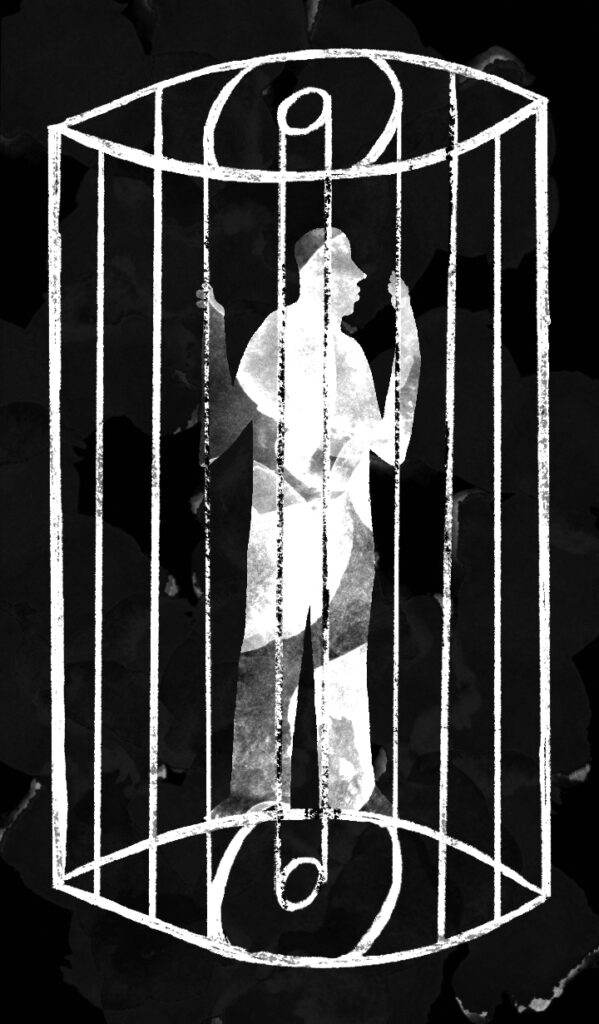
Perhaps the real danger isn’t the cage.
Natàlia Pàmies Lluís
In fact, there is no such thing as an irresistible craving, and no single reason why people develop harmful relationships with drugs. If we really want to understand addiction and help those who live with it, we must move beyond simplistic one-size-fits-all narratives that reduce the complexity of this issue to faulty neurological wiring. Pickard patiently walks through the many reasons someone might choose to use drugs —“despite evident and severe costs”— such as self-medication, emotional attachment, a sense of identity, denial, and impulse. There is also the hard truth that for a person without any firm “stake in conventional life,” using may be a better option than not using. Rather than imposing a universal model purporting to explain the true essence of addiction, Pickard’s careful “working explication” is heterogeneous, driven by as many explanations and causes as there are people.
What Would You Do Alone in a Cage with Nothing but Cocaine? teases apart what we mean when we say “for a person’s own good.” Who gets to decide what is good for another? Pickard challenges our assumptions about an individual’s external behaviour and encourages curiosity about their inner life, asking good-faith questions that lead to a mutually respectful conversation between equals. This is still a radical idea in a society that dismisses the agency and values of people who use drugs.
The stakes of this “rescue-blame trap” couldn’t be higher. If we ignore psychological nuance, we can justify harmful policies like incarceration and involuntary treatment under the benevolent guise of offering therapy for a brain disease. Pickard offers an alternative position of “responsibility without blame,” where the point of holding someone accountable for their actions isn’t to punish them but to identify how they can change and how we can support them.
This is much easier said than done — and easier to implement in interpersonal relationships than on a societal level. In egalitarian therapeutic communities like those in which Pickard has worked, people care about and want the best for one another, even when things go wrong. The same can’t be said for society at large, where most people want nothing to do with strangers in crisis. Would the imaginative exercise of placing yourself in a drug user’s shoes be enough to override a knee-jerk emotional reaction toward a dehumanized group? For all her focus on psychological contexts, Pickard seldom touches on the fact that stigma and systemic inequality produce conditions that foster addiction.
What would the “shared work” of repairing the damage done by addiction look like in a community that doesn’t see itself as responsible for all its members? “Insofar as we collectively tolerate social injustice, we are implicated in it,” Pickard warns. “Insofar as we are implicated in it, our collective standing to blame may be compromised, for our hands are far from clean.” Addressing our complicity would require the difficult task of starting to build a different world, one where everyone has access to safe housing, regular meals, secure work, and mental health care. Pickard doesn’t quite go there, but we can. Her model is ambitious, grounded, and rich in what our cultural conversations most sorely need to ensure that “drug use goes right”: nuance. It’s not a bad start.
Maria Cichosz teaches literature and creative writing at Victoria College in the University of Toronto.
Advertisement
Advertisement