
The act of walking has prompted numerous philosophical and literary reflections, from Jean-Jacques Rousseau’s solitary reveries and Henry David Thoreau’s spiritual and political considerations of peripatetic life to Teju Cole’s meandering novel Open City. If one is interested in the subject, one notices that many of its proponents are men. Notable exceptions exist, perhaps most famously in contemporary literature Rebecca Solnit’s Wanderlust, from 2000. The spirit of that book seems to linger throughout Women, Walking.
This robust collection is curated around a single notion: reflections on walking by women. It contains universes of discovery within that. Whether a hike, a stroll, a ramble, or an amble, in cities or in nature, with purpose or without, the editors Zahra Ebrahim and Jane Farrow assert, “There is deep significance to be found in an ordinary walk.”
The claim that this way of moving through the world is gendered has been debated — and is again questioned within these pages. Indeed, the editors cite the essayist Maria Popova, who once argued that walking is a “hallmark of our creaturely inheritance” and therefore not gendered. Even so, they have a “hunch” that women’s experiences of walking are vastly different than men’s. This remains a guiding question rather than a thesis. Each contribution, in some way, provides a possible answer.
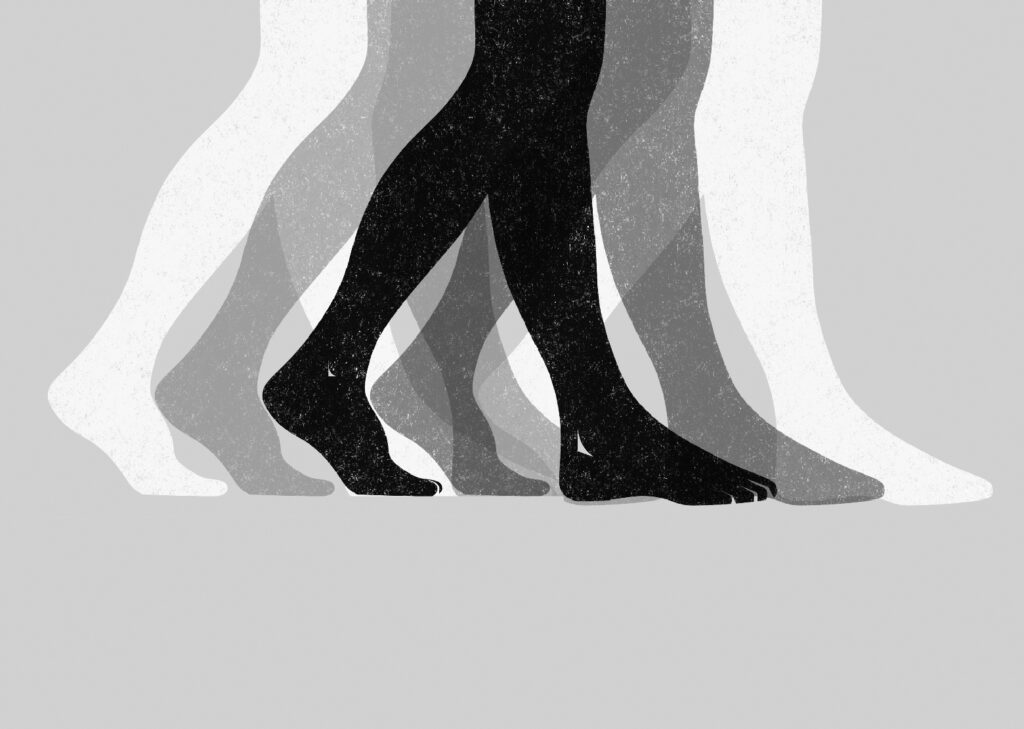
Their experiences are vastly different than men’s.
Diana Bolton
To say that the essays, illustrations, poems, and reflections here are rich in diversity is an understatement. As this volume bears witness to a variety of cultures, ages, and identities, we hear from those who are not writers by profession, including urban planners, educators, visual artists, and activists. At times, the vast assortment registers as inconsistent. In lieu of a strong theoretical or formal framework, the loose curatorial approach may leave some readers feeling adrift. In several essays, the aspect of walking itself is only tangentially related — or mentioned in passing. Even so, this limitation is offset by the zeal and sincerity of the selected works. After all, isn’t a tangent essential to the experience of strolling?
While the book does not announce its themes or try to organize them in any explicit way, the essays organically assemble several strong motifs. Writing about her medical journey, Simone Dalton views walking as an intentional way of letting the body carry her along, as it has carried her through the world thus far. The stroll as a metaphor for life’s pathways continues for Janika Oza, who explores how we turn to the image of walking to describe significant emotional or ideological shifts: walking away, walking beside, walking alone, walking back.
For most authors in the anthology, the embodied practice of putting one foot in front of the other is a way of bringing oneself into different forms of knowledge. As Jenny Odell notes in an interview with Ebrahim, “Walking is re-embodying at the same time that it’s dissolving you in a sort of congress of other bodies.” The YA author Louisa Onomé describes the effects on her muscles of traversing different landscapes, before turning her attention to gratitude. The “deep presence” that comes with each step, she writes, “has saved me from a lifetime of orbiting myself, orbiting my life, but never quite landing.”
In several entries, walking is presented as a method for recovery, both after physical injury and to heal spiritual wounds. A harrowing car accident inspired Pauline Craig to view the act as a way of binding traumatic time together: “To walk is to welcome my history and pull it into the present where it can become something new.” Ann-Marie MacDonald draws parallels between walking with her mother, who suffered from dementia, and her own prolonged illness: “If I extended even a little of the compassion toward myself that I had found so easily for my mother — if I could recognize myself in my illness — then slowly . . . slowly . . . more slowly even than I had walked when my mother could no longer keep up — I might be able to walk out of it.” The urban and cultural planner Sara Udow reflects on her Winnipeg childhood and the way that her mother passed on a ritual of an evening stroll, which began as “hobbling halfway up the block and back” after an injury. In many instances, the restorative aspect of walking is passed on intergenerationally, much like a cold remedy or a family recipe.
Many of these works affirm the idea that walking is political. A particularly compelling and beautifully composed essay about protesting is penned by “The Girl with the Voice” (it is unclear whether this pseudonym is a conceptual gesture or a safety concern — perhaps both). In just a few pages, she addresses the symbolic significance of marching for Palestine. “As bodies inherently remember, mine carries a lineage of walking: ancestors displaced and expelled, walking for days across borders that were drawn without them,” she writes. “For immigrants, walking is identity. For women, walking is inheritance. For Palestinians, walking is returning home.” With profound pieces like this and Catherine Hernandez’s illustrated thoughts on combatting the heaviness of this worldwide moment, the collection reminds us that even when a walk is not a march, any public act performed by a woman can be political.
At the intersection between deep wisdom and open curiosity, Women, Walking is a welcome addition to the canon of itinerant literature. In it, we find a new path trodden by the cadence of women who march to a beat of their own.
Bronwyn Averett is a writer and translator in Montreal. She holds a doctorate from Emory University in Atlanta.
Advertisement
Advertisement