
The hospital room was flattened by the dim overhead lighting and a lack of exterior windows, the way sad memories become flattened, like overexposed Polaroids thumbed over a thousand times. Bubba, a large woman for most of her life, had shrivelled, her failing body forced to survive without the machines that only minutes before had been keeping her alive.
She was my maternal grandmother, a quarter Cree, a quarter French, and the other half a smattering of European nations that no one had ever bothered to keep straight. My Auntie Nan, my wife, and I sat beside her as she died. We watched silently as her chest rose and fell at increasing intervals. At some point, when we were sure she was gone, her chest rose again.
“Is she dead?” Nan asked, a hint of gallows humour in the question.
Nan had a way of making even the worst things funny, a gift shared by most of our family. It was the propensity to laugh in the face of despair instead of succumbing to it. And there was something absurd about the confusion we all felt about Bubba’s movement. Was it a natural motion of death or her body’s final insistence on living?
A few days later, sitting in my mother’s living room, we revisited this scene. Then we started talking about the last year of Bubba’s life. She had opened up near the end, especially to my wife, and I’d seen and spoken to my grandmother more in that year than ever before.
She’d taken a liking to my wife’s warmth and gentleness, her ability to present herself as someone with an earnest ear. Bubba, though, was not a soft person. She was the product of a hard life. But something in my wife had disarmed her. Once, after she made Bubba a roast chicken dinner, my mother commented, diplomatically, on the saltiness of the meal. Bubba, who had been known to critique anyone’s cooking with real vigour, shouted, “There was nothing wrong with that chicken!”
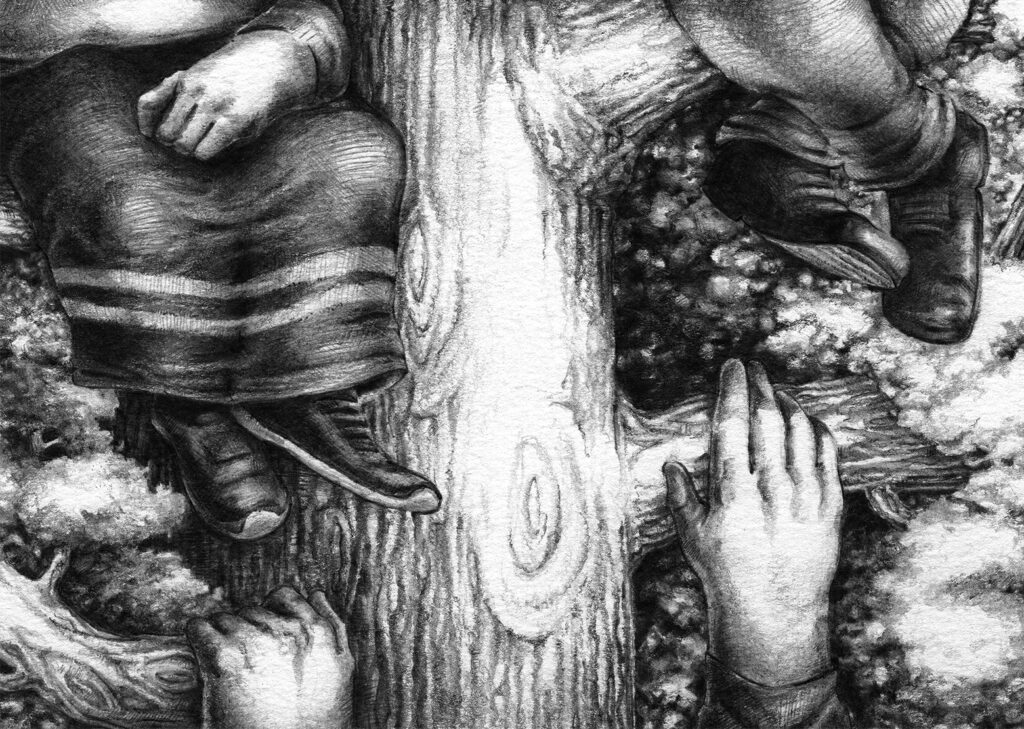
A family tree pieced together at last.
Scott Shields
In those last months, Bubba had also started talking about things she’d never revealed before. The Indigenous side of her heritage, for example, which she still referred to as “the savage part.” She also told us about how she and her sister, Jean, had been removed from their childhood home and placed in an orphanage. She said it plainly, as though it was little more than a footnote, with no particular invitation for us to respond.
That day in my mother’s living room, I brought up the orphanage story, hoping Nan would have details to add. She didn’t say much about that, but she did tell me that we were direct descendants of a prominent Métis politician named Charles Nolin, who was a first cousin of Louis Riel. He had been an important figure in the movement to recognize Métis rights. In fact, because of his opposition to taking up arms against the Canadian government, he went on to testify against Riel. Nolin’s testimony, by some accounts, contributed to Riel’s hanging. Then Nan mentioned his son, Adolphus Nolin, and another relative of ours, John Pritchard, both of whom protected a group of white women and Métis people during the Frog Lake Massacre of 1885. Adolphus’s daughter and John’s son married, and their child was Bubba’s mother, whom I knew as Grandma Pearce.
Later that day, I drove home in a stupor, my knuckles white from my grip on the steering wheel, trying to process what I had just heard.
I am thirty-eight, and for most of my life my family history was a mystery. On my mother’s side, these were just things we didn’t talk about: an omission so old and natural that it had calcified into fact. We were “part Native,” as it was referred to when I was a child, which became “Métis” somewhere in the early 2000s. But it was said inwardly, quietly.
When I was growing up, most of my friends were Asian. Among other childhood cruelties, I remember “Native” being used as a slur. Every time I heard it from peers, I saw the social danger in recognizing it in myself. So I learned to keep quiet, like the rest of my family. There was another reason I did not talk about my heritage. It wasn’t just the shame — though it was certainly that too. I didn’t care for the idea of being “Métis” in the same way I didn’t care for other labels that seemed to summarize humans into neat boxes. I didn’t want to be told what being a “Taurus” or an “introvert” meant, or, when it came down to it, what being “male” meant either. I wanted to be judged as me, not some preprinted personality that came with instructions. I wanted the freedom to be a loner one day and the life of the party the next. I believed, for most of my life, this was a principled position bred from an intellectual outlook about the complexity of humans. A desire for malleability and growth.
In retrospect, that’s not quite right. The reality is that I had reflected on what I knew of our history and concluded that I came from nothing. I pieced together, through the silence, that my family had decided not to talk about our history because, to put it bluntly, there was not much to say. We were nobodies. And that was that.
What I did know was this: I was born to a single mother on welfare. My father wasn’t in the picture. We lived with Nan for a while — also a single parent, also on welfare — then with my mom’s cousin, my Auntie Cathy. We moved when rents went up. We didn’t have a car. I played soccer because it was cheap and hockey was expensive. My mother became a Jehovah’s Witness for a few years, because she was looking, I think, for somewhere to belong.
Once, when we were kids, maybe nine and eleven years old, my older sister turned to me during an argument and said, “You’re so poor.” She said it like an insult, wielded at me specifically, without enough of an understanding of the world to know that she was too. We were, to use the phrase I’d always liked, mutts of many feathers. An unclaimed people. I had taken that lack of an identity and dressed it up as a philosophy.
So I grew up feeling undefined, and my resistance to labels probably came from the need for control: to have the freedom to break out of being a nobody and to become a somebody of my own choosing.
When I got home from my mother’s, the first thing I did was sit at my computer and search “Charles Nolin.” The top hit was a Wikipedia entry. I stopped, my mouse hovering over the link, shocked that he had his own page, however brief.
I wanted to know more, so I called my mom’s sister, another Cathy, and asked her to send me the family tree connecting me to him. I knew it existed because I had needed it to receive my status card a few years prior. She emailed me nine PDFs, which I printed in my office and began to arrange on the laminate floor. The chart was bigger than I’d expected. I had to move the desk chair out of the way as I bent over it, fitting the edges together, smoothing the tape flat, until the full tree was staring up at me.
When it was done, I crouched down and traced the line, from my name at the top, down through the generations, through Bubba, through Grandma Pearce, all the way to Charles Nolin.
As I looked down at it, my relationship changed with my history, with labels, with my understanding of who I was and where I came from. I just didn’t know yet what to do with it.
So I started reading. I learned that Nolin and Riel had been close: that Riel had stayed with Nolin when he visited, that they had worked together toward the same cause before their split. I read about the Frog Lake Massacre, eventually ordering Two Months in the Camp of Big Bear. First published in 1886, it is an account of the massacre by Theresa Gowanlock and Theresa Delaney, the two women Adolphus Nolin and John Pritchard had protected.
When it arrived, I sat in my reading chair, pen and highlighter in hand, excited to learn more. I read slowly, stopping to remind myself that the people in the book were real, and reading out loud to my wife whenever I got to a part that included Nolin or Pritchard. Theresa Delaney wrote of the latter:
He had only one horse and the Indians wanted two horses for me. As good luck would have it, he got Nolin — another half-breed — to give the second horse. It was all they had and yet they willingly parted with that all, to save me from inhuman treatment, and even worse than a hundred deaths.
My voice broke, and I coughed to gather myself and continue. “I fully trusted to Pritchard’s manliness and good character, and I was not deceived. He . . . stands, ever since, in my estimation the type of God’s noblest creatures — A TRULY GOOD MAN.”
It was unfamiliar territory. Reading those sentences, I no longer felt like a nobody. I found, in my ancestry, somewhere deep within the past, something to be proud of. A label I wanted to wear. A team I wanted to be a part of. There was relief in discovering that we had not, in fact, come from nothing. The label I had always resisted suddenly felt different. We, my family, were more than nothing. At one point, we had mattered. There was something uncomfortable in it, too. Something self-serving about the sudden pride I felt. Something unearned. I had done nothing. I had chosen nothing. I simply shared their blood. Existed by chance.
I also didn’t know what to do next. “Métis” felt different to me now — heavier but also more honest, as if it had acquired mass. When I was a kid, people would ask me, “What are you?” because of the olive skin, the dark hair, the not quite white of my face. My Arab friends thought I might be from their region. When I visited Spain and Italy and France, locals spoke to me in their languages first, mistaking me for one of their own. This used to suit me. But now it feels wrong.
I once liked being able to blend in anywhere. I could walk into any crowd and let people read me the way they wanted. I could choose, that day, whether their reading was correct. I liked belonging everywhere, to no one permanently, and changing from one moment to the next what I was and what I wasn’t. I leaned into the ambiguity and built an identity on my refusal to have one.
I was able to do that only because I was passing. My mother is blond-haired, blue-eyed, and pale-skinned. I am not, but being perceived as Métis was always optional for me. I could have gone my entire life never claiming it. I had the choice to sidestep my history when it was inconvenient, to pick it up only when it seemed worth carrying. When I look at pictures of John Pritchard or Charles Nolin, I realize it was a privilege that they didn’t have.
I still don’t know exactly what it means to be Métis. I’m not sure I’m the right person to ask. I know what it meant — or didn’t mean — to Bubba. I know what it meant to the family, broadly: something to be held at a distance, not denied, not claimed, just kept at the edge. And I know what it means now to the people working to reclaim that history.
What I keep coming back to is what it feels like to discover that the identity was already there. That it didn’t need me to acknowledge it. That I was not, as I had always quietly believed, unmoored, free-floating, self-made, or unattached. The line was already drawn. I just hadn’t looked at it.
The pages are taped to the wall in my office. Some of the tape is already starting to curl at the corners, pulling gently away from the wall. I press it back down when I notice. But it always starts to lift again.
My name is at the top. Charles Nolin is at the bottom. The line runs between them and through the names of people I will never know, through many different versions of the country, through a history I spent most of my life not thinking about.
It doesn’t ask anything of me. It was there before I looked. It will be there whether I keep looking or not.
Even now, when I try to hold the fact of it — really hold it — it verges on fiction. It feels like someone else’s story with my name written in at the end. But that’s my name. And I’ll keep pressing the tape down until it holds.
Ian Canon is a Métis novelist, poet, and book reviewer from Edmonton.
Advertisement
Advertisement