
At the heart of any love story worthy of the name is a mystery. This mystery — unlike the crime-fuelled ones found regularly between book covers — is shared by authors, readers, and characters alike. It has been with us for millennia and will, with any luck, be with us for at least a little while longer. While innumerable explanations have been offered over the years, none is altogether complete, persuasive, or satisfying. Perhaps the most compelling and frustrating part of the mystery is that encountering it — whether in life or in art — is both inordinately rare and excessively common.
The mystery consists of a series of questions that are simple to pose but impossible to answer: What, why, how, and to what end is love? In Colin McAdam’s Daphnis and Chloe, even Love personified, the novel’s narrator, can’t quite solve it.
Daphnis and Chloe is a modern retelling of Longus’s second-century Greek pastoral by the same name as well as a delicate exploration of why love stories must be told and retold. Set on an island city somewhere off the coast of Canada that is dreamily mythical and nightmarishly real, the book limns the lives of two abandoned children, Daphnis and Chloe. Separately, they are taken in by two couples who happen to be old friends: the former by Frank and Lina and the latter by Charlie and Sue. The foundlings are something like an answered prayer, as neither couple could conceive. They are raised alongside each other and, in time, begin to work in the garage that Frank and Charlie own.
As a teenager, Chloe comes to notice inchoate feelings about Daphnis. She does not put words to them but instead tries to fashion his likeness on paper. She finds herself “trying to draw but finishing nothing.” In the broken-down van where she was discovered as a baby, she produces drawing after drawing, every one of them “a partial sketch of Daphnis.” Art provides, as Love explains, “the same combination of understanding and wonder” as love itself. Chloe’s sketches go unseen and her feelings for Daphnis grow.
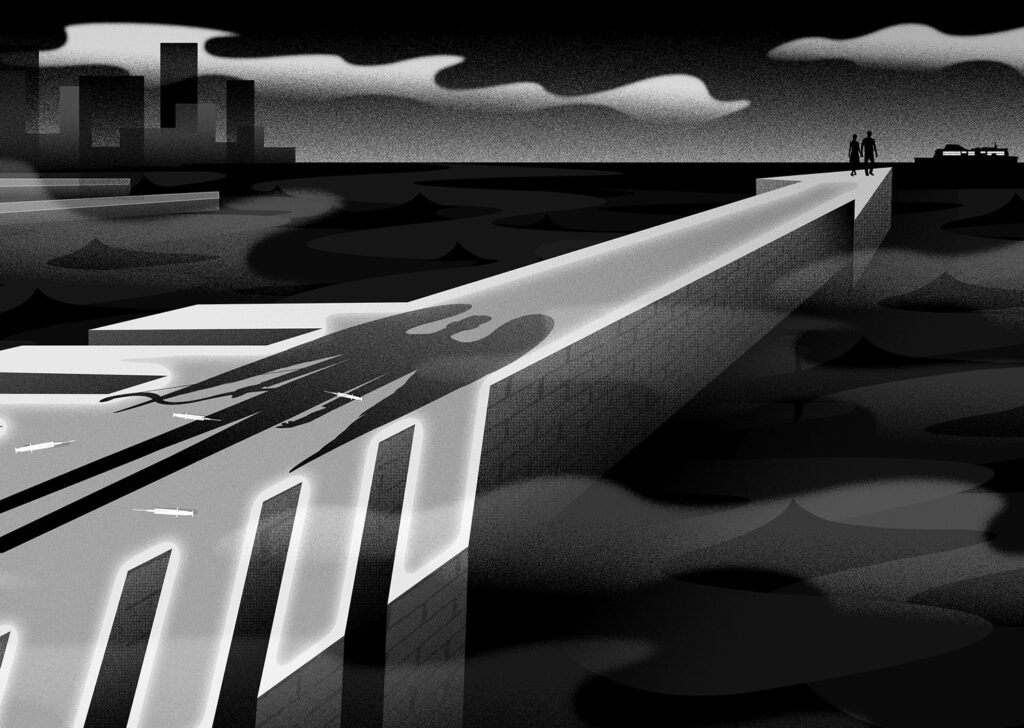
Struck by Cupid’s arrow and by the realities of an island city’s violent underbelly.
Neil Webb
One night, Shane Dorcon, a mechanic who is infatuated with Chloe, invites the young not-yet-lovers out to a dive bar. Witnessing Shane trying to impress Chloe, Daphnis recognizes something in himself. He feels “some kind of energy rising.” When she looks at him from across a dirty table, Daphnis knows he “loved her eyes that stared at him.”
Shane proposes a drinking contest in the hope of winning Chloe’s affection, but it doesn’t go to plan. Even though Daphnis loses, Chloe leans over and kisses “those lips she had dreamt of.” In this simple, impulsive, and irresistible act, “Daphnis awakened, transformed, and left a boy behind who had never seen how richly soaked the reds and pinks of this world could be.” From this moment on, the pair are “taken” with and by each other. Each is all the other thinks about. It is a brute and unexplainable fact. “They were never happy unless they were looking at each other.” They are in love.
Of course, the course of true love never does run smooth. Daphnis and Chloe are quickly driven apart by the moral failures of others and the general social decline of their island home. Frank gambles himself into debt with Coyote, the head of a gang called the Jokers. Daphnis attempts to help his father by running drugs. After an attempt to defend Chloe’s honour, he ends up even more entrenched in the criminal underworld. Shane, driven by possessive and rapacious so‑called love, attacks Chloe and, believing he has killed her, seeks Coyote’s help to dispose of the body. Chloe survives but gets introduced to opiates and is forced into sex work. Both caught up in the city’s ugly underbelly, Chloe and Daphnis lose each other. They live through separate hells not of their own creation and eventually recognize that “they are alone, that their works and sadness are of equal inconsequence.” While flirting with nihilism in the depths of despair — their days replete with unwanted sex, unsatisfying drugs, and untold violence — they still manage to hold on at least to the idea of the other and the sense that their separation may not be permanent. The lovers eventually reunite, get revenge, and live — perhaps happily (if “happily” can apply after so many harrowing events) ever after.
Daphnis and Chloe is a love story shot through with ugliness. It is both lean and digressive, pulpy and poetic. There is an elliptical and mythical quality to McAdam’s book, as if Raymond Carver and Anne Carson were goading him to write each sentence as beautifully and brutally as possible. While the novel sometimes crosses into tawdry or sentimental territory, McAdam has nonetheless crafted a narrative that exceeds the sum of its parts. Like countless stories before it, his tale tries to answer that stupid and beautiful question: What is love? In this telling, it is an act of faith. It is a belief that everything can be fixed without any promise or guarantee that anything will be fixed. It is a stubborn commitment to a future that persists amid hopelessness. Daphnis and Chloe will certainly not be the last book about the tragedies and triumphs of lovers — but all the better. As someone once wrote long ago and someone will no doubt rewrite far from now, love might simply entail forever “telling what is told.” As unsolved mysteries go, it’s a pretty good one.
John Casey is a writer and photographer from Montreal, now living in Toronto.
Advertisement

Advertisement