
Wayne Grady makes no bones about his literary inheritance. Each of the eight “cover stories” in The Cartel reconceives a canonical work in a more or less contemporary vein. Appended to every adaptation is a brief essay in which Grady dutifully acknowledges his source material, supplying readers with insights into his artistic aims.
Certainly the short story lends itself well to interpretive manipulation. Swap a setting, compress an ending, reorient a quarrel from an undersung point of view: et voilà! Grady isn’t the first to rejig a Nikolai Gogol. What sets this collection apart is its generous versatility, the cumulative fusion of fiction and gloss.
“La Gordita,” the first and longest entry, recasts Guy de Maupassant’s “Boule de Suif” in Mexico. As drug cartels descend upon the city of Colima, six American and British expats charter a private bus to Manzanillo, where they plan to fly back to the United States. Accompanying them are two Canadian missionaries, a drifter named Houseman, and La Gordita, a self-employed beautician, who the expats assume is a sex worker. The evacuation doesn’t go as planned. The travellers are detained by members of the Caballeros Templarios cartel in Minatitlán, and their release is made contingent on La Gordita’s agreeing to sleep with the subcomandante. As Elisabeth Rousset does in “Boule de Suif,” La Gordita deliberates and eventually assents, exposing her party for the band of pampered hypocrites that they are: “No one speaks to her. No one even looks her way.” Grady does a fine job of mimicking the reportorial buoyancy of de Maupassant’s objective style. The use of present tense — de Maupassant favoured the passé simple — allows him to float nimbly from one bundle of characters to the next. “Bob and Christine Lethworth talk quietly to each other; only the occasional word is audible to the others: ‘airport security,’ ‘presents,’ ‘limousine,’ ” Grady writes. “The two missionaries study the prospectus for the orphanage they’re going to work in in Manzanillo.”
Sing along if you know the words.
Scot Ritchie
Subsequent stories adopt a similar rhythm. Characters and settings shift, while the styles generally preserve a tonal fidelity to their precursors. An adaptation of Isak Dinesen’s “The Ring” places the action in Windsor, Ontario, in 1946. Like the Danish countryside of the original, the border city reveals itself to the main character, Vivian, the daughter of “a wealthy Newfoundland trading family,” with incremental lushness: “The tops of the train tracks were shiny with use, two smooth ribbons of light against the dark-red cinders that had been spread between the ties by workers she didn’t know.” In “It Happens Every Day,” Grady assumes the “deadpan manner,” chaotic logic, and one-letter names of Franz Kafka’s “A Common Confusion.” Lengthier sentences enlist a Germanic pattern, delaying the final verb amid a phalanx of subordinate clauses.
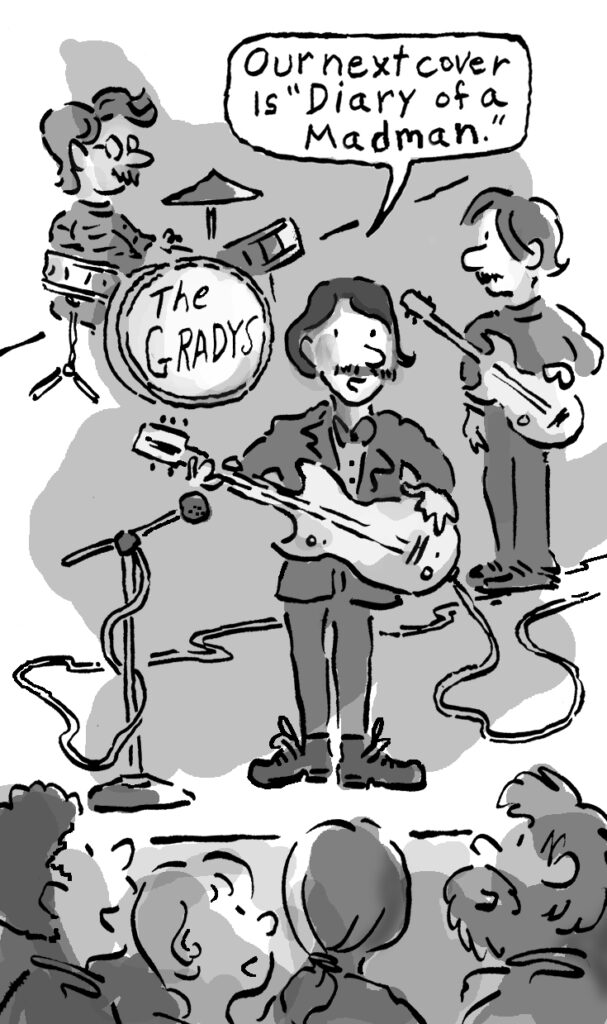
Grady’s rendition of “Diary of a Madman” retains Gogol’s frame (and talking dogs) but shifts the point of view from a clerk to a conspiracy theorist. “I spend a lot of time on the internet,” he says. “I think you can learn more on the internet than you can from books, because it’s so much faster and people don’t worry too much about fancy writing.” As the madman’s grip on reality unspools, so do Grady’s sentences: “Dear Belinda. No, Dearest Belinda. No, Our dearest darling Belinda. It is with deep, no, profound, dismay no regret no sadness that we write are writing this email to tell inform you that we must break off no end our engagement.” The assertive, self-correcting style resembles Gogol, but the wonderfully disintegrating syntax is Grady’s own.
That the cover stories succeed owes a great deal to their formal control. Reading “The Woman with the Dog,” “The Cartel,” “The Question,” and “Ministry to the Dying”— faithful reworkings of Anton Chekhov, Joseph Roth, Günter Grass, and Lydia Davis, respectively — I was struck less by their distinctive allegiances than by their commonalities. Each piece features a writer or academic protagonist, and Grady leans into their explicit literariness, occasionally brushing up against his own biography. “I told Michael that I had begun collecting words and phrases associated with the pandemic,” the narrator of “Ministry to the Dying” admits. Grady published Pandexicon: How the Language of the Pandemic Defined Our New Cultural Reality in 2023.
In his acknowledgements, Grady credits A Swim in a Pond in the Rain, by George Saunders, for proving “that it was possible to combine fiction and essays in one book.” The two collections share an approachable tone, but this project is less overtly didactic than Saunders’s anthology, and the essays here are at their best when they veer off script. We learn that de Maupassant, who “hated the Eiffel Tower,” still liked to eat “his midday meal in a restaurant at its base” and that the Canadian novelist Matt Cohen had hoped to write a biography of Roth.
At times, readers familiar with these writers might find themselves itching for a little more embellishment and nuance. In his discussion of Kafka, Grady writes that Gregor Samsa “never once wonders what had happened to him or even why.” I take his point — and agree that Gregor “is not an existential insect”— but this statement isn’t wholly accurate. After all, the first sentence of the second paragraph of “The Metamorphosis” is “ ‘What in the world has happened to me?’ he thought.”
Collisions of literary and biographical detail offer scintillating hints of the artistic crucible out of which many of these retellings evolved. “I was also struck by the way Dinesen’s story intersects with my own life,” Grady writes. “Like Dinesen’s Lovisa, my mother lost her ring in the first year of her marriage.” Near the end of his essay on Davis’s “Glenn Gould,” Grady describes the moment at which his own narrative took hold:
I was about two-thirds of the way through Davis’s story, at the point where her narrator walks past “the Reformed Church and Pastor Elaine’s house.” This image so forcefully recalled to me the circumstances surrounding my mother’s death that I had to sit back and take a few deep breaths. Then I closed the book and began to write.
I suspect this is what Ralph Waldo Emerson meant when he wrote, “One must be an inventor to read well.”
Rod Moody-Corbett wrote the novel Hides and the forthcoming collection Malady Head.
Advertisement

Advertisement