
In the opening pages of her latest novel, Michelle Porter introduces readers to one of the main characters, a glacier. “A glacier’s a restless thing,” warns Doug, the uncle of Robbie, a young Métis man on a quest to find his father, who has disappeared on the ice. “Time moves differently when you’re out on a glacier,” the mountaineer explains to his nephew. “It’s possible for thousands of years of change to crack up in the ice in a sudden moment. Your father used to say the glacier’s cracks let the past catch up with the future.” With A Glacier’s Guide to Dying, Porter gives an inner life to the frozen formation, revealing its fluid, shifting nature. In doing so, she opens the door to another world, one in which Western notions of time collapse.
Like the “sparkling plumbing” and “icy tunnels” from which centuries-old material may suddenly emerge, the novel is structured around a series of flashbacks that surface throughout Robbie’s search. The story — which spans a summer of record-breaking temperatures — begins as Robbie is tasked with evacuating his stubborn mother from her home in northern Alberta. Even though she claims “she’d go if the fire came too close or if a spark caught in the clusters of birch and pine,” Robbie knows she isn’t “going to leave on her own.” The extreme weather triggers memories of his father, Mike, whose rare visits he associated with tornadoes, thunderstorms, and winter winds. Mike had schizophrenia, and these brief encounters were visceral and highly charged. Robbie recalls feeling “fear and fascination twist together” the first time Mike showed up. While his father always represented the volatility of the natural world, Robbie also compares him to a superhero. “I could see he lived on the edge of everything,” he admits, “that he could have walked out of my favourite Saturday morning cartoon where good guys and bad guys battled over the fate of the entire universe.” This childhood admiration for the lone, troubled adventurer is tempered by his fear of inheriting his missing parent’s psychotic disorder. Robbie has Mike’s heterochromatic eyes — one green and one blue — and worries “that instead of giving me powers, having the same eyes meant I’d grow up to be like him.”
Porter is careful not to dismiss Mike outright, despite some of his more cliché paranoid delusions. Robbie thinks with fondness how his father would take him out sledding and instruct him to place his ear against the ice to “listen to what it says.” He asked his son to consider the possibility that there’s more “to everything” and that “so many things have been kept hidden.” These tender insights could be read as the advice of a parent or the anxious thoughts of someone caught in the grip of mental illness — or both. Without treading into questions of pathology, the novel suggests that Mike’s dysfunction stems from the overwhelm that comes with his heightened perception. “He could see too much of the world at once,” explains Robbie’s mother. “When you see too much, I think it’s hard to put everything in order. You can’t put what you see into a story the way people need you to, and that can break your mind in two.” Later, Doug reveals that Mike — his brother — was once a knowledgeable tour guide of the Montana glacier where he went missing and “could see what was happening to the ice beneath the surface,” as if he possessed a greater capacity to understand the natural world.
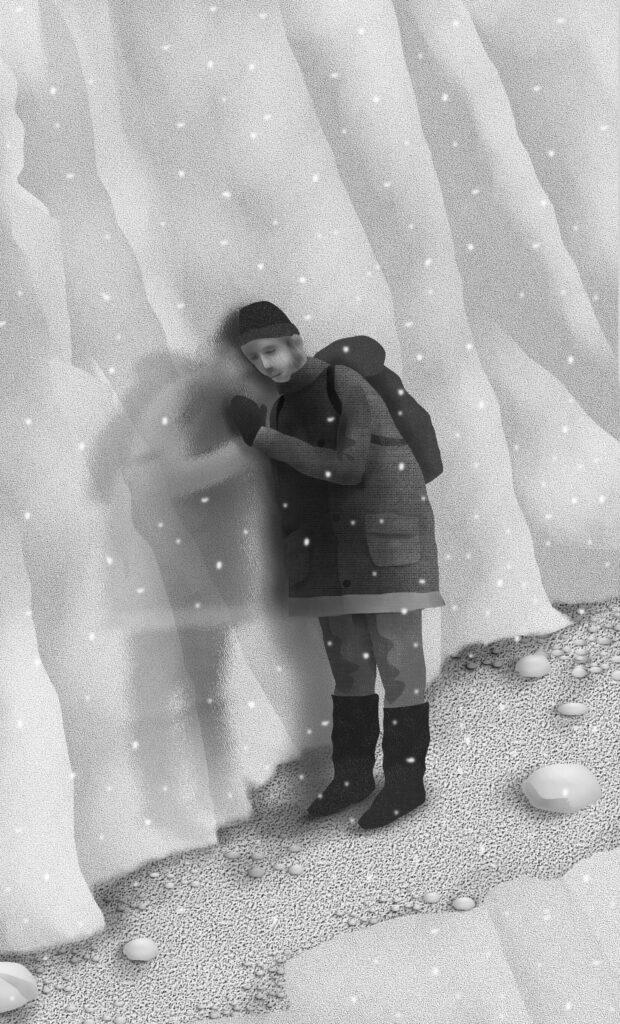
Hearing what the ice has to say.
Dave Cutler
The question of how Robbie is to make sense of things — including the abuse he and his mother have suffered at the hands of his stepfather, Ray, and the hallucinations he tries so hard to ignore — drives the tale. After fleeing with his mother (and leaving Ray in the wildfire’s path), Robbie turns to his old coping mechanisms of avoidance and listening to heavy metal. Even though parts of him are “tangled up” with his stepfather, he decides he doesn’t “have to feel anything if I didn’t want to.” This strategy proves ineffective. He is haunted by Ray’s half-dead body as he travels south to Montana and out onto the glacier where his father disappeared. “I closed my eyes but when I opened them he was still there,” says Robbie. “The flesh still on his face was charred and covered in oozing blisters.” Robbie also sees mythical figures straight out of his mother’s stories. After meeting Doug and his other paternal relatives for the first time, Robbie is drawn back to when Ray beat him for playing the fiddle, which Ray conflated with being “a fairy.” While running away, Robbie was scooped up by a giant who asked him who he was and mocked his uncertain responses. He was let go only after telling the creature that he was Métis and “a descendant of the Genthon family,” who are known for their fiddling skills (and from which Porter herself descends).
Whether folkloric in origin or born of traumatic experiences, Robbie’s visions force him to confront his relationships and come to terms with his grief. At the end of a series of fantastical obstacles, he is left alone in the snow, cradling the body of his father. As he begins the process of setting his parent’s spirit free, which he learned from his mother, Ray appears to him as a taunting crow. “I wanted to show him I was stronger than he was,” Robbie thinks, and feels the urge to “beat him to a fucking pulp for one final time.” Instead, he recognizes that it’s his responsibility to release Ray’s spirit too. Another trickster figure, the glacier, who has been “texting” Robbie in a dialect of ones, zeroes, and moans, decides to prove a point about death. At odds with the environmental activists, the glacier insists:
i’m not dead but, okay, about to die maybe
i don’t think the word die translates properly
transforming or metamorphosing are better words
because here i am i’m definitely Still Alive.
The glacier cracks open, revealing a cave from which a herd of buffalo emerges —“a roaring, musky, river of them.” Robbie watches an outpour of “all the dead calves” that, as the glacier describes, “crowd around the dead elders, calling for the story to begin.” This staggering image of life and death flowing together is the culmination of Porter’s interest in what we can learn in the in‑between. Like that of a melting glacier, our survival depends upon our ability to adapt “as we all wait, for the world that’s on the way.”
Sophia Ohler reads and writes in Vancouver. She asks that you please give her a job.
Advertisement

Advertisement