
The American writer William H. Gass once described autobiography as the “vulgar copulation” of history and fiction. Whether he overstated his case or not, there is little doubt that the genre sometimes gets things wrong. Witness Alice Sebold’s Lucky, which sent an innocent man to prison for sixteen years after its publication in 1999, and James Frey’s cancellation over his treatment of “the facts” in A Million Little Pieces, from 2003. Even Frank McCourt, whose 1996 tell‑all, Angela’s Ashes, rocked the publishing world, came under scrutiny when some, including his mother, Angela, called him out for exaggerating his family’s poverty.
Now the memoir market is said to be saturated, and what was once a tsunami of titles is slowing to a trickle. Data from Publishers Marketplace, which covers the United States, United Kingdom, and Canada, shows that while book deals for fiction in the year leading up to November 2024 stood at 1,828, deals for memoir were a paltry 267. That represents a marked decline in the form since 2021.
So are the days of Wild and Educated over? Will readers no longer be expected to distinguish “my truth” from “the truth”? I, for one, hope so. There is something undeniably creepy and voyeuristic about our collective desire to be entertained by the often sordid details of other people’s lives. Considering the plethora of recently released titles in Canada, however, it seems that reports of the genre’s demise, in this country at least, may be greatly exaggerated. New memoirs include Scott Oake’s For the Love of a Son, Haley Mlotek’s No Fault, Cathrin Bradbury’s This Way Up, and Vinh Nguyen’s The Migrant Rain Falls in Reverse. Sarah Polley’s Run Towards the Danger and Ian Brown’s Sixty have enjoyed robust sales in recent years, so much so that Brown has written a sequel, Seventy, due out a year from now.
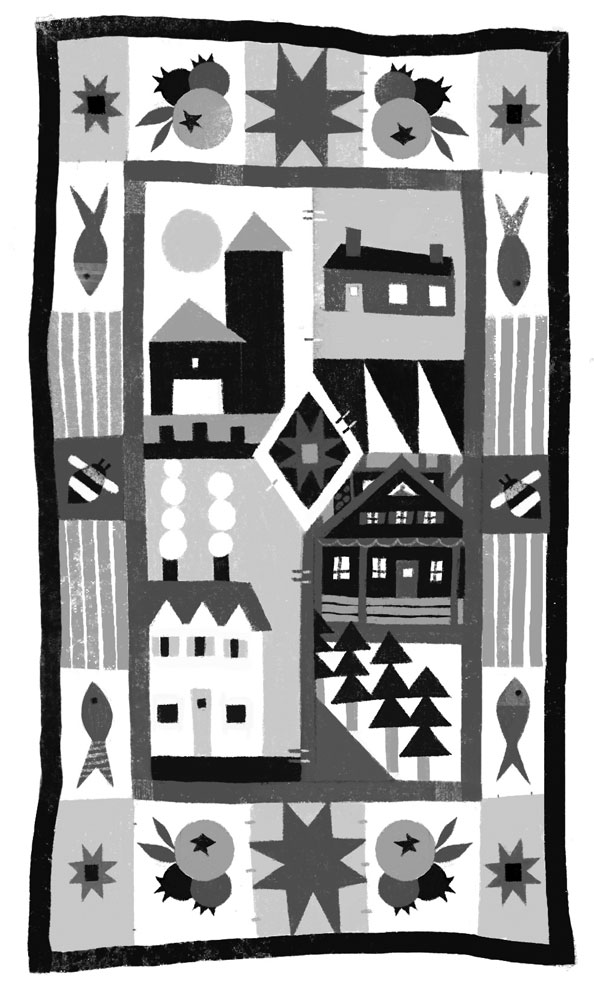
Stitching together the layers of a life story.
Sarah Farquhar
Of course, many memoirs are full of sensitivity and insight, and I’m sure that includes all of the above although I haven’t read any of them. Most are written in response to a deep need that humans, and writers especially, have to tell our stories, even if they may not be of interest (and, sadly, often are not) to anyone else. Despite my ambivalence, or perhaps because of it, I agreed to review a memoir for this magazine. The book in question, unlike the aforementioned titles, is not by a celebrated author or well-connected journalist. Nor is it published by one of the so‑called Big Five. Rosalie I. Tennison, the author of Naomi’s Houses, works in communications for the Faculty of Agriculture and Food Sciences at the University of Manitoba. Her account of growing up poor in northern Manitoba is published by an independent press based in British Columbia that is “committed to amplifying the stories and voices of the extraordinary people who have helped shape the diverse cultural landscape of Western Canada.”
In a field that elevates the jottings of mostly accomplished or famous people, Naomi’s Houses stands out for its lack of pretension and for the very ordinariness of the author’s memories, despite her family’s poverty: Grandma’s shell collection, blueberry picking, jellied salads, mail-order catalogues, hand-me-down dresses, and on and on. Tennison tells her story in straightforward, unadorned prose, with diction that is sometimes as flat as the prairies where she came of age and sometimes equally unexciting. It is, nevertheless, a detailed first-person account of what hardscrabble farm and small-town life was like in the 1960s and ’70s, and for that alone it’s surely worth preserving.
On the popular Brevity Blog —“essays exploring craft and the writing life”— Allison K. Williams, an author, editor, and writing coach, and Jane Friedman, the author of The Business of Being a Writer, suggest one of the reasons memoirs are becoming a harder sell. “At this particular moment in time,” Friedman points out, “where I see more writers than ever writing about trauma, especially from childhood, the story lines can unfortunately start to look the same.”
While Naomi’s Houses is not, strictly speaking, a trauma memoir, there’s no doubt Tennison experienced real hardship growing up, especially considering the affluence and conveniences most of us take for granted today. For much of her childhood, she lived without indoor plumbing, refrigeration, central heating, a telephone, or a functioning car. Still, Tennison’s reminiscences are bathed in the sepia tones of nostalgia that tend to colour our memories, whether we grew up poor or not. Above all, the book is a biography of and an apology to the author’s mother, Naomi, delineated through the inadequate houses she struggled to make into homes for her children. The first of these, which Tennison calls the farmhouse, is where she and her two older siblings, Edward and Lynette, were born.
Situated about 500 kilometres northwest of Winnipeg, near the village of Bowsman, the farmhouse was built by Tennison’s father. Because she was very young, her memories of her first home are fleeting: frost on the inside of the windows, the smell of bread baking in the wood stove. “Though it was the most basic of shelters and remained largely unfinished,” she writes, “the structure he built became a home filled with love.”
But life was hard, the winters cold, the soil grudging, the neighbours nosy. Water had to be hauled in ten-gallon milk cans from another farm a mile away; transportation was a team of horses or a 1930 Plymouth. A fourth child, a baby brother, died in infancy. But “Mum” carried on making do, mending and sewing, saving scraps of old clothing for quilts, “kneading bread, whipping cream, mixing and decorating cakes and cookies, and preparing vegetables and meat for canning.” She iced the birthday cakes to become sailboats and elephants and rabbits. Daddy was up at dawn to stoke the fires and to feed and milk the cows. Baths were taken in a galvanized tub, and pyjamas warmed by the wood stove. “Looking back, I marvel at how protected and loved we were,” Tennison writes.
Then, when she was six, her beloved father died suddenly — of an ulcer. “No one dies of an ulcer,” numerous doctors have told her since then. “But my father did,” she has always maintained. If things were bad up to this point, they became infinitely worse. Naomi, overcome with grief and fears for the future, allowed her overbearing father to oversee the sale of the farm and “bully” her into buying a house in Swan River. Tennison unapologetically refers to it as the Hovel. The tiny two-bedroom house built in the 1930s was a wreck, lacking an adequate kitchen. The family had electricity now, but the wiring was dangerously faulty, with few outlets. Tennison slept with her mother in one bedroom, her brother in the other, and her sister on the living-room couch. Tennison finally got her own room after Edward and Lynette moved away. Although Naomi had “secretarial skills,” she was unable to find an office job: “For someone so shy, I imagine Mum ‘didn’t interview well,’ as we would say today.” Naomi and her young daughter subsisted on government welfare and the meagre earnings gleaned from decorating cakes and cleaning the Anglican church. Shame and resentment, the evil twins of poverty, did not spare Tennison. Why, she wondered, did no one help them out? She describes her mother as “demoralized” and “always aware of her inadequacies,” but she tries to put a positive spin on this too: “Indirectly, she taught me self-sufficiency because I saw that no one else was stepping up to assist us and soon developed a ‘no fear’ attitude when it came to banging together a shelf or mastering complex sewing or knitting patterns.”
Over the years, brief respite from the grind of doing without was provided by a third house. Wildwood, which belonged to Naomi’s parents, “stood elegantly on a slight rise surrounded by a manicured lawn.” It was an oasis of plenty throughout the author’s childhood. She compares her memories of visits there to memories of Rosebud in Citizen Kane: “The word Wildwood has me thinking of laughter and happy times.” Tennison recalls picking berries and seeing relatives smoking fish, making jam, and quilting — and, of course, she remembers television. When visiting Wildwood, she was able to watch The Ed Sullivan Show, Hazel, The Beverly Hillbillies, and, when she was five, the funeral of John F. Kennedy. These sojourns were nevertheless overshadowed by the knowledge that a return to the cold and cramped miseries of the Hovel was inevitable.
The fourth house figured only briefly in Tennison’s life. “The Haunted Acres,” she writes, “is a mere blip in my memory of the houses I inhabited.” Now seventeen, she had begun to resent the limitations of poverty and her mother’s passivity. But the biggest upheaval was Naomi’s remarriage that summer, which must have been a severe blow to a teenager who was used to having her mother all to herself. The Haunted Acres was a palace compared with their earlier homes. It had every modern convenience, and the marriage got Naomi off welfare. But her unnamed new husband turned out to be controlling and abusive, and the marital home turned into a prison for Naomi. Tennison soon escaped, moving to Ontario to attend university. Fortunately, Naomi had refused to sell the Hovel, and it was there she fled to when her marriage disintegrated completely.
It was a brief hiatus, however: her father soon insisted that Naomi move to Wildwood to care for her mother, who had dementia, and a brother with cancer. Tennison expresses anger that her “kind, sweet mother could be so ill-used throughout her life,” while also admiring her “sturdy commitment to never complain.” When her mother and brother died, Naomi returned once more to the Hovel, “the house she always hated.” An old-age pension, when she turned sixty-five, provided more money than she’d ever had, and for a short period it enabled her to travel to the East Coast and the southern U.S. After dementia came for her and her children moved her to a comfortable apartment in a seniors’ residence, Naomi “walked back to that house almost every day to sit in the cold and dark.”
It is, frankly, a sad ending to a sad life, and Tennison’s regret at not being there to help her mother in her final difficult years feels like the impetus behind this memoir: “I no longer lived in Swan River and was shamefully oblivious to Mum’s plight through the five or so years while her marriage unravelled and her older brother and mother declined.”
Tennison had the decency to wait until her mother was dead before she publicly unpacked the trials and the humiliations that come with being poor. When we lose someone, it is only human to wish we’d expressed our love and regret while they were still alive. Naomi will never read her daughter’s tribute, though I wonder what she would think if she could. Would someone so shy and stoic object to having her sometimes humiliating circumstances laid bare for anyone to see? Would she bridle at the portrait her daughter has painted of a passive, timid woman beset by an uncaring world?
Memoir writers are ethically bound to be as exact and as true to others’ experience as they are to their own. But how is this even possible? Given Naomi’s natural reticence, we will never fully know what she thought or felt, and that, perhaps, is the saddest part of the story.
Cecily Ross is an editor, novelist, and poet in Creemore, Ontario.
Advertisement

Advertisement