
The epigraph of this book states its thesis. “In fact,” the great photographer Edward Steichen wrote in 1903, “every photograph is a fake from start to finish.” Carla-Jean Stokes’s study of the First World War photographs of William Ivor Castle largely proves the point.
Born in 1877 in Bristol, England, Castle had his first photograph published in the Illustrated London News in 1897. His career took off, and in 1904 he was hired by the Daily Mirror. From there, he travelled extensively, and his photos were often on the front pages, not least during the Balkan Wars of 1912–13. The outbreak of war with Germany in August 1914 saw Castle covering the invasion of Belgium, but British censors tried to stop pictures that showed the fighting. The public wanted to see what was happening, however, and soon official photographers were authorized so long as their work was subject to censorship.
In charge of Canadian publicity in Britain was the member of Parliament Max Aitken, who was born in New Brunswick and would become Lord Beaverbrook. Appointed by Ottawa to head the Canadian War Records Office, Aitken hired an official photographer in 1916, but ill health forced the man to resign within a few months. Castle took that photographer’s place.
Quickly Castle was in France, where he made his name with a series of images that showed Canadian soldiers going “over the top” into action at Courcelette on the Somme. Or so they were presented to the press in England, Canada, the United States, and elsewhere. In fact, the scenes were staged well behind the lines with troops in training, and touch‑ups had been done on the weapons. Even more shameless was the claim that to get the shots, Castle had come under enemy fire, particularly in one taken from in front of the charging soldiers, some of whom, the story went, were almost immediately killed. Did Aitken know of this compounded fakery? Probably. Indeed, he likely encouraged it since it created enormous publicity for the Canadians, which was, after all, the CWRO’s task.
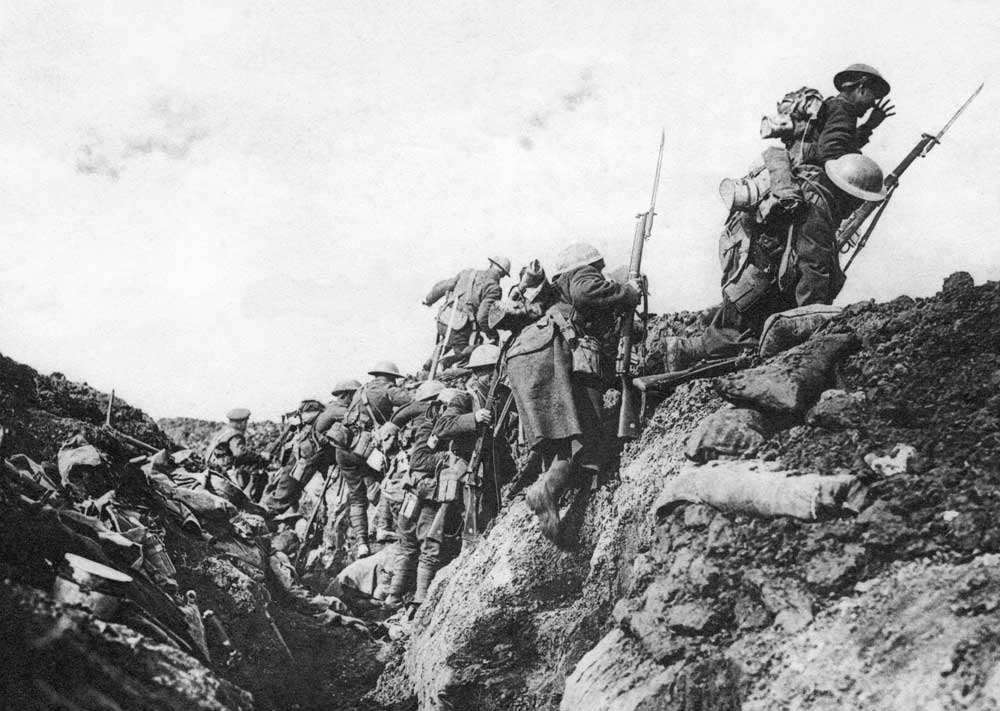
Is the soldier at the top thumbing his nose at the camera in this October 1916 photograph?
Seaforth Highlanders of Canada Museum & Archives; Courtesy Wilfrid Laurier University Press
Castle’s staged photographs were good, arguably some of the finest he ever took. They looked real, and they showed the troops at their best. Yet in one of them, a soldier seems to be thumbing his nose, perhaps a gesture of scorn for Castle. No one pointed that out for some time, however, and the way the composition had been staged remained unknown in detail until the 1990s.
Then came the battle of Vimy Ridge, in April 1917. The intrepid photographer took some 150 photos, many showing preparations, Canadian wounded, artillery, and German prisoners. Forty-nine of these pictures were sold to and published in the British press between April 16 and April 28, the fees going to the CWRO. Even more famous, however, were Castle’s photos of the Canadian advance on April 9, when, as he falsely claimed, he was with the first wave. He pictured advancing troops moving through enemy wire entanglements, surrendering prisoners, and shells exploding. All this was real enough, though not quite when he took the photos.
What came next was different yet again. Vimy was a great battlefield success, and the CWRO took advantage of the victory to stage a large exhibition of Castle’s work in London. The centrepiece was a wall-size version of Castle’s shot of the advance with added details from three additional photos: dead troops, more action, more smoke from the artillery explosions, and more proof of Castle’s “courage” under fire. Along with other Castles, the huge image was on sale for £80 (or some $13,600 today). More than 80,000 visitors paid to see the exhibition, and Beaverbrook later claimed that it was the “most brilliant series of war photographs ever shown together.” It was certainly the best publicity the Canadians had received to that point.
Castle was soon replaced at the front by William Rider-Rider, another Englishman, who was less given to embellishment. Eventually Rider-Rider exposed some of Castle’s retouching, perhaps because soldiers had jeered him for his predecessor’s fakery. That’s not to say Castle was the first to alter photographs. Newspapers had added details to them for decades, with shell bursts and smoke regularly enhanced for “realism.” Castle, however, took more liberties and did so better, and he was decorated by the British government for his efforts.
The Taking of Vimy Ridge tells the story fully and fairly. The one drawback — not Stokes’s fault — is that the images, unfortunately not printed on glossy pages, are too often muddy. They are striking nonetheless, and Castle clearly was a fine photographer. Even his fakery was well done.
I’ll end with a personal comment. I belong to a First World War group on Facebook. Some months ago, a member posted Castle’s famous picture of troops going over the top during the “attack” on the Somme, pronouncing it superb. After I wrote a polite comment that it was long known to be a fake, I was instantly jumped on as something of a spoilsport. I have not posted anything since, and some people, I’ve decided, are simply more interested in Trumpian “truth” than in fact. Today, with AI giving anyone with even limited computer skills the ability to alter (or create) photographs any way they choose, William Ivor Castle’s tampering with reality seems quite benign indeed.
J.L. Granatstein writes on Canadian political and military history. His many books include Canada’s Army: Waging War and Keeping the Peace.
Advertisement

Advertisement