
Albert Kahn has been called “the father of industrial architecture” and “the architect of Detroit.” His firm was certainly prolific: it was responsible for the Ford Motor Company of Canada factory in Toronto, near a laneway that bears his name, and the General Motors assembly plant in Regina, along with nearly 900 buildings in Motor City alone. Kahn’s oeuvre encompassed offices, grand homes for his industrialist clients, and libraries and fraternity houses at the University of Michigan, in Ann Arbor, not to mention a post office, a synagogue, and multiple hospitals and skyscrapers. Many of Kahn’s buildings reflect a pastiche of styles that might be considered a precursor of a postmodern eclectic. Yet this prolific architect is relatively unknown today, especially outside of Michigan.
In the preface to Albert Kahn Inc.: Architecture, Labor, and Industry, 1905–1961, the University of Toronto professor Claire Zimmerman notes that in the 1980s, “my generation of young architects-in-training knew little of this work.” I was in architecture school a decade earlier, and I also don’t recall Kahn’s buildings being mentioned. I must have assumed that large, glass-walled, skylighted industrial structures were a European invention, copied in North America by what the historian Henry-Russell Hitchcock called bureaucratic architects. Thankfully, Zimmerman notes, Kahn’s work is now being “reevaluated as central to the techno-utopian project of modernism, not ancillary to it, for better or worse.”
Zimmerman’s fascination with Kahn was sparked by a building for the Detroit Seamless Steel Tubes Company, from 1919, which she describes as “three long tubelike sheds punctured by window walls and capped with skylit ‘butterfly’ roofs that allowed light to penetrate evenly over the course of the day.” Her interest goes beyond the structure’s aesthetic, however: “It was there that I first encountered a building that seemed to demonstrate not just its own function (extrusion), but also a core principle of industrial capitalism: that industrial production flows without friction, just as jet fuel, boiling water, or steam under high pressure would flow through seamless tubes.” That’s an intriguing metaphor, but the next sentence reveals the leitmotif of her book: “Such a correspondence between architecture and the economic regime under which it came to be made quite an impression.” A cover blurb is even more explicit, explaining that “Zimmerman shows how the coalition of US private capital and state power built industrial installations as imperialist projects, and how its practices survive to the present day.”
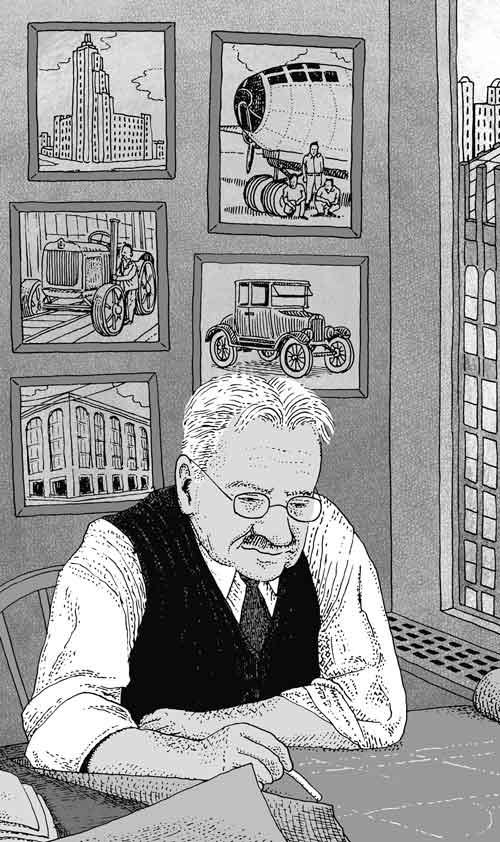
One down — many hundreds more to go.
Tom Chitty
Albert Kahn Inc. is certainly scholarly — sometimes in a good way. Zimmerman, the author of Photographic Architecture in the Twentieth Century, from 2014, and a co-editor of Architecture Against Democracy: Histories of the Nationalist International, from 2024, is meticulous in her research, drawing much of her material from sources not previously examined. The illustrations she includes are fascinating and plentiful. The narrative, especially about Kahn and his family, is at times empathetic. Yet too often a compelling story — including that of Kahn’s determination to realize better working conditions as he accommodated new industrial processes — must be read through a fog of jargon. For example, Kahn is rendered complicit, even if inadvertently, in the suppression of workers by cynical capitalist elites who believed they could squeeze out more productivity and impede unionization through physical space: “The daylight factory . . . was indeed just another extraction machine for industrial capital — a more efficient instrument for alienating the labour of workers.” It’s as if there are two books here: one the accessible rehabilitation of an individual who had a remarkable impact on the built environment and the other a rather esoteric conversation for ivory towers.
Albert Kahn was born in 1869 in Rhaunen, Prussia, the eldest son of a rabbi and an artistic mother. When he was eleven, the family immigrated to the United States and he went to work as an “apprentice boy,” eventually with the Detroit architectural firm Mason & Rice. On Sundays, he took drawing classes with the artist Julius Melchers, and he earned a scholarship from the American Institute of Architects that allowed him to travel to Europe. Shortly after he returned to Detroit, he established a short-lived practice with two Mason & Rice designers. Another partnership with his old employer followed, resulting in Mason & Kahn. By 1902, Kahn had established his own firm.
Kahn was loyal to his family, including his six siblings, several of whom, along with his wife, Ernestine, were involved with his projects. “He helped pay for brothers Julius, Moritz, Felix, and Louis to attend the University of Michigan engineering college,” Zimmerman writes, “thereby securing for them a kind of educational pedigree that he lacked; he recruited three of the four to join him, starting with Julius in 1902.”
The following year, Julius patented a revolutionary method of reinforcing concrete. His system made the material more appealing, because it cost less than steel-frame construction and could now be used to create larger open interiors than were possible with wooden beams. Reinforced concrete was also less susceptible to fire and had a greater load-bearing capacity. To market his product, Julius and Albert established the Trussed Concrete Steel Company, or Truscon. By 1905, buildings around the world were being constructed with the technology. They included the first reinforced concrete automobile plant, for the Cadillac Motor Car Company, designed by Henry Leland. “Truscon’s expansion continued as older colonial empires contracted after World War I and again after World War II,” Zimmerman writes, “as the United States exercised increasing power and influence over other states.”
Beyond Truscon, Albert pioneered an entirely new scale of architectural practice — eventually employing 600 people in the Detroit office. To harness this workforce, he developed a unique process that could deliver mammoth projects on time and on budget. Such an approach might be considered ordinary today, but it was astounding then.
A rising star, Kahn was noticed by Henry Ford, who hired him to create the Highland Park plant, where the Model T would be produced on a moving assembly line, beginning in 1913. That building paved the way for the Model T plant at Christie and Dupont in Toronto as well as Ford’s massive River Rouge complex in Dearborn, Michigan. “As a site of experimentation and constant innovation,” Zimmerman explains, “the design and planning of the Rouge was governed less by established system and more by the improvisation that Henry Ford valued highly in his quest for a vertically integrated manufacturing company.” Driven by a desire to make every part of a car on one site, the plant became the nucleus of a larger campus with over 120,000 employees.
During the First World War, Albert Kahn Inc. took on numerous projects for the U.S. Army and Navy. A generation later, it designed critical airplane manufacturing facilities, among them the sprawling Glenn L. Martin plant south of Omaha, where the Enola Gay and hundreds of other B‑29s would be built. Through such work, the firm played a major role in Franklin Roosevelt’s so‑called arsenal of democracy.
Between the wars, Moscow contracted Kahn for the Stalingrad Tractor Factory, the first such plant in the Soviet Union. “Albert Kahn Inc. was one of many American firms engaged in Soviet modernization, particularly in the First Five-Year Plan of 1928–1932,” Zimmerman writes. In 1930, the firm became the consulting architect for all Soviet industrial construction. Kahn sent his brother Moritz and a couple dozen staff members to run a state-controlled office in Moscow. Known as the Gosproektstroi, it trained several thousand architects and engineers and was credited with some 520 factory campuses: “a far greater volume of building than that demanded by even Henry Ford or GM in the United States in a similar time frame.” Throughout, Kahn and his team “learned about the tremendous possibilities for large-scale, transformative building that arise when state power is combined with private enterprise.”
Kahn died in Detroit on December 8, 1942, with roughly 1,900 buildings to his name. Zimmerman concludes that he was “a cipher” and “a talented, well-intentioned individual who was, by his own description, no revolutionary.” Despite the Marxist overtones early in the book, she also concedes that, even with its “neutrality with respect to politics,” Kahn’s firm ultimately “worked to make architecture better in a spectrum of ways.”
After reading Albert Kahn Inc., I began to wonder if I have something of an antiquated perspective — so out of date that it aligns more with Vitruvius’s three aspects of good architecture (firmness, commodity, and delight) than with current trends. For someone like me, a building’s visual appeal and its construction finesse are essential considerations, alongside an understanding of the kind of lived experience it supports or encourages. Kahn’s factories endure as elegant albeit austere manifestations of the energy of the epoch in which they were realized. His more eclectically styled non-industrial commissions are also pleasing if odd companions to the factories; today, many have landmark status, including the Detroit Free Press Building.
These structures are beautiful — not merely physical manifestations of class struggle. With too much focus “on the mutability of political purpose that is implicit in the built environment — its openness to cooption by forces of right and left — and on the possible unintended effects of creative invention in subverting the optimizations of capitalism, a force that exploits and accumulates,” Albert Kahn Inc. can unfortunately lose sight of this crucial quality.
Kelvin Browne wrote Bold Visions: The Architecture of the Royal Ontario Museum.
Advertisement

Advertisement