
During last year’s eight-week Hockey Canada criminal trial in London, Ontario, when five former junior players stood accused of group sexual assault against a woman known as E. M., the TSN investigative journalist Rick Westhead was turned upon by a large man outside a courthouse elevator. “This is all his fault,” he screamed as he pointed a finger in Westhead’s face. “You are ruining these boys’ lives.” The next day, the same man showed up wearing a T‑shirt that read, “Rick Westhead is a piece of shit.”
The man was eventually barred from court, and Westhead continued his coverage of the trial. His earlier account of E. M.’s 2022 civil suit and its settlement had brought the grotesque inciting events to light. That led to a parliamentary probe of Hockey Canada’s operation and a more thorough criminal investigation by London police, who, more than most forces, had a history of dismissing rape allegations as “unfounded.” The man by the elevator thought, perhaps correctly, that the recent trial would never have taken place without Westhead’s previous reporting.
Of course, it also wouldn’t have taken place if five or as many as eight hockey players hadn’t done what they did with E. M. one terrible alcohol-and-testosterone-fuelled night in June 2018. Justice Maria Carroccia discharged the jury and found each of the five men not guilty — decisions that remain controversial, especially now that the goalie Carter Hart, one of the accused, has resumed his high-profile career with the Vegas Golden Knights — but her verdict didn’t change what had happened in that hotel room. If the conduct of the young men wasn’t criminal, it was heartless and inhumane. It was also emblematic of a much larger problem with hockey in this country.
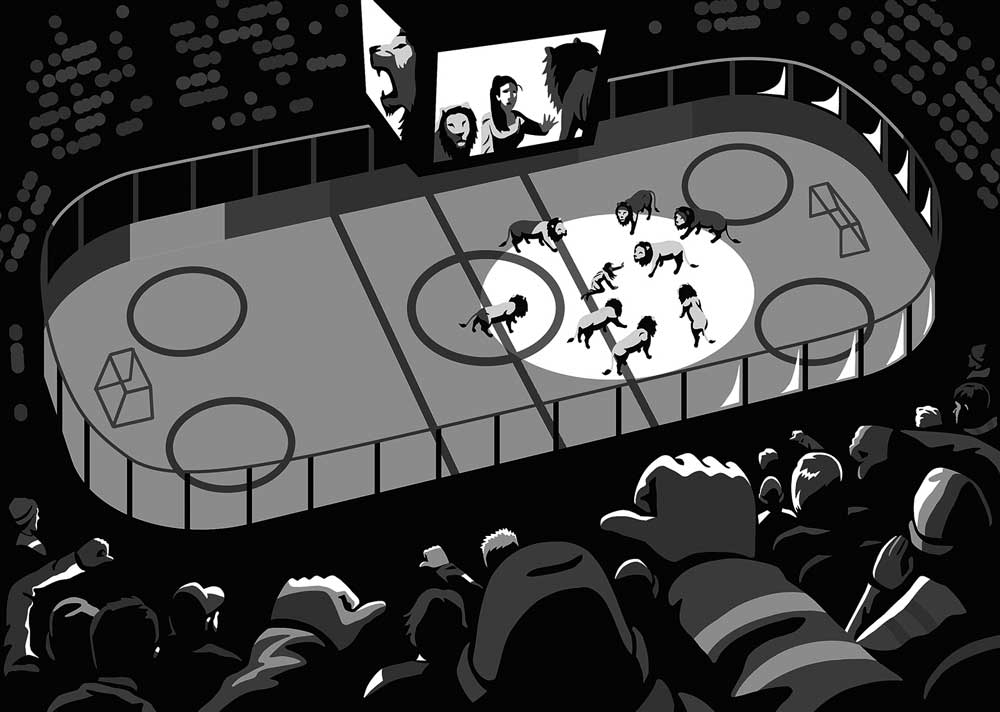
How do you stop them from doing what they’re bred to do?
Min Gyo Chung
In We Breed Lions: Confronting Canada’s Troubled Hockey Culture, Westhead makes a careful case that the organized version of the sport is irreparably flawed, constructed in a way to favour a privileged, powerful few at the expense of the vast majority — including, by the way, most of its athletes. The book’s title comes from an interview Westhead did with a former player in the Ontario Hockey League, which, along with the Western Hockey League and Quebec Maritimes Junior Hockey League, is part of the Canadian Hockey League, the network of teams in mostly small and medium-sized towns that can turn teenagers into National Hockey League stars and, with greater frequency, damaged and sometimes dangerous men.
“Civilians wouldn’t understand it,” the player, now in his thirties, told Westhead. “When we look around the room, we see twenty clones of ourselves and we all know we are better than everyone else. This is our culture. We breed lions, and how do you tell a lion to stop being a lion?”
That our young lions go on to do what lions do should come as no surprise. In 2023, Jonathon Gatehouse, an investigative journalist with the CBC, found forty-seven publicly documented cases of prominent hockey players being accused of sexual assault over the previous three decades. “The insular dynamics of the game, after all, rarely remain confined to the rink,” Westhead writes. Players are treated like objects, and they learn to treat other people that way, especially the young women they encounter in bars and hotel lobbies. Life doesn’t have boards to contain their violence.
Yet the particularly chilling omertà of the locker room means that much of the wrongdoing stays secret, even when the same code that protects players also makes them vulnerable to predatory coaches, trainers, and teammates. Graham James, the sadist who sexually abused his young athletes throughout the ’80s and ’90s, including Sheldon Kennedy and Theo Fleury, was able to get away with his crimes in part because of junior hockey’s almost prison-like system of reprisals. Hazing rituals such as hot-boxing, elephant walks, and mashing — I’m reluctant even to recognize them, let alone define them — are physical degradations that also serve as punishments of the soul. Not many kids get sodomized with hockey sticks and emerge unchanged.
Walter Gretzky, after his sons Wayne and Keith were hazed, drew up a contract for any college or junior team interested in signing his youngest son, Brent: hazing him would cost $10,000. But few parents have the heft to protect their children the way Walter Gretzky did. Westhead talked to one mother whose son developed severe anxiety during his junior career, leading to his being institutionalized for nearly three months. He asked her why parents don’t complain when they find out their children are being abused. “Teams hold all the cards,” she explained. “They have the power to make or break players.”
The making, at least, now starts earlier than ever in minor hockey leagues; the game we used to play on ponds has become its own industrial complex, with high fees and an accompanying sense of entitlement. Agents have begun courting children as young as twelve. “We’re creating egotistical adults with no boundaries or social etiquette or understanding of consequences,” Larissa Mills, a cognitive behavioural coach, told Westhead. “The kids don’t fear anyone. They don’t fear their coaches or their parents.” Until, that is, they get drafted and shipped off to Owen Sound or Swift Current or Rimouski at sixteen and the breaking begins.
Perhaps the closest analogue to junior hockey in Canada is NCAA football in the United States. In 2009, I taught at the University of Montana, where they breed Grizzlies instead of lions, and I saw first-hand the unchecked behaviour of Division I players and the collective blind eye turned by coaches, school administrators, and police. (Jon Krakauer later documented what became a full-blown crisis in Missoula: Rape and the Justice System in a College Town, from 2015.) When student journalists began publishing stories about the football team’s criminality, the kid reporters, not the players, were perceived as the gravest threat to the school’s reputation. I was summoned to the vice-president’s office for encouraging them and was left shocked by just how much derangement was dismissed as “boys being boys.”
According to Westhead, researchers have found twenty-two cases of group sexual assaults involving at least seventy Canadian male athletes between 1990 and 2020, and all of them were perpetrated by hockey or football players. It really does seem a question of breeding, as though the blood lust of the sports themselves — the ruthlessness and physical recklessness that are encouraged by coaches — becomes part of the DNA of its participants. Westhead dispatches the usual “a few bad apples” arguments by documenting a litany of horrific assaults committed by and against players, but any of us who’ve had the misfortune of sharing a hotel with a minor or junior hockey team knows how many of them are monsters in training.
The fallout of the Hockey Canada parliamentary hearings included a stunning revelation: the governing body had seen the need to establish a slush fund for civil settlements with the victims of sexual assault and had paid out $7.6 million since 1989 to settle nine suits. No other details were available because Hockey Canada didn’t keep minutes of its settlement discussions. The organization wrote cheques and moved on as though the victims were the problems and they had been solved.
That odious disclosure led to a reckoning, with executives forced to resign and sponsors looking for the nearest exit, but it was a partial corrective at best. Hockey is still hockey, and junior hockey is still a flawed factory, spinning out the wrong sort of product. For outsiders, it’s almost unbelievable what’s accepted practice within: winter after winter, hundreds of boys are sent to live with strange families with season tickets and placed under the charge of coaches, trainers, and twenty-year-old veterans, each of whom control some amount of their hockey fate, in exchange for little in the way of compensation beyond prestige and less protection. “Both NHL team owners and CHL team owners love it,” Roy MacGregor, one of our foremost hockey chroniclers, told Westhead. “It works for everyone.” Except, as MacGregor knows, for an ever-expanding army of discarded players and the people who need to find a way to survive their company.
We Breed Lions is not an easy read. I had to put the book down several times, and it took me a long time to finish it, because I knew the next page would bring some fresh outrage that would upset me. (For reasons I can’t explain, one scene that’s come back to me was a relatively slight aside about a European player sobbing while his teammates watched him being jerked off by a prostitute as part of his twisted welcome to Canada. “I have a girlfriend,” he said through his tears.) But it would be weird if We Breed Lions were a page-turner or if Westhead gave us permission to look away. He does the victims of hockey’s endless cycles of violence the honour of being unsparing, and the result is a necessarily difficult book. It should be uncomfortable to read about cruelty.
Last September, I met Westhead while we both covered the Canadian men’s soccer team on a trip to Wales. We sat in a hotel lobby together, and he talked about how his trial coverage had made him a kind of sin-eater, how story after story of abuse now arrives in his pocket with sad regularity. He was looking into the near distance when his phone chimed again. He pulled it out and put his hand on his forehead. “Another one,” he said.
The man who screamed at him in court, the man who made that stupid T‑shirt, probably thinks Westhead hates hockey and wants to destroy it. He doesn’t. Westhead still plays in a pickup game, and like a lot of middle-aged men and women, he rates those hours at the rink with his friends as some of the best of his week. “Two things can be true,” he writes. “You can love a sport and also recognize aspects that need to change.” Hockey is, at times, a glorious game, and its players sometimes do wondrous things, worthy of our praise and attention. It also, pretty plainly, turns many of them into beasts, and the rest of us should no longer accept that the reward of one is worth the cost of the other.
Chris Jones is a former staff writer at Esquire and a contributor to The Atlantic, The New York Times Magazine, and the Wall Street Journal.
Related Letters and Responses
Vince Braca London, Ontario
Advertisement

Advertisement