
We are trying to take sexually explicit content out of elementary schools that is inappropriate for me to show on the television news at night, and so it is inappropriate for seven-year-olds to see.– Danielle Smith, August 29, 2025
A friend in my hometown of Edmonton was recently alarmed to discover that her daughter had watched Heated Rivalry behind her back. Gay romance was not the problem; my friend had devoured the six episodes herself. But the girl was in junior high, barely a teenager, surely too young for all those barely veiled blow jobs. What’s more, her daughter confessed that she hadn’t simply been curious about the hype. At thirteen, she was a full‑on connoisseur of “boys’ love,” an East Asian genre that centres on romance between young men. She’d secretly streamed dozens of Thai and South Korean television series, keeping a colour-coded list to indicate whether they were “spicy,” “WILD,” or “mid.”
Rather than panic or leap to punishment, my friend asked to see the list. To her relief, the other shows were far more wholesome than Heated Rivalry, less about hooking up than about holding hands. She decided to turn the situation into a bonding opportunity: Shane and Ilya’s encounters became shared references for conversations about sex that had been just around the corner anyway. Then she vented to me about the difficulties of controlling what children consume in the age of the internet and the endless balancing act between keeping them safe and letting them grow. What my friend didn’t do — because, really, why would she? — was try to get a bunch of graphic novels banned from her daughter’s school library.
Alberta’s forays into censorship made international headlines last summer, when it looked as if Margaret Atwood’s The Handmaid’s Tale might be pulled off high school shelves. Danielle Smith’s United Conservative Party government had issued an order to eliminate all books with graphic sexual content from high schools and ban implicit sexual content for younger groups. In response, the Edmonton Public School Board released a list of titles slated for removal. In what the premier dubbed an act of “vicious compliance,” they stuffed it full of classics, including F. Scott Fitzgerald’s The Great Gatsby and Maya Angelou’s I Know Why the Caged Bird Sings, alongside dystopian works like George Orwell’s 1984, Aldous Huxley’s Brave New World, and, of course, The Handmaid’s Tale. After a chorus of voices, including Atwood herself, denounced the UCP as a bunch of totalitarian book burners, the order was rescinded, then amended. Descriptions of sex in literature were fine. Only images were prohibited.
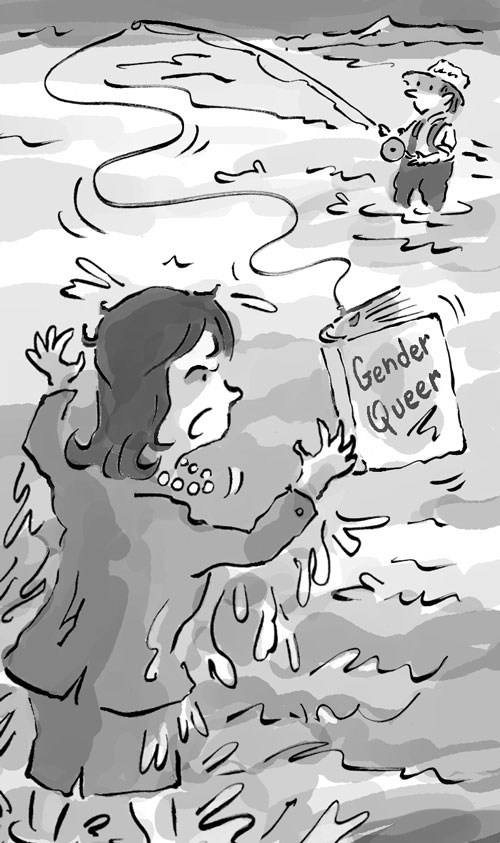
Oh-so-tempted by the rage bait.
Scot Ritchie
In the months since, the censorship push has continued with less media scrutiny and a more specific target: graphic novels. In January, the ban on sexual images came into force for school libraries. Orwell’s original text was safe, but some boards pulled the graphic novel adaptation of 1984; others eliminated Rupi Kaur’s popular poetry over illustrations that were arguably risqué. Another measure, announced in April, will require public libraries to keep volumes with sexual images in a controlled section, accessible only to people older than fifteen.
If these policies are truly designed, as the government claims, to shield young people from sexual content, they are so woefully inadequate as to be barely worth the effort. Boys’ love may have started as a sub-genre of manga, but my friend’s daughter was downloading her material, not browsing the shelves at school. Those in her generation are so glued to their devices, where actual pornography is but a click away, that there’s something charming about imagining them finding subversion in the stacks. More plausibly, this ban is just the latest episode in the MAGA-fication of Alberta politics, as the UCP imports American-style culture wars by catering to anti-vaxxers and putting limits on the school sports trans kids can play. Demetrios Nicolaides, the education minister, claims the library restrictions were a response to concerns from parents. But, as the journalist Mel Woods has reported, Nicolaides met with the Christian organization Action4Canada before announcing these policy changes. Like U.S.-based Moms for Liberty, this right-wing advocacy group highlights books that it wants banned and provides template emails for people to complain to elected officials. The librarian Heather Ganshorn has framed the group’s political agenda as nothing less than “white Christian patriarchal supremacy.”
Nicolaides’s choice of targets further supports the view that the government’s measures are an attack on the queer community orchestrated by the Christian right. The education minister has repeatedly singled out four graphic novels as problematic: Alison Bechdel’s Fun Home, Mike Curato’s Flamer, Maia Kobabe’s Gender Queer, and Craig Thompson’s Blankets. The first three deal with, respectively, a lesbian cartoonist, a teenager coming out as gay at a Boy Scout camp, and a young person reckoning with being non-binary. While the romance in Blankets is heterosexual, the memoir criticizes how evangelicalism led the author to internalize shame surrounding sex and art. All four are American and have been subject to controversy south of the border. In fact, Flamer and Gender Queer made the American Library Association’s list of the top ten most challenged books multiple times in the past five years.
Still, I can’t help but feel that the Alberta government, despite itself, has done something interesting by singling out graphic novels as the enemy. On the one hand, it has drawn a stark line between literature, as a sophisticated medium that requires interpretation, and its multimodal cousin. Following the logic of the UCP, writing about sex can be justified as art. But throw in a drawing, and a penis is just a penis. On the other, it has signalled that this medium is popular enough to be cause for worry — that it has the type of subversive potential and power that, back in the day, saw Lady Chatterley’s Lover and Tropic of Cancer condemned as obscene. Graphic novels may be uniquely frightening to these particular conservatives, or they may be convenient scapegoats. Regardless, I’ve realized I should probably take them more seriously.
According to the comics scholar Aaron Kashtan, the push to ban graphic novels reflects a few fundamental misunderstandings. Writing in Inks: The Journal of the Comics Studies Society, Kashtan argues that critics mistakenly assume all comics are meant for children simply because they are illustrated. The result is a manufactured controversy. Books like Blankets were always intended for teens and adults, not the “seven-year-olds” that Danielle Smith claims to be protecting. No one is pushing for them to be in elementary schools. Likewise, censors take individual panels out of context, focusing on one or two that may not represent a work’s overall tone or intention. In this way, they imply that “comics don’t need to be read critically or contextually in the same way as prose texts.”
At the same time, Kashtan recognizes the focus on graphic novels as a sign of their increased social status. Previous moral panics over comics framed them as “low-quality, harmful trash.” Those being targeted today are instead the ones with “literacy sponsors”: books that have won prizes, been sanctioned by the school system, and entered the mainstream. The prominence of graphic novels in recent debates is, paradoxically, a sign of their growing importance.
As a college literature teacher, I don’t share Kashtan’s deep enthusiasm for the medium. Over the years, I’ve enjoyed some of the titles touted as evidence of the art form’s increasing maturity: Art Spiegelman’s Maus, Marjane Satrapi’s Persepolis, and, more recently, Kate Beaton’s Ducks: Two Years in the Oil Sands. But I also wince whenever I hear of a colleague assigning the illustrated version of The Handmaid’s Tale rather than the real thing. Kashtan is right that comics require their own forms of interpretation, that the visual codes of drawings intersect with text in ways that are complex and meaningful. I’m just not convinced they’re the best tools for cultivating advanced reading comprehension. Maybe it’s elitist for me to complain that the material is too easy, but I think that students can double back to consider comics philosophically once they have the skills to read cultural theorists like Stuart Hall.
It is therefore entirely thanks to Nicolaides that I have now read Blankets, Flamer, and Gender Queer. In each case, I had the distinct feeling of not being the main audience. Craig Thompson, in his 2003 memoir, writes about growing up poor in rural Wisconsin and his teenage love for a girl he met at a church camp. A little research assures me that the book was a landmark in the emergence of introspective comics that deal with daily life. And I zipped through its 500-plus pages in a few hours. Flamer is clearly meant for young adults: the character is about to begin high school, and the story is a straightforward denunciation of bullying, homophobia, and racism. The illustrations are so innocent — with one reference to the protagonist stumbling over his father’s porn, which is depicted as a blank screen — that some Edmonton high schools are still carrying Curato’s volume even with the revised ban.
Gender Queer might be the most controversial of these texts: scandalmongering over its inclusion in Virginia high schools played a role in the surprise election of a Republican governor in 2021. Part coming-of-age memoir, part field guide to non-binary identities, Gender Queer charts Maia Kobabe’s liberal California upbringing; embrace of the gender-neutral pronouns “e,” “em,” and “eir”; and acceptance of asexuality. As someone who likely shares Kobabe’s politics, I found the book mildly annoying, its tone too preachy for my taste. For homophobic conservatives, it may as well be rage bait. Yet accusations that this graphic novel is pornographic are absurd. The scene that has attracted the fiercest blowback features Kobabe wearing a strap‑on and receiving a blow job from a date. (When Nicolaides condemns material with “sex toy use,” I suspect he’s talking about this drawing.) If that sounds outré, the whole point of the scene is that Kobabe realizes “it was more erotic in my head” and decides against pursuing sex altogether.
Fun Home, by contrast, is a magnificent work of art that I would applaud any high school teacher for being ambitious enough to assign. It shouldn’t need a defence from me twenty years after its release; the critically lauded bestseller was adapted into a Tony Award–winning musical and has become a mainstay of college curricula. Rereading it in 2026, I was mostly struck by how highbrow Bechdel’s project is. Fun Home details her fraught relationship with her father, who she discovered had been having affairs with young men shortly after she came out as a lesbian in college. Before the two could really hash things out, he died in a suspected suicide. Bechdel processes these complex family dynamics, in part, through literature. She considers her father’s obsessions with F. Scott Fitzgerald and Marcel Proust through the lens of sexual repression, tries to understand her mother through a Wallace Stevens poem, and draws on Henry James’s The Portrait of a Lady to appreciate her parents’ early courtship. With Fun Home, the argument that graphic novels can be stepping stones to the classics seems obviously true.
As for the sex scenes (there are a total of two), they are almost aggressively literary. A panel that shows Bechdel’s head between her lover’s legs is surrounded by references to the Odyssey, as she observes, “Like Odysseus on the island of the Cyclops, I found myself facing a ‘being of colossal strength and ferocity, to whom the law of man and god meant nothing.’ ” The comparison is clever, as rather than reject the “monstrous,” Bechdel discovers the thrill of intimacy that defies social scripts. The moment also builds on Fun Home’s extended dialogue with James Joyce’s Ulysses, a favourite of Bechdel’s father that she neglected to finish in favour of her voyage of queer discovery.
Rather than unearthing some pervasive and corrupting salaciousness, reading these works against the backdrop of their denunciation is an exercise in irony. Fun Home mentions that Ulysses was banned as obscene and details Oscar Wilde’s prosecution for committing indecent acts. As I read Bechdel’s comments on her father’s attraction to Albert Camus, I recalled that the graphic novel Introducing Camus had, bizarrely, been prohibited by the Calgary Public School Board. More tragically, Bechdel celebrates libraries as the place where she consolidated her new identity. She really did go through the stacks and check out whatever she could find on homosexuality, assembling a Sapphic canon that included Adrienne Rich, Colette, and Virginia Woolf.
Bechdel portrays her constructing of the self through text so artfully that it allowed me to take a more generous view of the volumes that perturb Nicolaides. Gender Queer dedicates pages to the books that Kobabe read as a teenager, including the library’s queer collection. When the adolescent discovered the “very tame gay sex scenes” in the manga series Fake and the fantasy trilogy The Last Herald-Mage, “it felt as if lightning was coming from the pages.” Clearly Kobabe hopes that Gender Queer might produce a similar shock of recognition for some readers.
Flamer and Blankets, meanwhile, testify to the power of the creative impulse even without these external supports. Raised in the Filipino Catholic community, the protagonist of Flamer imagines himself as Jean Grey from the X‑Men, as he slowly discovers the extent of his own power. In role-playing games, he yearns to be Galadriel from The Lord of the Rings, even as his friends insist he makes a better hobbit. This search for identification sees him leap over prescribed boundaries; absent material that is explicitly gay, he queers whatever he can get. In Blankets, Thompson describes the mental toll of growing up in a rural evangelical community where his drawings were condemned as satanic. He became a cartoonist anyway.
In the end, I found these texts oddly comforting. I trust educators to fight the good fight, and the Coalition of Alberta Public Libraries is taking a stand to protect its members’ collections. I hope all our libraries remain places of freedom where teenagers can make sense of themselves.
If worse comes to worst, I remain confident that the Alberta government is picking a fight it will not win. Even discounting the existence of the internet, young people are not easily controlled. They will work with the scraps they are given, project themselves into normative spaces in radical ways, make things up when that’s all they can do. My friend’s daughter doesn’t see herself as an anti-censorship, anti-government rebel, I’m sure, though her consumption habits are the material of Smith’s nightmares. Even if she had a different mother, the kind who confiscated her phone to preserve an illusion of innocence, she’d still ride through the tumult of adolescence in her own way. Eventually, whatever adults tell her, she’d get where she wants to go.
Amanda Perry teaches literature at Champlain College Saint-Lambert and Concordia University.
Advertisement
Advertisement