
Leonardo da Vinci, Jean-Jacques Rousseau, Montaigne, Catherine the Great, Horace Walpole, Samuel Johnson, Louis XV, Florence Nightingale, Mark Twain, Ernest Hemingway, Stephen Harper, Taylor Swift. Despite their prominence, these are all outliers, historically speaking, in their affinity for cats. The most widespread terrestrial carnivore in the world — and the driving force behind 90,000 YouTube uploads each day — Felis catus has been loved by some but loathed by most. “They lived solitary lives, they were more attached to places than to people, and they seemed resistant to training,” the Carleton University historian Rod Phillips writes in Cats: A History. “They were easily defined as outsiders, unsuited to human society.” Nonetheless, humans owe a debt to the house cats, street cats, and feral cats that have kept us company and, in part, kept us fed since we settled down in the Fertile Crescent some 12,000 to 15,000 years ago.
Phillips seeks to describe the “essentially utilitarian and mutually beneficial” human-cat relationship that has emerged since then — a development that has been anything but linear. Unlike some related books, including Jerry D. Moore’s lively Cat Tales, from 2025, Cats has relatively little to say about sabre-toothed tigers, cave lions, or most extant members of the Felidae family. Even with a tight focus and 400-plus pages, though, Phillips can’t tell us everything about his mysterious creatures. Are they, for example, even domesticated?
Experts have differing opinions on that question — but if cats are domesticated, they’re certainly not domesticated in the sense that dogs are. Setting the “are they or aren’t they” debate aside, most can agree with conventional wisdom: “Dogs have owners; cats have staff.” Indeed, in the many homes around the world that include a pet cat — more than half of households in Argentina, nearly a third in the United States, and roughly 20 percent in Canada — we generally serve at their pleasure.
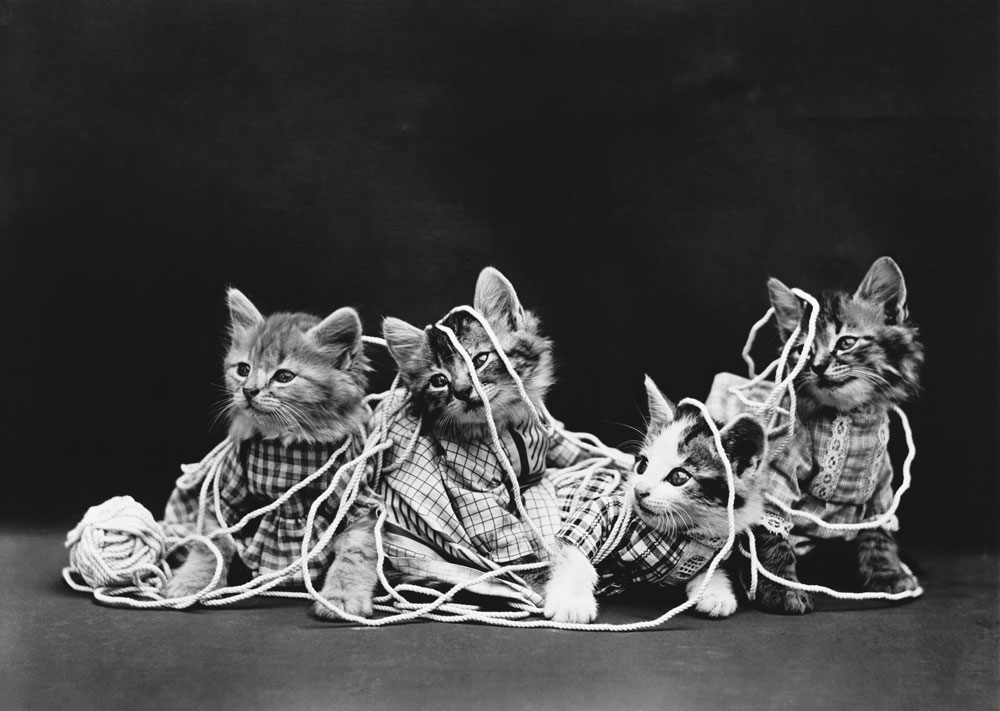
Untangling a remarkably intertwined relationship.
Harry Whittier Frees, c. 1914; Bridgeman Images
What they want, we provide: the most comfortable seat in any room, the toys, treats, and jungle gyms, our laps whenever they’re inclined. Legend has it that the prophet Muhammad so indulged his cat, Muezza, that he once cut a sleeve off his robe and wore it that way rather than wake her while she was sleeping on it.
Muezza and Larry — who has served under six prime ministers at 10 Downing Street as the chief mouser to the Cabinet Office — are descended, like all house cats, from Middle Eastern wildcats, which tend to be slightly taller, slightly heavier, and slightly less fecund. There are other wildcats in the world — African and Scottish, for example — but their progeny have never cohabited with us.
Our Natufian and Neolithic forebears first attracted Middle Eastern wildcats when they started storing grain, because those stores attracted vermin. Had we not tolerated the presence of Felis silvestris, sustained agriculture would have been much more difficult. Archeological sites, including Hof Shahaf on the Sea of Galilee and Hallan Çemi Tepesi near the headwaters of the Tigris River, suggest that wildcats were part of the picture as early as 13,500 BCE. “It is important to recognize that wildcats did not enter settlements to help humans protect their food supply from rodents,” Phillips writes. While their intention was entirely selfish, it benefited them and us alike. Over time, some of those wildcats developed the physiological characteristics we associate with cats today, even as their DNA remained unchanged.
By ship and by land, cats spread with agriculture. From Turkey they went to Egypt, and from there to Greece and Rome, the empires that sent them north to the British Isles and beyond. Evidence suggests that cats were preying on rodents in the farming village of Quanhucun, in central China, around 3300 BCE, not long before Egyptians started depicting them in domestic situations on the walls of tombs.
“The history of human-cat relationships is like a redacted document,” Phillips explains, “with key information blacked out.” It’s not clear, for instance, when cats entered our homes, let alone our hearts. But a 2004 excavation in southern Cyprus hinted that a thirty-year-old was buried with a pet cat around 7500 BCE. By the twelfth century CE, cats had ingratiated themselves into libraries and studies, enough to leave pawprints on the letters of Pope Gregory I and on manuscripts in Croatia. In 1420, a Dutch kitty urinated on a manuscript in progress. The next morning, an annoyed scribe annotated the affected portion of parchment: “Take good care not to leave books open at night where cats can come.” (Something similar might be said about Russian blues and unattended keyboards.)
Cats are not mentioned in the Bible or the Quran, but they have been a religious preoccupation for millennia. Ancient Egyptians did not worship cats, as is sometimes said, but they did revere them. Felicide was illegal in the Nile Valley, and, at least according to Herodotus, Egyptians would shave their eyebrows when mourning a house cat that had died of natural causes. Yet there was an industry of votive cat mummies, which were offered to the goddess Bastet. “The kittens that were put to death for mummification and votive purposes were not household or street cats,” Phillips writes, “but were raised exclusively to be mummified.”
In England, one of Exeter Cathedral’s towers has a sixteenth-century door with a small hole at ground level to let the resident cat, which once received a quarterly stipend, come and go as it pleases. Not all of Christianity has been so kind.
Despite the tabby that supposedly hopped into the manger to keep baby Jesus warm, the Catholic Church assumed a largely negative view of cats beginning in the thirteenth century. That’s when Gregory IX issued his papal letter Vox in Rama, in which he linked black cats with heresy and Satan. It didn’t matter if it was black or white, a willful puss challenged assumptions of man’s dominion over the natural world and embodied three of the seven deadly sins (lust, gluttony, and sloth). Cats were seen as familiars of witches; their approach to hunting, diabolical. “The devyl playeth ofte with the synnar,” England’s first printer, William Caxton, wrote, “lyke as the catte doth with the mous.” Long after the Church retracted its claws, cats are still subjected to torture and abuse more often than other pets, and they continue to serve misogynists as stand‑ins for supposedly wayward women whom men struggle to control.
According to some Islamic accounts, God did not create cats until after Noah herded animals two by two onto his ark. The problem was the mice, which soon had babies, which soon had more. To address the infestation, God told Noah to rub a lion’s muzzle: “When he did so, the lion sneezed out a pair of cats.” Unlike dogs, cats possess baraka, or divine blessing. “Food that has been nibbled by a cat is still considered halal,” Phillips notes, and “water that a cat has drunk from can be used for personal ablutions before prayer.”
For centuries, cats have been traded for reasons other than mousing. Their fur was valued in second-century Scandinavia as a novelty. During the Middle Ages, English furriers prized pelts from Spain, even as the killing of cats was banned there under Islamic law. Later the grey Chartreux, named after the habits of Carthusian monks, was similarly popular among luxury clothiers, as the influential Dictionnaire universel de commerce, from 1723, attests.
However fashionable, cats are targeted when times are tough. From the bubonic plague to COVID‑19, they have been regarded as likely vectors. In 2020, the British government briefly considered asking the public to kill their pet cats — all 11 million of them. Cats have also been accused of spreading impurities beyond disease. The Nazis considered them “the Jews of the animal world.” As the German critic Will Vesper reportedly told his son, “Cats are an alien, untrustworthy breed. They come from the East, from Egypt. They belong in no community.”
Even without the antisemitism, countless others have objected to our feline friends because of the ecological damage often pinned on them (think of declines in songbird populations). Beyond the Middle East, the cat is a non-native species anywhere it lives, whether indoors or out. That’s why, in 2022, the Polish Academy of Sciences classified the animal as invasive.
Such a designation is difficult to square for the millions who, especially in recent decades, have built their lives around cats. In China, half of young people consider them to be suitable replacements for children. In the United States, they’re overwhelmingly seen as kin by those who keep them. Whether family or foe, cats remain uniquely inscrutable. But though we cannot fully understand them, this fascinating book helps us better understand ourselves.
Kyle Wyatt is the editor of the Literary Review of Canada.
Advertisement

Advertisement