
It took a century and a half for British Columbians to recognize James Cook’s third voyage as an origin point for their province and nation. In 1924, the lieutenant-governor and other dignitaries journeyed to Friendly Cove (Yuquot) on Nootka Island, just off the west coast of Vancouver Island. They sang the first stanza of Rudyard Kipling’s “Recessional” and unveiled a memorial tablet, among the first in western Canada to be erected by Ottawa’s Historic Sites and Monuments Board. The cairn memorialized Cook’s discovery in 1778 of the harbour he named King George’s Sound, as well as the controversy of 1789–94, in which the Spanish arrested British traders before withdrawing their claims over the area. F. W. Howay, the judge and Historic Sites and Monuments Board member who pressed for the marker’s creation, knew that the British presence at Nootka Sound had been “spasmodic,” but he nonetheless felt that it had opened “paths which have led us to the proud position of to‑day.”
The popular historian Graeme Menzies has updated Howay’s sense of imperial destiny for the elbows‑up era. Trading Fate: How a Little-Known Company Stopped British Columbia from Becoming an American State draws attention to the fur traders who followed Cook, arguing that they established the foothold that saved a future province from absorption by the United States — and so ensured Canada its outlet to the Pacific.
Cook’s sailors had discovered that the merchants of Canton (the Chinese port now known as Guangzhou) would pay exorbitantly for the sea otter pelts that the Nuu-chah-nulth people traded for everything from guns to iron nails. The liveliest stories in Trading Fate concern those who rushed to Nootka Sound to exploit this market. Cook had worked for the Royal Navy and became an icon of the Enlightenment, but the adventurers who followed him cared only for gain. They sailed from Canton under many flags of convenience. The Britons among them were soon outnumbered by “Boston men”: Americans who went around Cape Horn to join the frenzy.
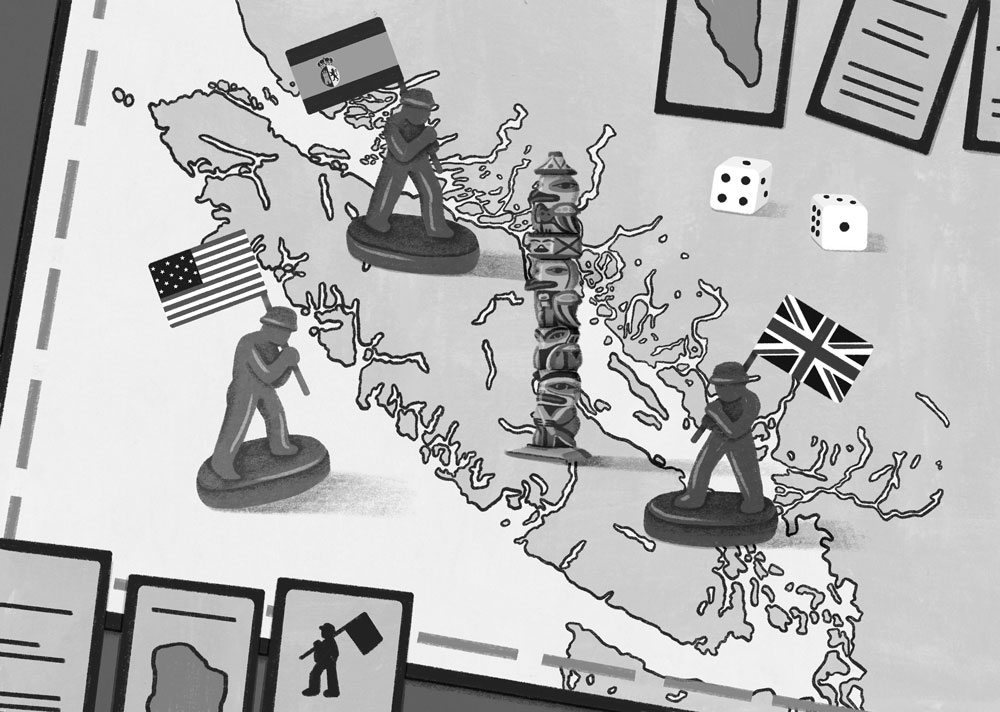
Risky business on the edge of the continent.
Paige Stampatori
Menzies uses their memoirs, which historians have studied since Howay’s time, to give a graphic account of their activities. Armed to the teeth and frustrated by the deft haggling of Indigenous leaders, whom they feared and distrusted, traders resorted to hostage taking and killing. Sometimes the trouble began with claims of theft from their ships; at other times, the Nuu-chah-nulth complained about the quality of the goods they were offered. In 1785, James Hanna of the Sea Otter shot twenty people over a pinched chisel; seven years later, in nearby Clayoquot Sound, Robert Gray burned down 200 homes in the village of Opitsaht. The Nuu-chah-nulth consisted of more than a dozen First Nations, used to fighting one another for prime hunting grounds, and they gave as good as they got. In 1803, the Mowachaht chief Maquinna, who controlled Friendly Cove, stormed the Boston and beheaded twenty-five of its crew, enslaving the only two survivors.
Menzies is less interested in the fascinating, bloody dynamics of the fur trade than in its geopolitical implications. He introduces us to Richard Cadman Etches, a nondescript but ambitious wine merchant from London. The publication of Cook’s voyages inspired him to found the King George’s Sound Company with the assistance of Joseph Banks, the celebrated naturalist who had participated in them. The KGSC hoped to corner the Canton market in otter pelts through deals with the chartered corporations that monopolized the trade with China: the South Sea Company and the East India Company. It named its ships for the royal family and hired Cook’s officers to captain them. Etches persuaded one of his rivals, a Canton adventurer called John Meares, to merge his outfit with the KGSC to form the new Associated Merchants of London and India Trading to the Northwest Coast of America — the little-known company with a very long name. Etches may now be a forgotten founder of the nation, but nothing could be more Canadian than his corporate dislike of open competition.
The association’s semi-official status proved important when the Spanish navy arrived to arrest its captains and seize its ships in the summer of 1789. The forty-seven-year-old commander José Martínez was a brutal type who summarily killed a Nuu-chah-nulth chief, but he was merely enforcing what the Spanish understood to be their exclusive possession. King George’s Sound was for them Surgidero de San Lorenzo, part and parcel of the Territorio de Nutca that extended to Alaska. Juan Pérez’s exploratory voyage of 1774 had confirmed the Spanish hold over the lands granted them by Pope Alexander VI’s 1493 bull Inter Caetera, and they were determined to preserve the area from foreign penetration. Meares, who journeyed to England to seek revenge in the spring of 1790, cast Martínez’s actions as an insult to the “British Colours” that he had flown over land purchased from Maquinna. Etches’s brother John wrote to George III, condemning the Spanish “arrogance to assume an exclusive right to the gates, locks, and keys of the whole Pacific.”
Although William Pitt, the British prime minister, struggled to find Nootka Sound on a map, he needed little persuading that something must be done, because he stood for the principle that his compatriots should be free to trade wherever they liked. His government allocated a million pounds to fit out the navy to take on the Spanish in the Pacific, even as a greater threat was blowing up closer to home: the French Revolution. The implosion of the French monarchy resolved a crisis. The king of Spain had hoped to revive the Bourbon Family Compact, which had proven so effective during the American Revolution, when the French and Spanish navies had cut off British forces from supplies, but the French of 1790 were too absorbed in domestic tumults to help. The Spanish duly signed a convention that bound them to compensate British traders for their losses and that committed both sides to the withdrawal of any territorial footprint in Nootka Sound.
London dispatched George Vancouver, once one of Cook’s subordinates, to negotiate the British evacuation in detail. Although he got on famously with his Spanish counterpart, Francisco de la Bodega y Quadra, they could not reach a settlement; diplomats in Europe eventually had to produce a further set of conventions. Yet Vancouver did circumnavigate the disputed island and map the coastline up to Alaska. The geographer Daniel Clayton has described his charts as a scientific anticipation of settler colonialism: Vancouver scrubbed out Spanish toponyms and ignored Indigenous ones, instead naming sites after the Hanoverians or his junior officers. This made the British mentally at home in the region, so much so that they were soon abbreviating the moniker of the place they had agreed to call Quadra and Vancouver Island and became inclined to think of it as theirs.
The final chapter of Trading Fate goes too far in implying “no Etches, no Canada.” Menzies offers us a simple argument for assigning hero status to this grasping capitalist. If the Spanish had not had to compromise on their imperial ambitions, they might have continued their shaky hold on the Pacific Northwest until forced to sell up to a rival power (as they did with the vast Louisiana Territory, which passed to the French before they sold it to the Americans in 1803). Or the United States might have annexed the Territorio de Nutca through war, diplomatic pressure, or the movement of settlers, just as it rolled up most of Spanish North America, from Florida to California. Vancouver’s Georgia Strait might have become the Freedom Strait.
Britain’s commercial presence in the region did create vested interests that its diplomats defended in the 1840s — when gold attracted Americans and when Yankee statesmen began to talk of annexing their way to continental hegemony. But the corporation that dug the earthworks of British sovereignty was not the maritime KGSC but the decidedly earthbound Hudson’s Bay Company.
Menzies is forced to turn from Nootka Sound to give a potted story that has often been told before. The expansion of the HBC’s trade in pelts along the Columbia River and its overcoming of Canadian and American firms motivated the British to sign an agreement in 1818 that gave it a free hand in a neutralized Oregon Territory. When the fur-bearing animals dwindled and American settlers began arriving in numbers, the British withdrew in 1846 to an extended dividing line with the United States along the forty-ninth parallel, then granted Vancouver Island to the HBC as a consolation prize. The difficulties of enforcing law over the mainland from Fort Victoria led to the formation of the Colony of British Columbia, in 1858; its amalgamation with the Colony of Vancouver Island, in 1866; and its entry into Confederation, in 1871. Vancouver’s surveys had made his island seem a viable if remote and forbidding prospect for colonization, yet the claim that Etches’s greed “stopped British Columbia from becoming an American state” is a reach all the same.
Trading Fate reels off the “wins” for “Team Britain” that ultimately “saved” British Columbia for Canada. It is natural to read today’s nation-state back into the past and to celebrate the stages of its apparently inevitable formation. But if we leave Menzies’s chipper patriotism aside, some of these wins look like disasters. Etches was less an architect of Canada than a pioneer in the so‑called Great Hunt: the near extermination of sea otters, fur-bearing seals, and grey whales by Indigenous hunters working for Russian, British, and American traders. Nuu-chah-nulth people strained their societies and starved themselves to satisfy their partners, who swiftly moved on the minute the otters vanished. Menzies suggests that the formation of British Columbia saved this region from white supremacy and the other American evils that thrived in Oregon, but it did not do much for First Nations. Joseph Trutch — the surveyor, engineer, and future lieutenant-governor who has a cameo in this book as one of the commissioners who brought British Columbia into Confederation — despised them and had shrunk their reserves to the smallest size possible. Menzies tells some unfamiliar and stirring yarns, but he could have been much more critical about his master narrative.
Michael Ledger-Lomas writes about history and religion. He lives in Vancouver.
Advertisement

Advertisement