
Among academics, I suspect I’m not alone in struggling to reconcile the moments of joy that university life affords — witnessing students come alive in seminar, savouring that exhilarating book that reshapes my thinking — with a sense of systemic brokenness. The signals are everywhere: Decades-long cuts in public funding. Rising costs (and eventually debt) for students, forcing many to take on jobs that limit study time. The steady replacement of tenure-track positions with low-wage, precarious ones. The gradual transfer of power over governance from faculty to a non-academic managerial class. The growing expectation that scholarship demonstrate its immediate “impact” for business, which short-sightedly scants the exploratory projects that often yield more lasting breakthroughs. The proliferation of metrics for research and teaching, along with the administrative burden they entail.
But the most fundamental marker of decline might be the increasingly pervasive notion that a university’s main social role is to train young people for the labour market, an outlook that marginalizes — is indeed openly hostile to — unfettered intellectual discovery. Universities in this vision become tools of corporate welfare, with students paying tuition for the sort of career training that, generations ago, an employer would have provided on the company’s dime. The growing legitimacy of this idea among politicians, parents, journalists, and guidance counsellors has led many undergraduates, ever more debt-saddled, to understandably regard their four or so years on campus as a financial investment. One problem with this approach is that markets can shift unexpectedly: witness the many unemployed computer science majors amid the dawn of artificial intelligence. Another is that public perceptions of a subject’s utility can be flawed. Contrary to stereotypes, for instance, humanities grads earn salaries comparable to those of people from all sorts of other majors.
It’s easy to forget that our marketized universities haven’t always looked this way. In his fine What Could a University Be? Revolutionary Ideas for the Future, the philosophy professor (and inaugural director of the Jackman Humanities Institute, in Toronto) Robert Gibbs recounts how in early nineteenth-century Germany, thinkers such as Immanuel Kant, Wilhelm von Humboldt, and Friedrich Schleiermacher designed the template for what became the modern research institution. In their models, philosophical reasoning formed the heart of intellectual life. Later that century, in Britain, Matthew Arnold and Cardinal John Henry Newman placed literature, which they considered the noblest form of civilizational expression, at the university’s core. In the 1960s, Clark Kerr, the president of the University of California, coined the term “multiversity” to describe the sprawling conglomerate of institutes, constituents, interests, and purposes that universities had come to encompass. “The university is so many things to so many people,” he wrote, “that it must, of necessity, be partially at war with itself.”
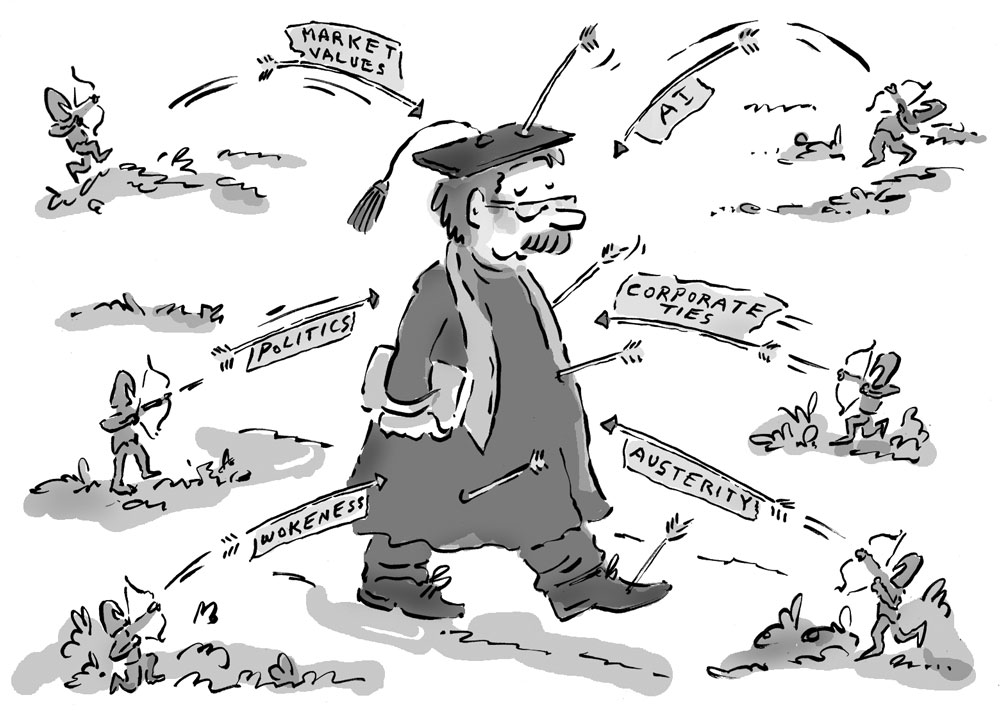
Returning to campus with two books that examine present-day predicaments.
Scot Ritchie
Whatever our universities have become, they’ve long been discussed in the language of crisis. But this register isn’t necessarily helpful. For one thing, administrators and their pricey consultants often adopt the language of emergency to justify cost-cutting. More broadly, as the former English professor Christopher Newfield puts it in his contribution to Knowledge Under Siege: Charting a Future for Higher Education, the “crisis” can last “so long, for so many years and decades, that it convinces us that there’s no solution.” Indeed, the Université de Montréal professor Bill Readings’s brilliant The University in Ruins, from 1996, outlined how “the university of culture”— an institution that once cultivated national identity — had become the corporatized “university of excellence.” For decades, we have known in broad strokes how to fix higher education. The difficulty has been in actually implementing the solutions.
What Could a University Be? and Knowledge Under Siege contribute fresh and vital insights to the noisy conversation about how to renew higher ed. Some of that freshness arises from each book’s Canadian vantage. As Gibbs notes, the outpouring of commentary on the decline of universities in the global North often elides the particularities of institutions here. Many Canadians imagine our schools through imported frames, often those supplied by media frenzies over culture wars waged on stateside quads. But our system has important differences from America’s. Our major institutions are all public, for example. Tuition is far lower, as are endowments. Unlike their counterparts at America’s ivory towers, students at our major research universities mostly commute to campus, with dorm life reserved for only a minority. Football coaches don’t top the institutional payrolls. Our universities arguably hold a different place in the public imagination, too: the anti-intellectual streak afflicting America has less influence here, at least for now.
What Could a University Be? helps us think through present-day predicaments by focusing on historical developments and philosophical thought that offer lessons for renewing academia and reimagining its purpose. Knowledge Under Siege, meanwhile, interweaves synoptic essays on the basic animating principles of our universities with more concrete appraisals of specific challenges. Together, these books propose a dizzying array of reforms. Overall, that sheer breadth conveys a galvanizing sense of opportunity. Yet it also evinces — often, but not always, in ways these writers acknowledge — the scale of threat that universities face.
Each book reimagines the scope and role of research in university life. Our standard measures of institutional prestige, Gibbs notes, depend heavily on scholarship by professors. Yet professors make up a sliver of a campus population; the largest community by far is the undergrads. To understand this tension between core mandates — professorial research and undergraduate education — Gibbs turns to Schleiermacher’s model, ultimately rejected, for German academia of the early nineteenth century. Schleiermacher’s university would not have conducted research. Rather, that sort of work would have been carried out at independent, student-free academies, tailored to specific disciplines (think of Germany’s Max Planck Institutes). For Schleiermacher, universities would enable students to discern the unity of all bodies of knowledge, instructing them in how to integrate the claims of distinct fields and, in so doing, perceive the limits of our understanding. The institution’s core activity, he maintained, was critique: unsettling knowledge through self-conscious questioning.
What’s startling about Schleiermacher’s model is its focus on undergraduate education itself. His template, Gibbs argues, “should lead us to demand an educational justification for the university’s extensive research activities.” Why house undergraduate teaching and field-altering research, he asks, within the same set of buildings? Using Schleiermacher to expose the oddness of this seemingly natural pairing, Gibbs argues that teaching at research universities should move beyond inculcating students with powers of critique. Instead, these schools should place the act of research at the heart of their teaching. The logic of critique reveals for students the boundaries of knowledge. By instructing them in research, Gibbs continues, universities can teach the logic of inquiry, which enables students to create knowledge themselves.
Conceived abstractly, Gibbs’s model not only satisfies but excites. Given the sheer size of Canadian universities, though, with thousands of undergraduates, putting it into practice may be harder. In Schleiermacher’s ideal scenario, where learning was made systematic, students would arrive with ample field-specific comprehension. But this is not the case today. There’s a reason first-year course offerings typically feature introductory surveys. Can one do good research without first learning the basics of one’s subject? Classroom time being finite, teaching the logic of inquiry leaves less time for those basics. That’s not to say inquiry has no place; Gibbs argues persuasively for its importance to a revitalized system. But it may be a matter more of integrating inquiry within existing curricula — of supplementing, not supplanting, the emphasis on knowledge and critique students already receive.
The essays in Knowledge Under Siege reconceive research in their own ways. The collection — involving a powerhouse group of thinkers, and superbly organized — embraces multiplicity: no single vision predominates. A strong contribution by Simon Marginson, an editor-in-chief of the influential journal Higher Education, explores the tension between global scientific networks and government initiatives that try to shoehorn science within “nation-bound agendas.” The problem is not just that “technological nationalism” frays research networks, stymying invention and scientific autonomy. Housed in the global North, the most prestigious scientific journals publish exclusively in English, and what they select for publication exerts outsized influence on world rankings. What knowledge is marginalized by this “Anglophone control of science”? The breathtaking speed with which Chinese universities have overtaken their American counterparts atop worldwide rankings may augur a multilingual world of science, with English no longer paramount. But it also reflects, and exacerbates, nation-based scientific competition. What we must pursue, Marginson insists, is a culture of science marked by pluralized knowledge, multiple languages, and open networks.
Marginson is hardly the only writer in the collection who calls for universities to open themselves to “knowledge that is excluded.” While many still cite the University of Bologna, founded in 1088, as the world’s oldest, the Mexican physician and social scientist Consuelo Chapela shows that the work we associate with higher education was being carried out in other parts of the world long before. (Islamic institutions such as Cairo’s al‑Azhar Mosque, for example, established a century earlier, were renowned for their research and teaching.) Chapela’s essay is one of several — the Māori scholar Linda Tuhiwai Smith’s is another standout — that argue for transforming the Euro-American university into a place of genuine intellectual pluralism through far-reaching changes to curricula and institutional design. Many others, though, chart the siege-like forces of corporatization and managerialism that threaten notions of exploratory research as a public good. While such criticisms of the neo-liberal university are commonplace, they are incisively articulated in Knowledge Under Siege, with nuance, evidence, and, most crucially, possible solutions. Often I found myself simply cheering the authors along.
It is entirely reasonable that our laboratories and classrooms should be accountable to wider society. What is less clear is how to adequately measure their social benefits and what their appropriate role in public life might be. Both What Could a University Be? and Knowledge Under Siege place the question of how universities relate to society somewhere near the core of their quest to understand the purpose of universities. Gibbs does so in characteristically ingenious ways. Turning to the German theologian and philosopher Franz Rosenzweig, he grapples with whether research can flourish only in total freedom, unburdened by societal demands. Or, rather, do researchers bear an inextricable responsibility to the non-academic world? Rosenzweig regarded scholarly debate as insular, its subjects bounded solely by other scientists and by the limits of inquiry. As he saw it, professors were unworldly pedants, oblivious to interests and queries from the wider world. For them, he claimed, scholarship constituted an “inexhaustible curious insatiable gluttonous spectre, which . . . consumes him until nothing of his humanity remains.” (Perhaps it’s no surprise that Rosenzweig turned down a professorship in 1920.) Rosenzweig advocated an approach to research that saw it as responding to the questions of other people. Discovery arises, he argued, from a foundational obligation to respond to others.
It is worth emphasizing that much seemingly insular investigation in fact bears worldly relevance. There’s a long history of basic, non-instrumental science unexpectedly yielding world-changing knowledge. Deepening our awareness of cultural history leaves us better equipped to navigate the world of the present. It’s the marketized framework of “impact” under which universities labour that often keeps us from apprehending their broader societal contributions. But Gibbs widens the aperture by addressing oft-neglected nexuses between town and gown. In a chapter on professional programs and another on the lives students live beyond their studies, he shows how the logic of inquiry might infuse each realm of experience. His account of academia’s social role is expansive and imaginative.
Many of the relays between universities and society defy financial tabulation. As Marc Spooner and James McNinch of the University of Regina, the co-editors of Knowledge Under Siege, put it, universities help invigorate democracy by “asking difficult questions of governments, of other power structures, and of society itself.” Their research furnishes insights for public debate. Their courses foster, at least ideally, habits of critical thinking and respectful discourse crucial to democratic citizenship. Yet within their own walls, universities are, as many contributors observe, increasingly undemocratic. Ascendant managerialism has sidelined collegial, faculty-led governance. As the last few years have made especially clear, threats to academic freedom and tenure abound. Given universities’ historic role in perpetuating class hierarchy, caricatures of them as hotbeds of threateningly radical progressivism or wokeness (to invoke the meaningless epithet of our time) have always been suspect. However, increasingly reliant on casualized labour and market-oriented activities, they are far more conservative than many appreciate. Amid growing threats to free inquiry, their potential to enrich democracy wanes.
Other than on the political right, few attack the notion that universities bolster democracy. But should they weigh in on socio-political matters of the day? This question has long been contentious. Even before the 1960s, campuses were sites of student activism. Intra-campus debates on whether universities should embrace “institutional neutrality” have a long, tangled history, as Shannon Dea of St. Mary’s University in Halifax shows. Her contribution performs a great service by soberly, thoughtfully charting major standpoints on the concept. Some have argued that, aside from exceptional circumstances, institutions of higher learning should remain strictly neutral. Others have championed restraint, with departments and other constituent bodies authorized to opine publicly so long as they specify that they do not speak on behalf of the university as a whole.
Dea carefully parses the advantages and weaknesses of these and other stances. Unfortunately, her own proposals for when and how institutions should express themselves underwhelm. Universities should, she argues, speak out on “matters in which they are morally or materially implicated,” and in particular those related to their core values — in the abstract, a reasonable proposition. The trouble is that in practice, teasing out degrees of implication can be messy, indeed well-nigh impossible. Moreover, as Dea notes, institutional values, the products of communal negotiation, are malleable. Facing “the trickiest challenges,” universities will, Dea admits, “almost inevitably” get the balance between values and voices “wrong.” She claims that mistakes and imperfection in this realm are okay, due to the importance of “moral repair.” In making this argument, however, she blithely discards her earlier worry that official speech risks having a chilling effect on open discourse among individuals. Admitting her blueprint’s impracticalities, Dea ultimately comes close to unwittingly making a case for strong neutrality.
One dimension of the institutional-neutrality debate that Dea’s essay neglects is the benefit for universities of appearing as venues of open, non-partisan debate, with inquiry proceeding wherever evidence and reasoning lead. Public trust in academia thankfully remains stronger in Canada than in many other countries, but amid bad‑faith attacks from politicians on so‑called campus wokeness, preserving that trust is an especially urgent — and formidable — task.
The question of public esteem for higher ed is one of several that remain muted in these books. Beyond a sprinkling of mentions in Knowledge Under Siege, we hear little of universities’ increasing reliance on low-paid, precarious adjuncts, surely among the more shameful features of contemporary higher ed. It goes unmentioned that the professoriate comes disproportionately from affluent upbringings — an issue of access and equity rarely addressed in commentary on university life. Gibbs and several essayists in Knowledge Under Siege grapple with the rise of AI. None, however, reckon with its potential to upend labour markets for which our marketized institutions currently credentialize job seekers. As the technology makes ever more entry-level roles obsolete, how will course offerings shift? And will students, increasingly encouraged to view education as career training, still value universities?
There’s a habit among humanities professors of extolling revolutionary, utopian alternatives to our broken social orders without outlining any practical path for getting there, and this tendency appears occasionally in Knowledge Under Siege. (Newfield’s essay is an exception: acknowledging the unlikeliness of quick fixes, he sets a goal of rejuvenating higher ed by 2050.) That said, keeping hope alive matters. Without it, why even bother struggling, as so many are, to renew academia from within?
A doctoral candidate at the University of Regina, Whitney Blaisdell makes a wonderful contribution by charting “the gap between what universities could do and what they actually do.” Cataloguing the shortcomings of present-day higher ed, she offers a rousing vision of its multifarious potential. Universities are spaces “for research and exploration, contemplation, self-discovery, knowledge dissemination, job training and employment, enriching daily life, and nurturing democracy.” A flourishing twenty-first-century university, Blaisdell argues, will be defined by intellectual and cultural play; it will be a place that “resists submission to outcomes and prioritizes process over production.” Hers is a stirring institutional template rescued from market values and restored as an instrument of civic uplift.
Canadian academia is, to be sure, not there yet. But if the rejuvenated university for which so many of us long is to be realized anywhere, Canada may be the place. Higher ed remains less neo-liberalized here than in the United Kingdom. Compared with America’s, our universities enjoy far greater public trust. We’re less prone to European academia’s culture of regulatory strangulation and insular hiring. The exodus of high-profile American academics to Canada since Donald Trump’s return to office is but one sign that our schools are perceived by others as among the strongest bulwarks anywhere against the political assaults and the logics of marketization and austerity that are ravaging higher ed globally.
Here and elsewhere, times are indeed dire. But there is still no country better positioned than Canada to construct universities as places of open discovery, genuine democracy, and the pursuit of public goods.
Spencer Morrison is a literature professor at the University of Groningen, in the Netherlands.
Advertisement

Advertisement