
This book should come with a warning: Proceed with caution if you are planning to become a parent. Presented from the perspective of a mother immersed in the initial period of her daughter’s life, Stacey May Fowles’s The Lost Season is equal parts tribute and tribulation. That the memoir summoned contradictory sensations — fatigue and alertness, frustration and euphoria — stored in my personal memory of early motherhood attests to its vivid accuracy.
This narrative is much more than a chronicle of giving birth and taking care of a newborn. To counter the “oppressive force” that insists women “never speak on the inherent realities of mothering,” Fowles plumbs “the unfathomable, unimaginable depth of this incredible physical, emotional, and spiritual experience, one that splits you in two and opens you up wide, making you question everything you knew about yourself and your world, destroying you while also somehow making you whole.” At the same time, she retraces her destabilizing struggle with infertility and her attempts to regain her footing as a writer while caring for her daughter. At its core, it is a record of longing — for a child, for autonomy, for meaningful work.
At the age of thirty-five, Fowles was diagnosed with “unexplained infertility.” For the next four years, she endured a “pervasive, insidious hum of disappointment” that transformed into a yearning that lingered over daily existence “like a malevolent ghost.” During this difficult phase of trying to conceive, Fowles had “a lot of time to dream of the future.” She turned to baseball to ease her distress. In 2017, she published the bestseller Baseball Life Advice: Loving the Game That Saved Me. That same spring, after “about forty-five months of trying and failing and trying again,” she discovered that she was pregnant. Her grief softened, making room for hope.
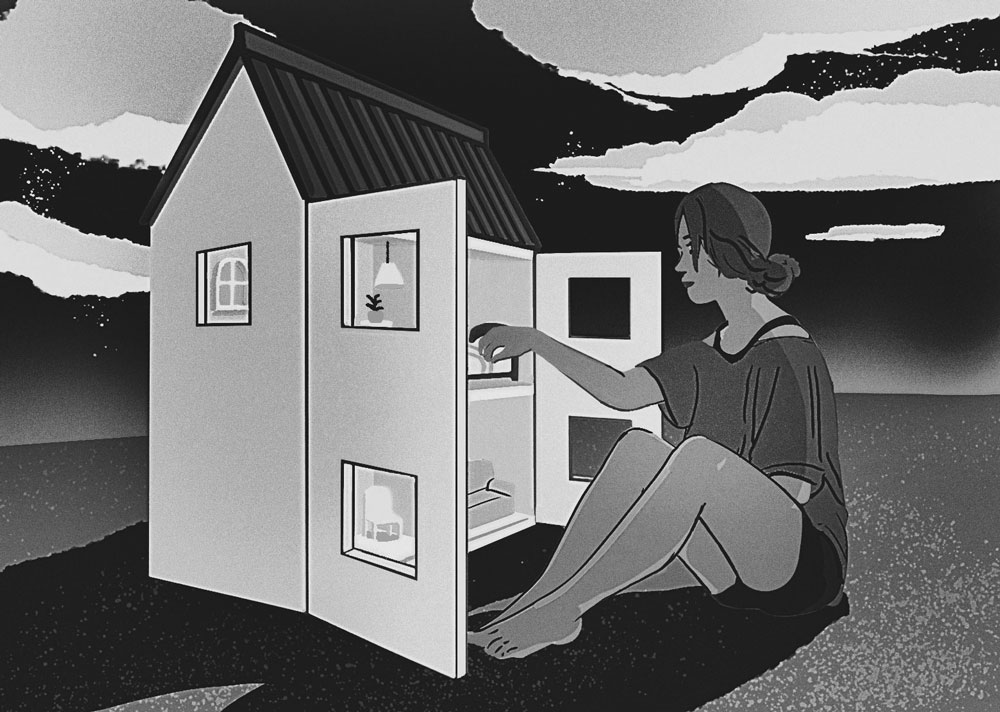
Having a baby rearranged the furniture of an author’s life.
Paul Kim
While pregnancy made Fowles feel “powerful, fearless, and determined,” delivery proved traumatic. “Twenty-seven hours of labour and four hours of pushing” left her with “third-degree tearing.” The intensity evoked another trauma: a sexual assault that had remained “written in my skin, in my flesh, in my bone.” But the triumph of birth also afforded a startlingly fresh perception of her body as neither frail nor vulnerable — and certainly not shattered. Rather, she saw it as “whole,” “capable,” and intact.
Nonetheless, breastfeeding problems, sleep deprivation, and demanding infant care induced postpartum anxiety, or PPA. “Defined as ‘excessive worrying’ that occurs after having a baby,” she explains, the condition is postpartum depression’s “less-discussed sibling,” similarly linked to hormonal changes. A previous diagnosis of an anxiety disorder predisposed Fowles to PPA and to extreme concerns for her infant’s well-being. “It was as if every errant anxiety I had ever had in my entire life rose from dormancy and happily found a renewed sense of purpose,” she remembers.
The forthright examination of her changeable psychological state is a distinctive feature of this volume. Fowles exposes her naive prenatal assumptions about parenthood — that she would be the one mother untouched by “loss of career and identity and sanity”— and her superficial judgment of mothers who seemed “so capable and perfect and together.” Despite a constant feeling of inadequacy, her first-hand experience and hard‑won knowledge eventually led her to conclude that all mothers were just “doing the best they could in a system that was never built for them in the first place.” Still, she wishes mothers were accorded the same “authority in the public sphere” as fathers.
One of Fowles’s greatest fears is that her daughter will “turn out like me” and become “a lifelong worrier.” To forestall that fate and to foster a robust sense of freedom and confidence in her child, she had to confront her own apprehensions. In reflecting on her own mental health, she was able to accept that her worries must be understood in the context of past circumstances. Participating in everyday activities, regularly and with intention, helped her subdue “the monster that is anxiety.” She walked her dog, Shelby, a needy but loving rescue. She mastered the art of cooking and relished baking with her toddler. She spent time with other parents and their children. She savoured coffee with friends and appreciated being alone.
Fowles’s writerly ambition waned in the first weeks of her daughter’s life, when her sleep was disrupted and focus felt unattainable. But it soon resurfaced to inform the central conundrum of this exploratory narrative: How can one be both a writer and a mother? The question was particularly pressing while Fowles was at home with her newborn, isolated from peers and colleagues and removed from her once active life. As she admits, in those heady months her infant “took up so much room in my psyche, was so close up in my view, that I couldn’t fathom writing anything more than her name over and over again.”
This memoir, in its depth and design, is evidence that Fowles has grappled extensively with this dilemma. Today she understands identity as “a complicated, shifting beast” and insists that she “cannot write without” her daughter. The wisdom —“that being present as a mother in my creative work is deeply important”— derives from devoted caregiving and a refusal to conceal an essential facet of her life. It is this intimate “chunk of my reality” that Fowles critiques and celebrates with candour in The Lost Season.
Ruth Panofsky is a professor of English literature at Toronto Metropolitan University.
Advertisement
Advertisement