The Literary Review of Canada

To learn more about the LRC's recent shift to charitable status, click here.

Get free email updates!

Magazine Issue ›› September 2009

Editor's Note

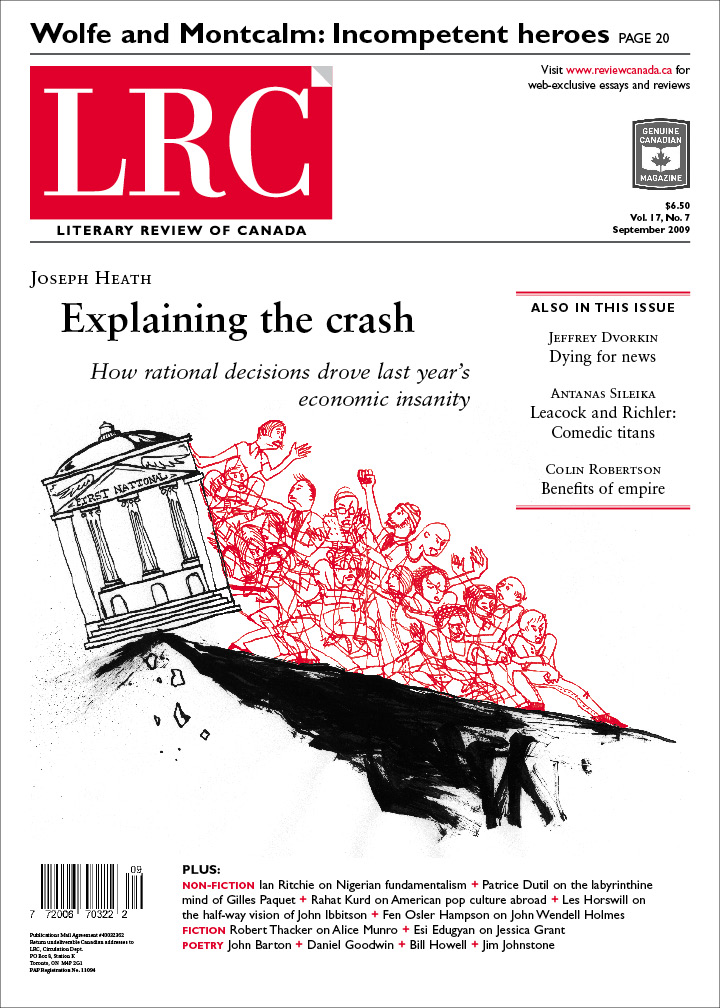
Did the banks go crazy? That’s the question U. of T. philosophy professor Joseph Heath asks in his provocative feature essay for our September issue, marking the first anniversary of what’s been dubbed “the financial meltdown of 2008.” In contrast to ex-Federal Reserve Board chair Alan Greenspan, who described his state of “shocked disbelief” at what he considered the irrational behaviour of institutional lenders, Heath argues that individually rational decisions proved disastrous when they coalesced into general practice.

September 2009 marks another auspicious anniversary, this time in Canadian history: it has been 250 years since the Battle of the Plains of Abraham in Quebec City. Jack Mitchell, a Toronto-based poet who has written his own full-length epic about the battle, considers five books that deal with this mythic moment in Canadian history and provides a brilliant critical analysis of the rather sordid political tug-of-war that ensued earlier this year over a proposed re-enactment of the battle itself.

In the past twelve years, more than 1400 reporters worldwide have died in pursuit of the news. A glamorous and exciting profession can also be a deadly one, apparently increasingly so. Jeffrey Dvorkin, one of Canada's most prominent journalists (first with the CBC and then with National Public Radio in the U.S.), examines two books that look at the lives of such brave, and sometimes reckless, reporters: Murder Without Borders: Dying for the Story in the World's Most Dangerous Places by Terry Gould, and Unembedded: Two Decades of Maverick War Reporting by Scott Taylor.

On the fiction front, a new Alice Munro collection of short stories is always welcome front-page news. We are privileged to have her new volume, Too Much Happiness, reviewed for us this month by Robert Thacker, author of the 2005 critical biography of the author’s work, Alice Munro: Writing Her Lives.

Happy autumn to all our readers.

Bronwyn Drainie
Editor

In the September 2009 Issue

  • Did the Banks Go Crazy?

    Whatever economists might think, rationality and efficiency don't always go together.

    Joseph Heath
  • A Loaded Anniversary

    A review of D. Peter MacLeod's Northern Armageddon: The Battle of the Plains of Abraham; of Jacques Lacoursière's and Hélène Quimper's Québec ville assiégée; of Joy Carroll's Wolfe and Montcalm: Their Lives, Their Times, and the Fate of a Continent; of Gérard Saint-Martin's Les plaines d'Abraham: L'adieu à la Nouvelle-France?; and of Stephen Manning's Quebec: The Story of Three Sieges.

    Jack Mitchell
  • No Problem Here

    A review of Alice Munro's Too Much Happiness

    Robert Thacker
  • A Dying Breed

    A review of Scott Taylor's Unembedded: Two Decades of Maverick War Reporting and Terry Gould's Murder Without Borders: Dying for the Story in the World's Most Dangerous Places

    Jeffrey Dvorkin
  • Benefits of Empire

    A review of Lineages of Despotism and Development: British Colonialism and State Power, by Matthew Lange

    Colin Robertson
  • American Dreams?

    A review of Richard Poplak's The Sheikh's Batmobile: In Pursuit of American Pop Culture in the Muslim World

    Rahat Kurd
  • Paquet's Labyrinth

    A review of Gilles Paquet's Crippling Epistemologies and Governance Failures: A Plea for Experimentalism and of Gilles Paquet: Homo hereticus, edited by Caroline Andrew, Ruth Hubbard, and Jeffrey Roy

    Patrice Dutil
  • Book-Ending Canada's 20th Century

    A review of Margaret MacMillan's Stephen Leacock and M.G. Vassanji's Mordecai Richler

    Antanas Sileika
  • Mill Creek Reverdie

    A poem

    John Barton
  • Domestic Epic

    A poem

    Daniel Goodwin
  • Character Based on an Old Letter with the Same Surname

    A poem

    Bill Howell
  • Invertebrate

    A poem

    Jim Johnstone
  • Tale of a Tortoise

    A review of Jessica Grant's Come, Thou Tortoise

    Esi Edugyan
  • Halfway There

    A review of John Ibbitson's Open and Shut: Why America Has Barack Obama and Canada Has Stephen Harper

    Les Horswill
  • African Reformation

    A review of Ruth Marshall's Political Spirituallities: The Pentecostal Revolution in Nigeria

    Ian Ritchie
  • Unsung Hero

    A review of Adam Chapnick's Canada's Voice: The Public Life of John Wendell Holmes

    Fen Osler Hampson
  • Another City

    A review of Martin Hunter's Young Hunting: A Memoir and Margaret McBurney's The Great Adventure: 100 Years at the Arts and Letters Club

    Mark Lovewell
  • Cover art and pictures throughout the issue by Norman Yeung.

    Norman Yeung makes pictures, plays and films. See www.normanyeung.com.

Letters for September 2009

  • Re: “Benefits of Empire” by Colin Robertson

    Colin Robertson's review of Matthew Lange's recent book, Lineages of Despotism and Development, takes issue with the rather reasonable view that the illiberal character of every imperial adventure is always unwelcome to those who are colonized. In response, he evokes the grandeur and nobility of sentiment that adorned the British imperial project at its apex. Yet one cannot help suspecting that where Lange sees the reality, Robertson serves up romance. He falls prey to the easy trifecta of self-serving arguments employed by defenders of the British Empire—it was preferable to its vampire empire competitors, it left behind some worthy institutions and, finally, it saved the Natives from themselves (witness the bloodshed when Britain finally left).

    Robertson reflects "it sometimes seems that more ink than blood has been spilled by both [the British Empire's] defenders and antagonists." Sadly, this was not the case. The long and grisly catalogue from slave trade to aborigine slaughter, opium wars, murderous collective reprisal massacres from the Sudan, Malaysia and Amritsar, to the Bengal famine of 1770, all tell a much different story of empire than that of the penny post. Rather, one comes to view a state of affairs littered with avarice, cruelty and incompetence only to be justified with the rhetoric of a humanizing and humanitarian ideal. History shows that where freedom and empire are in tension, those who would conquer display a preference for the latter. Robertson approvingly quotes Orwell, but misses a more instructive passage where Orwell notes that "empire is a despotism—benevolent, no doubt, but still a despotism with theft as its final object."

    Isn't this debate oh-so-1990s—aren't we all post-colonial now? The consequences of understanding empire and our role in it are real, particularly as former colonies that were at the business end of empire start to play larger global roles and flirt with their own imperial projects (China in Africa). English Canada is still recovering from our own post-colonial hangover, not sure what to be proud of and what to disassociate from. Our response to our own part in imperial history will inform our global relationships in the coming decades. The glories of dominion status and the glamour of association with such a grand global project as empire rightly started to fade in the trenches of World War One and have been thoroughly supplanted by the emergence of modern, post-Pearsonian Canada. In practice, we've fashioned a very 21st-century post-imperial idea of self that, if well told, travels well in the rest of the world. But, as Robertson shows, nostalgia, even amongst keen observers, fades slowly and is deeply wrapped up in our family and institutional memories. Robertson, and the rest of us, would do well to recall Edward Gibbon: "The history of empires is the history of human misery."

    Rana Sarkar
    Canada-India Business Council
    Toronto, Ontario

  • Re: “Halfway There” by Les Horswill

    Les Horswill's review of Open and Shut: Why America Has Barack Obama and Canada Has Stephen Harper, John Ibbitson's strange little book, both totally misses the mark and is bang on.

    Horswill ignores the parade of stereotypes and anecdotal claptrap that make the book a right-wing equivalent to Michael Adams's Fire and Ice: The United States, Canada and the Myth of Converging Values, except without the poll results. In 2003 Adams told us that "hot" George W. Bush was America, to smugly reassure "cool" Canadians in their own superiority. Now Ibbitson tells us that "open" Obama is America (and worse, "closed" Stephen Harper is Canada), to needle them with their own inferiority. Neither is right, of course.

    Horswill also ignores the fact that Ibbitson's book actually has almost nothing to do with either Obama or Harper. Instead, we have a smorgasbord of policy recommendations (hopes? dreams?) that make some sense to Ibbitson, but are much more difficult for the reader to understand as anything remotely approaching a coherent whole. There is an overwrought demand to "open" the Canadian bureaucracy, something about pushing charter schools, a rant that members of Parliament swear allegiance to the constitution, another bit about having the feds play a larger role in urban affairs, even a call for high speed rail.

    Horswill ignores these shortcomings to serve his own purpose, which he correctly understands is the real core of Open and Shut: advocating deep integration with the United States, which Horswill calls "impeccably mainstream." This is probably news to most mainstream Canadians, who might favour free trade but haven't shown a scintilla of interest in deep integration, either by creating a customs union, as Ibbitson suggests, or better yet, in Horswill's view, by allowing Americans to vote in our elections, adopting the U.S. currency or, ultimately, simply joining the United States.

    Both Ibbitson and Horswill are providing the one panacea deep integrationists always offer, no matter what the question, crisis or conundrum is. The way for Canadians to get rid of their stiff Harper and get a shiny new Obama is deep integration. Deep integration was also the answer to the plunging dollar. It will be so when the dollar reaches parity, too. Deep integration was the solution after 9/11, and the solution before 9/11. And so on.

    Stranger still, while Ibbitson and Horswill think that Obama's ascendance can convince stubborn Canadians of their logic, they both ignore the reality that Obama is probably the greatest obstacle to their dream.

    Dimitry Anastakis
    Trent University
    Peterborough, Ontario

  • Re: “Did the Banks Go Crazy?” by Joseph Heath

    There is much in Joseph Heath’s essay with which one can agree, including the critique of the rationality-efficiency emphasis by certain economists and practitioners of finance, which doubtless played a role in the credit crisis.

    Professor Heath also sometimes goes too far, however, as when he writes of the crisis that “many [economists] actively contributed to it by aggressively rationalizing the very practices and institutional arrangements that gave rise to the collapse of the U.S. investment banking system” (p.3).

    Many economists have long since qualified the view that markets were rational and efficient from a social point of view. The “new behavioral approach to economics,” emphasizing the role of psychology, has certainly challenged ideas of perfect rationality. But the quality of institutions, both public and private, has long been an important aspect of the economics of growth – see, for example, the long-standing publication record of those associated with the he Canadian Institute for Advanced Research.

    Professor Heath also says that relevant academic specialists have strongly resisted the common sense view that, in relation to stock options and executive compensation, “CEOs were just ripping off shareholders, taking advantage of information asymmetries and collective action problems that resulted in weak oversight.” But institutional economics has long studied the high incidence of opportunistic behavior, information asymmetries, and moral hazard in complex markets such as finance, all leading to excessive risk taking.

    Surveys by the American Economic Association (AEA) and others likewise present a picture that does not fit well with Heath’s depiction of economists’ views. A working paper by Samuel Klein and Charlotta Stein (2006) for the Swedish Institute for Social Research surveys AEA members on their views on 18 specific forms of government activism. They conclude “that a large majority of economists are either generally favorable to or mixed on government intervention, and hence cannot be regarded as supporters of free-market principles” (p.1). There are some problems here, including a relatively low response rate of 27 percent and questions about how one interprets the cut-off point for free-market supporter. But it is of interest that the tariff is the only case of the 18 forms of intervention which economists largely opposed.

    Similarly, Professor Heath goes too far when he castigates “most” economists for failing to predict the crisis. I do not know of a study of the proportion of economists who predicted the crash - and Professor Heath does not cite one. But as for the undoubted errors by some (not all) macroeconomists and those in financial economics, it is instructive to consider Robert Lucas’s recent piece in the The Economist (8 August, 2009, 67). It appears we will never be able to forecast crises adequately, despite all the evidence available on such collapses – after all, the recession under way in 2008, led by housing, was not very different from many that preceded it. What turned it into something much worse was the collapse of Lehman Brothers, which exposed serious underlying financial problems that had accumulated in the system over time. Nevertheless, one keeps hoping that analysis – theoretical, empirical, historical – will give greater success in such forecasting of very complex phenomena.

    (In their recent book, This Time is Different: Eight Centuries of Financial Folly, Carmen Reinhart and Kenneth Rogoff have argued that history and precedent bear very much on issues in current finance.)

    And yet, will anyone in power even listen to accurate economic analysis? During the 1990s, a U.S. hedge fund called Long Term Capital Management, based on a formulaic approach to investing with very high leverage and little regulation, had spectacular success for a time, then equally spectacular failure. Because of feared systemics effects, the Federal Reserve led a rescue operation along with various banks. Curiously, some of the financial tactics used and even some of the Federal Reserve and other banks’ personnel figured in the more recent crisis. Was there no learning going on at all during this earlier bailout, or do some of those in power not listen well?

    Obviously some economists have had a large influence on the ideas of policy-makers and business people, but decision-making power ultimately lies with government and big business groups. Think of the excessive leveraging, poor assessment of risk, and outright dishonesty at the most senior levels of some major firms. Think of the failure of government to regulate the shadow banking system which grew to finance such a large part of economic activity, including ridiculously overpriced mergers and acquisitionsssets now saddled with huge debt and low sales; of the poor timing of the repeal of Glass-Steagall, which had separated commercial from investment banking; of the easy acceptance of potentially explosive financial innovation because of government desire to make housing even more affordable; and the decision to hold interest rates low after the 2001 recession. So while some economists played a part, both business and government contributed mightily to the damage of the last few years.

    Ed Safarian
    University of Toronto
    Toronto, Ontario

    Response to Did the Banks Go Crazy?

The LRC welcomes letters. We reserve the right to publish such letters and edit them for length, clarity and accuracy. E-mail editor[at]lrcreview[dot]com.

Online Originals