
Turning, she looked across the bay, and there, sure enough, coming regularly across the waves first two quick strokes and then one long steady stroke, was the light of the Lighthouse. It had been lit.
— Virginia Woolf
Lead, Kindly Light, amid the encircling gloom,
Lead Thou me on!
The night is dark, and I am far from home,
Lead Thou me on!
— John Henry Newman
After months of anticipation, I had finally arrived. At mid-morning, on that crisp, clear day, I was standing in the presence of spectacular, dance-like waves hitting the rock. The spray cascaded with a graceful fall into bubbly white pools, while deeper parts of the ocean were turquoise, in varying tints of blues and greens, the wet stones an earthy brown, some of them speckled with lichens in gold. Overhead, tree swallows from the forest passed swiftly, darting with the wind.
At my side, a local retired fellow welcomed me with warmth, conscientious about his “keeping,” visiting the site throughout the day, acting as a host in gigantic proportions, proud of this pretty, historical place. “You’ll see the full moon,” he announced, insisting on its loveliness when viewed from the height. The fog, he continued, persists out here.
“Sea smoke,” he called it.
How often — and when — would it come? I wanted to know.
“One year, in July, it lasted for twenty-six days,” he replied with a breezy, lighthearted matter-of-factness.
I liked his poetic pair of words for the enticing mystery and quiet simplicity of fog, which I longed to experience.
As the artist-in-residence at the Port Bickerton light station, I would stay for two weeks in this sequestered setting: the home of an old illustrious lighthouse (now a museum), a modern automated one at its side, the former lightkeeper’s residence near the two structures, and twenty hectares of forest, bog, beach, and unspoiled shoreline in Guysborough County, on Nova Scotia’s Eastern Shore. In the spirit of the keepers and their families, I would anchor myself in isolation, at a formidable elevation over the Atlantic Ocean, at Barachois Head, the narrow entrance to the harbour.
“But never mind the fog,” my host resumed, in a sensible, practical tone, as he led me around the property, which the people of Port Bickerton, three kilometres down the road, had fought hard to keep in public — not private — hands. The villagers knew that this was an imperishable treasure to be guarded and saved.
In the 1990s, Ottawa began to scrutinize and classify lighthouses and their subsidiary buildings in an effort to identify “surplus” structures no longer required by the Canadian Coast Guard or the Department of Fisheries and Oceans, in an era of advanced electronic navigational equipment. The process produced a sort of doomsday list: lighthouses (or partial light stations) to be closed, demolished, burned, sold, downgraded in intensity, or left to deteriorate on their own. The only form of salvation had to come from local communities, who could rescue some or all of the buildings through diligent fundraising, volunteer labour, painstaking restoration, and, dare I say, steadfast love for these elegant, emblematic architectural gems. After all, they’d been integral for centuries to a Maritime economy: Nova Scotia’s first lighthouse, the earliest in Canada, was lit at the Fortress of Louisbourg in 1734.
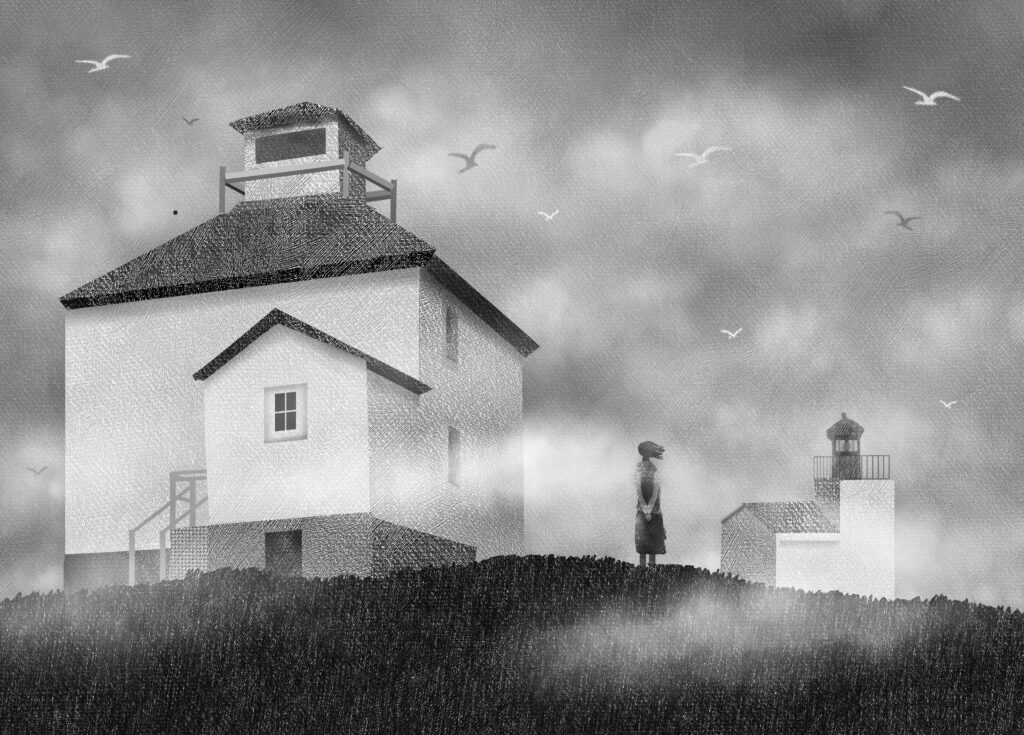
For two weeks, Port Bickerton would be home.
Dave Cutler
The people of Port Bickerton stepped up to the light and embraced the challenge. With patience, they persisted for fifteen years to “divest” the light station from government oversight, rebuffing a horrifying plan to use the land for a PCB incinerator. Proposing an ambitious project, they set out to restore and maintain the three principal buildings, to establish a comprehensive interpretive centre, and to protect the sensitive natural surroundings through a network of diverse and vividly scenic trails.
This community was among the first to defy the demise of the lights. The Nova Scotia Lighthouse Preservation Society honoured its effort — as a model of diligence, resilience, and foresight — in 2006.
The current keeper, as I thought of him, shared the richness of his mind with me in the days to come, the details of the history and the current management of the property, as well as his quiet but visible fondness for its cloistered location, unfolding as fluidly and as rhythmically as the waves that were banging on the boulders beneath us, with a deep, resonant, thundering reverberation. With his eyes on the modern, still-functioning lantern — rotating automatically through the night and day (with or without the fog) — he watches the site year-round from his home across the water, on the other side of the harbour.
What poetic pair of words would he have for light? Mist? Rain? Wind? Waves? Unseasonably cooler days? I would wait for the revelations, if they came: each eloquent phrase, one by one.
To be sure, fog appeared, in its freshness and ambiguity, as did the light from the lantern gallery, an octagonal turret of glass and steel, its red cap and red base serving as the frame for the rooftop structure, including a railed deck.
On my own in the mornings, at half past five, when I set out to hike on Lighthouse Road — a rustic, low-lying gravel avenue subject to damage in tempestuous weather, the only way into or out of the station — I would gaze at the lamp, which sparkles as a flash, not like a candle flame or a solid, steady beam. With every few steps, I turned around to look back, to witness the power of the luminosity, bewitching my eyes, as a guide for seafaring vessels and my wayfaring feet alike.
The two towers, the new and the old, rise up from the rock and the forest, sharing the work of crowning the mighty slope. They stand almost side by side, neatly attired in red and white, near replicas of each other, a stately couple, as custodians of the cape. Beneath them, the cliff descends to pillars of granite, which tumble and wedge their blocky formations into a dangerous, ragged ridge: a place where — without the light — wind or rain or snow or waves could smash a vessel into the wall.
Miraculously, on the brightest mornings, both towers appear to be lit: the old historic building, which lacks a lantern now, receiving and reflecting light from the sun on its east-facing square tower windows and white wooden walls, as if a wick has been kindled. The natural light is more brilliant, somehow, than the intermittent flash from the functioning lamp, which dims automatically as the day begins.
The Port Bickerton site is unique in hosting two lighthouses. The historic version, built in 1930, replaced the original structure, established in 1901 but later destroyed by fire. In the 1960s, the second lighthouse also ceased to function. Ill-equipped for electricity, including its mechanical weight, the elderly wooden building closed, while the third, automated lighthouse was fashioned in concrete at its side.
The 1930 lighthouse is certainly the star, exuding a personality and a character of its own, not only in its radiance, when sunlight glimmers on the glass in its tower, but also in its elegant design. One of the few remaining structures of its kind in Nova Scotia, it features a combined dwelling for living and maintaining the beacon: that is, a home in one space for both the keepers and their labours. Not the familiar “pepper pot” model, the square design is classic for its era. The building resembles, some say, a white country church, with the lantern gallery standing in for a sacred bell tower.
Almost a hundred years after its birth — and more than sixty years after the eviction of the keepers, when the automated tower replaced the old building, though the keepers remained on the property as caretakers, in a separate residence, until 1988 — this empty lighthouse has the essence of humanity about it. When stepping inside, a visitor envisions a family inhabiting and working within the simple but functional interior: a former living room, kitchen, and porch for wood and handwashed laundry on the main floor; three modest bedrooms on the second level; two steep vertical ladders with railings — twelve rungs, then a turn, then seven steps more — that lead to the third-floor lantern room; and, finally, a magnificent view from the top, with the Atlantic Ocean in three directions and woodlands in the fourth. Additional windows on the lower floors, most of them facing east, from where the harshest weather arrives, offer a thin barrier between the intricate domestic and operational interior space and the wild, elemental conditions around it.
Gale-force winds. Storm surges. Hurricanes. Snow squalls. Freezing rain. Heat. Haze. Thunder and lightning. Fire from forests and blazes from beach grasses. Salt spray from the ocean.
Fog, surely, would be gentle.
Lightkeepers, more than anyone, I came to believe, must have known how to read and to interpret the weather. Indeed, they were writers, of a particular sort.
Within days, I discovered inside the museum an unpretentious pile of notebooks, the covers now crackling and somewhat tattered with age, the faint pages revealing a simple, quiet story. Dated between 1904 and 1914, each book, a government-issued “Diary of Lightkeepers,” contains a meticulous record: a daily, rigorous account of life at the station. The authors, as I called them, in admiration for their elegant script, fine-tipped black pens, precisely chosen words, and uniquely expressed perceptions, were situated, in this case, at the Cranberry Island Lighthouse, east of Port Bickerton in Chedabucto Bay.
A sequence of narrow columns — for weather, direction of wind, time of lighting and extinguishing the flame, length of burning, quantity of oil, number of chimneys, sum of wicks, and general remarks — runs the length of every foolscap sheet, with a row for each day of the month. From page to page, across the delicate documents, the patterns in print rise and fall, like the rhythms of the tide, like the whistling wind that rattled the old windows and walls while I stood inside to handle the prose. On October 1, 1909, for instance, the lantern was lit at 5:40 p.m. and extinguished at 5:58 a.m., the flame sustained for twelve hours and eighteen minutes by one gallon and four pints of oil, on a day that began with fog, which cleared. During the darker weeks of December, another page reveals, the lantern burned for fifteen hours and six minutes, though on the final day of May, even with solid intervals of fog, the illumination lasted for only eight hours and thirty-nine minutes.
With dutiful diligence, lightkeepers’ hearts and minds were riveted on minutiae.
In the column for weather, the first line on every page, close to the spine of the honoured book, the words are precise yet cautiously expressive, rivalling my keeper’s “sea smoke.” Painstakingly composed, they vary from day to day, capturing gradations and fluctuations: “snow sleet fog,” “hazy rain,” “clear very rough,” “cold ice floes,” “mild and foggy,” “heavy vapour,” “westerly gale,” “rain and snow squalls,” “harbour full of drift ice.”
At what hour would the pulse of the weather be taken and composed, I wondered, and would the conditions alter after the ink had dried? In some cases, words were inscribed on their sides to fit the diminutive boxes; even so, letters cascaded into neighbouring columns — not enough room, the keepers must have felt, to properly chronicle the meteorological plot.
From book to book, I witnessed the eloquence, each lightkeeper distinguished to my eyes only by penmanship, not by a name, some of the records simpler and more circumspect than others. I envisioned their diverging personalities: What did they think and feel and aspire to do as keepers of light and of foghorns? Why had they chosen this exacting vocation, to live with their families on rugged rock? Even the lengthy lists of ordinary provisions delivered to every station — flannel, towelling, chamois skins, grey cotton, reflectors, matches, sponges, brooms, scissors, paint, brushes, soap, chimney cleaners — provoke the modern reader to a thoughtful pause, to contemplate and imagine this neat, orderly, measured existence, inaccessible to us now and pleasantly removed from the noise and clutter and frantic pace of our contemporary world.
Lightkeepers worked with integrity while using their hands in a daily, patient, and skillful application of manual labour: receiving containers of oil from supply ships for the lanterns, moving coal, climbing continually to the rooftop tower with a grip on the railings, lighting and extinguishing the lamp, monitoring wicks, polishing reflectors, removing salt, sleet, and snow from lantern room windows and foghorn stations, repairing and installing devices, and composing daily notes with nimble fingers and a gift for accuracy and detail. No task was neglected or considered insignificant for a lightkeeper’s calling: to keep people alive.
And when did they rest or sleep or stop to nurture their bodies when sick or dare to briefly leave the station, one wonders? Or to pray?
“2 men drowned 3:30 pm while returning from fishing,” one lightkeeper recorded in July 1913, his tidy handwritten letters almost microscopic, wedged into the narrow column for “Remarks,” a moment of silence and sadness, no doubt, when he noted the loss: the human frailty, in spite of his human effort.
Never a port for the lumber trade, shipbuilding, or large mercantile vessels of any sort, the Port Bickerton harbour, unlike others in Nova Scotia, has faithfully focused on fishing. Before Ottawa’s moratorium on the northern cod fishery in 1992, which depleted the strength and size of the village, the community sustained a vibrant groundfishing economy, with large trawlers — or draggers — sweeping the waters for cod, haddock, redfish, and flounder, all of them filleted, packed, frozen, and shipped from a busy plant nearby. Now fishermen pursue a single but thriving market for lobster (along with snow crab).
Port Bickerton’s lighthouses — the old and the new — have sustained and supported this pulse of the village. Two sets of hands, so to speak, have been intertwined: muscular lightkeeping hands for climbing stepladders and lighting and cleaning the lanterns and robust fishing hands for reeling in ropes and traps from the ocean floor, banding the live lobsters’ claws in the crates for the buyers, rebaiting the traps, and tossing them back to the water for the next day’s catch, the sequence of movements, in either case, swift and precise. Fishermen once built their traps by hand, boiling or steaming local black spruce, a flexible wood, to soften the timber, to shape the bow, which hardens when dry, the slats measured and cut; then the twine — knitted with a needle in an intricate process of looping and knotting a series of diamonds — wraps and tapers around the whole of the structure.
One might easily miss the finery: the understated, artful marvels that define a coastal community, like the forms of the rocks, which water and waves distill with wear.
Now lobster traps are metal, less likely to be smashed, and not handmade. Now a fisherman’s cabin is furnished with elaborate electronic navigational aids, including colourful maps on sizable screens. No need for a lighthouse, perhaps.
“Do you depend on the flash?” I dared to ask of George, the village’s esteemed and wisest fisherman, I sensed, and maybe one of its oldest — having fished for thirty-nine years, he told me when he invited me onto his boat.
In silence, he didn’t reply, intimating — without saying — that the lighthouse has been surpassed. Despite his reticent pause, I ventured to think that he values the flash at half past four in the morning, as he leaves the wharf in the dark, when the lobster season begins in April, with his daughter and his second mate at his side. The lamp must be a steady anchor in his soul: a glimmer, a companion on those cold early days, when drift ice persists in the harbour. Is the lantern also an image, a faint recollection, of his first small wooden boat, when he fished alone in his younger days with his handmade traps, crafted and mended throughout the winter? “Hard work,” he would say, in a weary tone, though his big brown eyes sparkled at the thought, an admission of joy for the only life that he knows.
Surely he cherished the light then, as he might still now. Quietly, at least.
“Sea smoke.” The fog obscures the craggy coastal rock, a defining feature of much of Nova Scotia, and hides the shallowest parts of this tricky harbour, which was never conducive to a vigorous, more diversified trade. It has been rightly reserved for fishing, for faithful labour in the art: for George, his ancestors, and his descendants (for five generations or more, he was quick to tell me), and for his companions in neighbouring boats.
While not the star of the Port Bickerton light station, the modern functioning lighthouse — self-driving like a clock and never inhabited — has a beauty of its own, with the lantern gallery as its prettiest feature. A slender tower, equally metal and glass, sparkles in darkness or at twilight or in fog. Like a diamond, I thought, some days. Or a crystal. Or a star. Or the moon. Not overbearing but reassuring. I would rise in the middle of the night to watch it rotate, spinning and spinning — what could rival a flash in the gloom? — as I intuited its musicality: an instrument finely tuned and impeccably designed.
Admittedly, the building below is clunky, awkward, and blockish in places — without windows. A sign on the door reads “Danger Keep Out,” while another heralds the risk of approaching too closely or curiously: “Caution! The foghorn could start automatically at any time. Please note that noise levels may cause hearing damage.” As a cold, impersonal structure, it is disconcerting: the human heart has been wrenched out of all of these modern towers. In the past, that heart would pause to write — to honour in script, at mid-afternoon, the invisible deaths of two fishermen — and to ponder, undoubtedly, the insurmountable splendour and wrath of the ocean, though one must try, as fishermen do, to be skillful and wise and to persist.
Yes, the lighthouse stands. It is still here. And functioning: not demolished as surplus, destroyed by fire, eroded by water, toppled by wind, vandalized by strangers, abandoned by the community, or disintegrating with age.
Although not as handsome as its older sibling, it complements the story: the first leaning on the second, so to speak, not only in the mornings when one reflects the rays from the rising sun, while the other revolves unreservedly regardless of weather, but also in the evenings, when the setting sun is aligned horizontally with the two structures, the elegant shape of the elder casting its shadow on the younger.
As a fortified pair, they watch over their natural surroundings: rocky, windswept, treeless peninsulas; dark, moist interiors of a forest; miniature coves decorated with seaweeds, shells, and stones; an abundance of bogs with oval ponds, in inky blacks or chestnut browns, edged by plants in tints of rose; marshlands matted with carpets of flowers; spotless beaches sprawling with sand.
Hospitably, the two embrace an extraordinary variety of sea creatures as they gracefully pass or dive or dart in the air, or placidly float in the water, or perch on the rocks. Northern gannet. Common and roseate terns. Double-crested cormorant. Minke whale. Harbour porpoise. Grey seal. Common eider. Common loon. White-winged scoter. Bald eagle. Great blue heron. Willet. Semipalmated plover. Least sandpiper. Greater yellowlegs. Great black-backed gull.
And while glancing principally toward the ocean, the lighthouses also guard their treasures inland: tiny wildflowers and plants, delicate and unassuming.
By keeping lighthouses, a community keeps its migratory, seasonal, and year-round inhabitants. It keeps the story running, with more logbooks and diaries from those who visit: informal lightkeepers, of a sort, who contribute, even imaginatively, to the longevity of these fragile structures, not unlike old farmyard barns or prairie grain elevators, still spotted on the rural horizon.
I left without speaking to the current keeper, the careful, casual custodian who has kept his voluntary post for twenty-six years. Where was he on that day? Why didn’t he come? Had my countless questions kept him away? With each of my inquiries, he had lifted his ball cap, as if needing space for the answer, replacing the hat on his head with a shift of the rim, from side to side, before speaking, the effort of careful thought unreasonably demanding, he might have felt. I departed without a final pair of his poetic words.
Two days before, he had arrived at the cape at seven o’clock in the morning. For what? I wondered. For the beauty? (He had spoken earlier of coming at midnight sometimes — for the moon.)
“Collecting the garbage,” he replied. “The trucks won’t come this far.”
Of course not. Not on that bumpy gravel road.
Would he be back later in the day?
Not today.
And that was the last that I saw of him.
In fact, the sea smoke had vanished by then. Warmth and sunshine — too bright for my sensitive eyes — had ravaged the richness of the moisture, which had welcomed me to the light station, along with the muffled booms from the horn on those days of deep fog.
At the earliest hours of the morning, does the current keeper also watch the two lights from the two towers: the irregular glow on the glass from the sun and the regular flash as the cylinder turns? Does he witness the shadow of the older structure imprinted on the wall of its mate, both buildings, by design or by chance, falling in line with the evening light?
I wasn’t able to ask.
Does George, from behind the steel wheel of his boat, with a windshield in the cabin — his “station,” as he calls it — share my doubled vision of the doubled towers?
Do these stewards of lights and lobsters, and everyone else in the village, cherish the magnificence of the pair? Cherish the doubling of luminosity, hospitality, and cheerful bands of red and white paint, so different from the black wet rocks and tracts of forest green in the coniferous trees?
“We like the light,” the keeper had said. “We want it to flash at night, but the foghorn is old.” The parts for repairs don’t exist anymore. “When it dies, it will be dead,” he conceded, with finality and with sadness, I thought.
Would he wish me to leave behind some words of my own, a modern visitor’s “diary of a lightkeeper”? Mine would be a fond account of life pared down. Of simple sounds: waves, wind, whistling from birds, and pleasant rumblings from fishermen’s boats. Of ocean and forest, sometimes brightly lit and sometimes dimmed by mist or fog or hazy rain. Of subtle smells: the salt in the air and the sweetness from coniferous needles.
“Do you want one of my shells?” the fisherman’s daughter had asked the day before my departure. “Keep it,” she said. “I find them every day. They come up in the traps with hermit crabs.”
Rattling her collection in a small white pail, she handed one to me.
“A slimy snail,” she called it.
Slender and spiralled and caramel coloured, the shell was exquisite, the length of the palm of my hand from tip to tip, and fresh from the darkness and depth of the ocean. No creature remained inside. Pointed and hollow, it was ripe for a story.
Beginning, perhaps, with a pair of poetic words: “Slimy snail.”
Suzanne Stewart is the author of The Tides of Time: A Nova Scotia Book of Seasons.
Advertisement

Advertisement