
A few months ago, the shelves and hanging rods in my closet fell down. Thankfully, my caring contractor installed a new system, but first I had to empty the closet. Being the daughter of a math professor, I did some counting: twenty-five black skirts, thirty black suits, fifteen black dresses, twenty-five cashmere sweaters, twenty white shirts. And, most appallingly, 250 pairs of shoes. I could not avoid the reality of my grotesque abundance — the reason everything fell down. Embarrassed by the episode, I was excited to read Steve Penfold’s The Dominion of Shoppers, hoping to gain insights into what drives shopping and consumption.
Penfold lays out a tidy linear narrative of the growth of shopping in this country, from colonial trading posts and settlement commerce to the birth of department stores, malls, and consumer capitalism. A historian at the University of Toronto, he shows how need shaped convenience, convenience built communities, and communities inflated status and desire, producing a society where we are more consumers than citizens. This sequence unfolded alongside the founding of the Hudson’s Bay Company in 1670, its upsurge, its decline, and its demise in 2025.
History professors, Penfold concedes, “are not very imaginative.” They tend to deploy dramatic terms — revolution, transformation — that belie the truth of how change happens. Every story has a beginning, middle, and end, but “history doesn’t work that way.” If we go back far enough in time, Penfold suggests, Moses could be the original consumer. The job of the historian is to make coherent the cacophony of human activity, by imposing organizing categories. Penfold promises to explain the course of Canadian shopping through place, product, payment, and power (perhaps mimicking the infamous five Ps of marketing). He describes the places where shopping was situated and scaled, says a little bit about the products, offers some discussion of the balance of cash and credit payments, and outlines the rise and fall of department stores’ curatorial powers.
The colonial phase of shopping serviced essential needs of explorers and settlers, while facilitating trade relationships with Indigenous communities. (Penfold is careful to note there was already trade among First Nations, but these dealings are not his focus.) Metal knives, kettles, glass beads, mirrors, and of course furs were the primary goods of exchange, driven by household need shifting from self-reliance to convenience. Introduce “I know who you are” credit, and you have the foundational ingredients of community-building commerce. Without such shopping, Penfold explains, there would not have been colonization.
Penfold describes the early years of the Hudson’s Bay Company, how it gained ascendancy over its competitors, and its emergence in the nineteenth century as the dominant shopping institution. What is absent is a discussion of the invention, use, and design of the iconic Hudson’s Bay blanket. Originally a French idea but made by British wool producers, the “point blanket” became an essential item for settlers and Indigenous communities. And it came with distinctive markings that designated size. Although HBC no longer exists, the design survives, making it one of the most successful branding stories of all time.
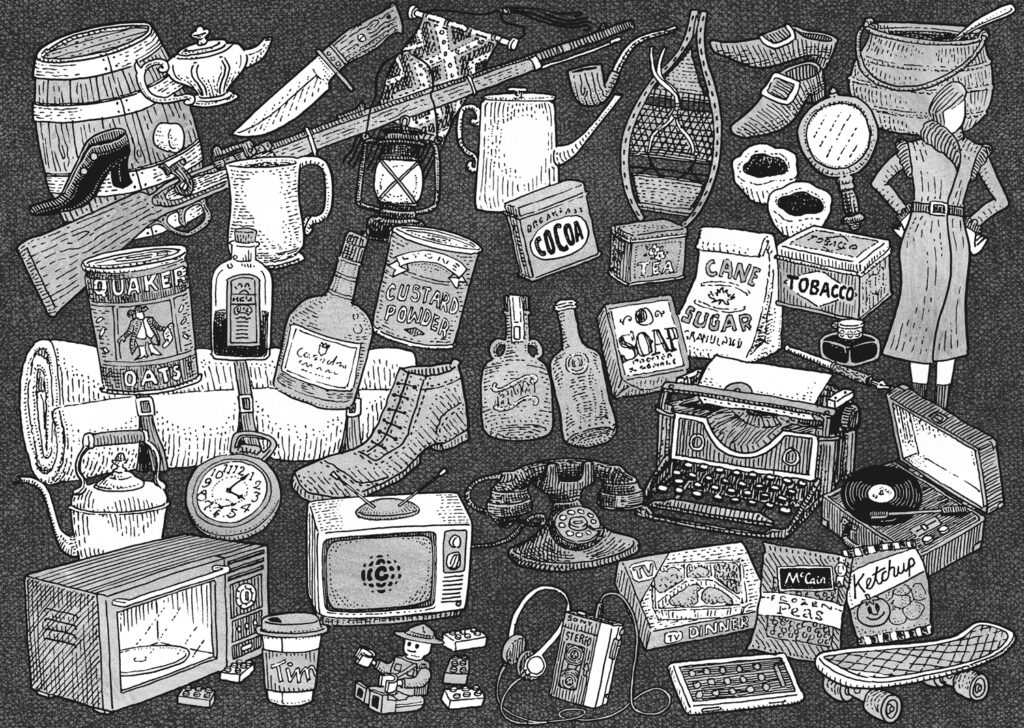
There’s always room for more stuff!
Tom Chitty
Population growth and resettlement fed the next phase of shopping. Increased demand generated new places of commerce — public markets and “frontier shops”— predominantly for linen, silk, sugar, tea, and alcohol. Penfold highlights several humbling stats: In the second half of the seventeenth century, the average person in New France owned 13.8 pieces of clothing. By the 1770s, that had increased to 21.4. Wool and linen were worn by most; the wealthy often wore cotton and silk. On average, someone had to work for a month in order to afford a pair of fashionable shoes and a silk kerchief.
With stores came early merchandising and dramatic displays. Need necessitated reuse, so people shopped with their own jars. Need also spurred on thieves, smugglers, and pedlars. Legitimate and illegitimate commerce grew alongside each other. And so emerged regulations: there were laws against “forestalling,” selling outside of market times; against “regrating,” reselling products at higher than legitimate market prices; and against “engrossing,” holding back goods until prices increased. Folks may not have had the benefit of Adam Smith’s demand and supply categories, but they knew how to game the market.
Marketing, merchandising, and branding characterized a third phase: modernity. In 1926, the Hudson’s Bay Company opened its Portage and Main store in Winnipeg, signalling the birth of “big retail.” While resettlement shopping was predicated on personalized service and credit, “modern retail” leveraged convenience, offering self-service and ready-made clothing. To feed convenience, secondary markets of stolen, second-hand, and damaged goods grew, as did the use of tobacco and alcohol. Consumers wanted more stuff to define their physical presence — and drugs to manage their state of mind.
Cash replaced personal credit, magazines grew fat with advertising, and branding cultivated allegiances. Long before Amazon, mail-order catalogues facilitated dispersed access. More people demanded more convenience to meet the faster pace of their lives, and that changed the nature of shops and products alike, leading to, for example, the creation of breakfast cereals. As Penfold elegantly puts it, “The overall balance of nature, labour, and family economy shifted towards more shopping.”
Distinctly Canadian stores opened in the nineteenth century, including Woodward’s, Eaton’s, and Simpsons; in the early twentieth century, Canadian Tire and Loblaws got started. Aggregators and curators of products and brands, they were organized into departments, hence the term “department store.” They offered payment plans and advertised in periodicals — nurturing related industries and creating self-reinforcing consumer culture.
Women were material to the growth of consumption, branding, advertising, and magazines. According to Penfold, they were its primary audience and were both consumers and culture shapers. This assertion jars with a personal family truth: in 1965, my mother, a full-time schoolteacher with her own income and bank accounts, was refused a Woodward’s credit card because she was recently divorced. Women might have been instrumental to the advance of consumer culture, but their value was often tied to having a husband. (Woodward’s filed for bankruptcy protection in 1992.)
The expansion of big retail brought forth supermarkets and shopping malls, in a period Penfold describes as the “Age of Booms.” Coming in three sizes, there grew neighbourhood centres (five to fifteen stores), community centres (fifteen to thirty), and regional centres (more than thirty). Penfold’s focus on the Lougheed shopping centre in Burnaby is odd: it neither predated nor has it been as successful as Oakridge Centre, an integral part of the Oakridge neighbourhood in Vancouver since 1959. Originally an open-air plaza, with Santa Claus and live reindeer at Christmas, it featured the city’s best shoe-repair store and a public library. It grew into a covered mall and began adding high-end retailers, including Lego, Tiffany, and Apple. Now called Oakridge Park, the site has been redeveloped as a city within a city. Its history might have been a more illuminating example of how shopping served and shaped a community.
Shopping and consumption have come to define who we are as individuals and communities. The growing numbers of newcomers, the creation of new consumer segments (like “teenagers”), easier and faster mobility with cars, and a credit industry designed to profit off of indebtedness together generated unprecedented consumption. Convenience and desire transformed new products into essentials: think refrigerators, frozen foods, stereos, televisions, microwaves.
The place, products, payment tools, and power of department stores and shopping malls held the source of their demise. The “Age of Disruption” has shifted shopping from stores and malls to scaled logistics and distribution, with Amazon and Walmart now leading the way. As brand marketing matured, luxury brands shaped desire into tribal alignment. Between scale and exclusivity, department stores were unable to figure out how to leverage their curatorial expertise. Simpsons shut down in 1991. Eaton’s closed in 1999.
Penfold’s is a phased chronicle of the triumph of convenience over community, credit over affordability, and scale over sociability — every stage transforming needs to desires to essentials. But he makes it clear that the marketplace had to deliver the goods and contend with the “moral” aspects of human demand. There was a constant push to minimize thievery, exploitation, and injustice. Penfold briefly notes moments of unrest and regulatory policies, including salt price protests in 1705; bans on Sunday shopping and efforts to limit alcohol consumption in the early 1900s; prohibition of margarine in 1886; and “Shop Canadian” campaigns dating to as early as 1962. All are examples of how we as consumers demand unfettered convenience and products, while we as citizens desire fair and just markets. The recent bread price-fixing by Loblaws, in cahoots with other retailers, reflects the fine lines between honest, acceptable, and deceptive commercial tactics.
Shopping in Canada started out as deeply social and political. Built on mutuality and reciprocity, it was instrumental in cultivating communities. Today shopping happens in digital spaces with almost unlimited credit and convenience designed to entrap us into buying more and more. What are the implications for our social life, our politics, our communities, and our planet if we have devolved into voracious, convenience-demanding beings?
Once upon a time, shopping was a shared activity: stores were a vital third social space and high streets the aortas of neighbourhoods. Notwithstanding a delightful recent experience at a Smythe store in Toronto, or waiting in a (tactically constructed) hour-long Brandy Melville line, I rarely spend time social shopping. Digital shopping is convenient and easy, but it denies me human interaction. What are the implications of surveillance and transactional shopping for how we relate as individuals and as citizens?
The Dominion of Shoppers reveals how desire is entirely elastic: How we are willing to be manipulated, watched, and enslaved to satisfy our needs and desires. How we are comfortable with the deception that we selected the cerulean blue sweater all on our own. Or how I really believe that one more pair of shoes will make me feel sexy, beautiful, and powerful. This is a history of how we always want more.
Fittingly, as an over-consumer, I wanted more from Penfold: More about the uniqueness of Canadian brands — from Red Rose Tea to Lululemon. More about high-street retail and how it both followed and led community development. More about the products that define us at different moments. How shopping has turned us into transactional consumers constantly seeking more, precisely because what we consume doesn’t deliver enduring emotional fulfillment. How we think shopping is rational. (As a wise Uber driver told me not long ago, sometimes a purchase is financially not smart but emotionally necessary.) I wanted to understand what the progression from colonial to settler to consumer commerce teaches us about how we might further coalesce as a twenty-first-century society. I wanted more about what shopping has done for — and to — us as individuals.
Penfold unfolds a Canadian story that starts with shopping being shaped by culture and need, and it concludes with shopping shaping culture and transforming wants into insatiable needs. I am not sure we are a dominion of shoppers, but I agree that shopping has gained dominion over us.
Pamela Divinsky holds a PhD in economics and history from the University of Chicago. She is the founder of InvisibleHand.Company.
Advertisement

Advertisement