
Shortly after cracking open Sam Wiebe’s highly entertaining Shot in Vancouver, I hopped into the car to take Harry, our Nova Scotia duck tolling retriever, for a lunchtime walk on some obscure trails not far from our North Vancouver condo. We crested a hill and entered a clearing, where our peaceful sojourn ended as we came across a sight that’s pretty common in these parts. Before us: several tents, a fog machine, a complex network of lights powered by kilometres of wrist-circumference rubber-covered cables connected to electrical generators. A workforce of human ants in baseball hats and headphones checked watches and spoke into squawking walkie-talkies while diverting trail runners, mountain bikers, and dog walkers like me away from the set.
I could almost see the thought bubbles emanating from the surly, tense, and rather unhealthy-looking workers. “Get these people out of here!” God forbid that I ask what movie they’re filming or if there’s a safe vantage point where I could get a five-second glimpse of, say, Owen Wilson, Warren Beatty, Arnold Schwarzenegger, or — if only — Gillian Anderson and David Duchovny. Passing several tables of sushi, sliders, croissants, and extensive charcuterie boards, I made a mental note to one day grab a paper plate and load it up with food, so that I could get yelled at by a fiftysomething woman with fuchsia hair and a neck tattoo.
Given the high American dollar, the willingness of Canadians to toil in “four hundred inches of rain a day,” as Duchovny once said of Vancouver, and the never-ending demands by network, cable, and streaming services to churn out “content,” our daily perambulations (not to mention commutes) will most likely continue being interrupted by production crews until the bots rule everything.
You don’t need to be a Vancouverite or a cinephile to enjoy the hundreds of anecdotes and historical references that Wiebe has compiled in this sprawling exploration of movie genres and filming locations around the Lower Mainland. Unlike the city portrayed in countless travel documentaries, this is not the land of Stanley Park, Grouse Mountain, and Granville Island. Hollywood directors prefer the rain-drenched, fog-laced firs found in the Seymour Demonstration Forest, the haunted halls of Riverview Hospital, and the cold concrete of Arthur Erickson’s Simon Fraser University campus.
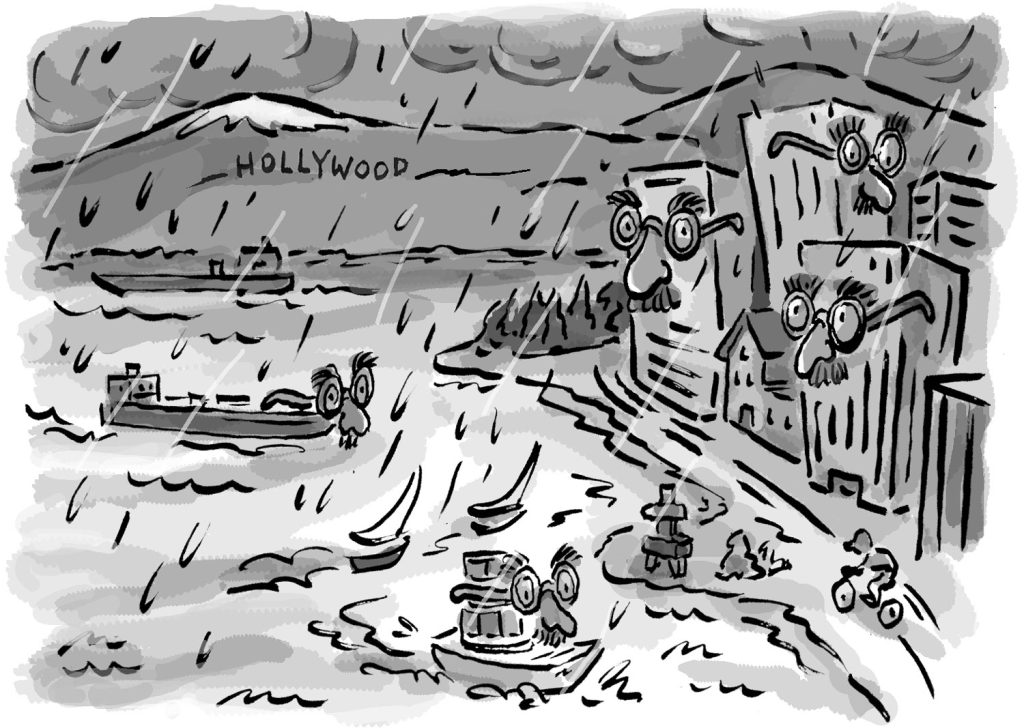
Raining Scully and Mulder.
Scot Ritchie
They call it Hollywood North for a reason. Vancouver has long served as a stand‑in for Seattle, Los Angeles, and New York. Sometimes it’s even a small American town with a made‑up name. Regardless, the flags, spellings, drinks, and other set details must be just right. Years ago, I took a hike in Cypress Provincial Park in West Vancouver and noticed a large pile of signs, maps, and campground props that were identical to those seen in famous national parks of the United States.
I was halfway through Wiebe’s witty, highly readable romp when I couldn’t stifle the anticipation any longer: I flipped to page 334 for the first of three chapters on The X‑Files. I’ve never watched much “appointment TV,” but Chris Carter’s sci‑fi thriller was an edgy, progressive noir that did, in fact, send hundreds of fans (later dubbed X‑Philes) scurrying around Metro Vancouver to see where each new season was filmed. In 1995, I lived on York Avenue in Kitsilano, where “Anasazi,” the cliffhanging final episode of season 2, was shot in the parking lot behind my apartment building. I remember a lot of bright lights and hearing a snippet of Duchovny dialogue: “He killed my father, Scully!”
That moment might very well have been peak X‑Files. Interest in the show grew so high before season 3 that the premiere, “The Blessing Way,” was the highest-rated episode up to that point. Many X‑Philes consider it one of the best of the best season of the nine seasons that were made between 1993 and 2002.
In 1997, on Late Night with Conan O’Brien, Duchovny hinted that The X‑Files might relocate to Los Angeles. I had completely forgotten the fallout until reading about it here: Vancouverites — hell, Canadians — had tender egos at the time, and Duchovny went through all kinds of repentance hell, including having to star in a terrible stunt sponsored by Tourism Vancouver. Wiebe suggests that the Conan clip was part of a skit — not an interview with Duchovny at all. But the Province newspaper didn’t recognize such nuance at the time: “Dry Your Eyes, David, It’s Only Rain” was the front-page headline shortly afterwards.
The X‑Files was Vancouver’s high point as a filmmaking influencer. Although it never cracked the Nielsen top ten — dominated at the time by such well-established shows as ER, Seinfeld, and Friends — its third season earned universal critical praise and was compared favourably to standouts like Homicide: Life on the Street, My So‑Called Life, and The Larry Sanders Show. Hollywood North did not collapse when the production did finally leave in search of sunnier pastures after season 5, though it’s worth noting that the show’s lowest ratings came after it decamped for L.A.
X‑Files brilliance aside, if Vancouver were given a Rotten Tomatoes score, critics would probably rate the movies and television shows filmed here at around 30 percent on the old Tomatometer. Because for every Five Easy Pieces (Bob Rafelson), McCabe & Mrs. Miller (Robert Altman), Star 80 (Bob Fosse), Best in Show (Christopher Guest), and Insomnia (Christopher Nolan), there are hundreds of real stinkers that have been released over the years, and I’m not even including the fifty-plus Hallmark Channel formula pictures that bring Christmas cheer to Edgemont Village and Fort Langley. (“Most Hallmark films shoot outside the downtown Vancouver ‘Zone,’ for additional tax breaks,” Wiebe explains.)
Anyone familiar with the shady dealings of the producer Barney Panofsky in Mordecai Richler’s Barney’s Version will know that many of these “direct-to-DVD” productions have been financed thanks to Ottawa’s generous tax credits. In one sense, Vancouver’s film industry developed alongside the Vancouver Stock Exchange of the early ’80s. One of the biggest winners was Air Bud, about a golden retriever that learns to sink a basketball in a fictional town in Washington State. Produced in 1997 on a $3-million budget, the movie made $50 million at the box office and spawned eleven spinoffs that added a mind-boggling $170 million to the total.
One aspect of filming in Vancouver that A‑listers enjoy more than the rain is the ability to toil from day to day in relative anonymity. Readers wanting the gossip on Ryan Reynolds or Shōgun ’s Anna Sawai will have to look elsewhere. This book does, however, include one salacious entry about Carnal Knowledge, the rather naughty Mike Nichols movie from 1971, starring Jack Nicholson, Art Garfunkel, Ann-Margret, and Candice Bergen and partly filmed in Vancouver. “There was plenty of sex at the hot tub–equipped house that Nicholson rented,” Wiebe writes. “Editor Sam O’Steen put it bluntly: ‘It was a picture about fucking and everybody on the crew was fucking like a bunch of apes.’ ”
Audiences are now so fragmented that it’s doubtful we’ll ever again see a cultural phenomenon quite like The X‑Files. Some might argue that our modern mania for conspiracy theories began with the show’s tag line, “The truth is out there.” Unlike the cheesy horror movies set in the Lower Mainland, The X‑Files frequently questioned the state’s power to control its citizenry, a theme that Stranger Things, filmed in faraway Georgia, fleshed out for another generation a decade later. Notice how many sci‑fi or horror dramas feature rogue elements inside a government agency, while megacorporations go scot‑free.
Unfortunately, the number of well-made Canadian films written and produced here in British Columbia is pitifully small. Wiebe gives special recognition to Double Happiness (Mina Shum), Better Than Chocolate (Anne Wheeler), My American Cousin (Sandy Wilson), The Grey Fox (Phillip Borsos), and The Sweet Hereafter (Atom Egoyan). But I suspect that most Canadians haven’t seen more than two or three of these. Even if they were inclined to do so, these movies are challenging to find on YouTube or through streaming services.
Just before I finished Shot in Vancouver, Chris Carter teased readers of Collider, the influential movie culture website, that he might bring Mulder and Scully back for a twelfth season of The X‑Files. There’s no word yet on whether it would be “shot in Vancouver,” but if it is, Sam Wiebe will surely be there to cover it.
Steven Threndyle lives a short hike away from Vancouver’s North Shore mountains.
Advertisement
Advertisement