
I must admit to a certain nervousness the first time I agreed to receive payment through the hawala system for editing work I had done for an organization in Mogadishu, Somalia. I vaguely knew émigré communities all over the world used such informal banking networks to send and receive money from home. But I knew for certain that within weeks of the September 2001 attacks U.S. president George Bush declared that the hawala had been used to finance terrorism, prompting U.S. authorities to freeze the assets of a number of operators and to force one of the largest—al-Barakaat—to close.
My client assured me the transfer was perfectly legal and would not land me in a U.S. jail or worse. Besides, I had little choice. Somalia, the ultimate failed state, has no formal banking system. So I agreed and he arranged the payment in Mogadishu. The next day I received an email: “Hello, my name is Ahmed and I have something for you. Please call me at the following number.” I called and within 24 hours Ahmed was at my front door, money in hand. The exchange rate was good. I paid no fees to receive the money. Best of all, this was a banker who made house calls. (1)
Why, then, was I so uneasy about using this service? R.T. Naylor, author of Satanic Purses: Money, Myth and Misinformation in the War on Terror, would say that I had been taken in by one of the many lies and half-truths told to gullible westerners by their governments in the wake of the attacks on the United States. His book is a compendium of these falsehoods, big and small, which have shaped our attitudes and made many of us unwitting foot soldiers in President Bush’s war on terrorism. The myth surrounding the hawala system is just one small example, but a telling one.
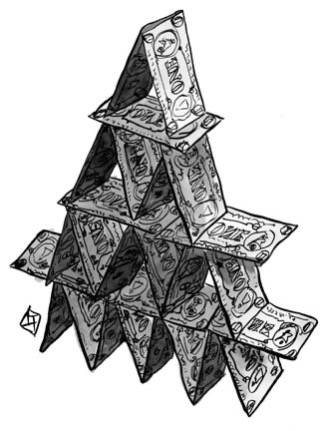
Far from being a nefarious innovation designed to aid Osama bin Laden and his followers, the system based on trust and little paperwork has existed for centuries under various names all misunderstood, sometimes willfully, resulting in proposed solutions that are expensive, invasive and designed more to benefit vested interests than to solve the perceived problem. And both have at their heart the big lie, supported by many little lies, and all designed to justify the costly and ultimately unsuccessful measures that governments have taken to date.
Sylvia Nickerson
For Beare and Schneider, the big lie is that there are no reliable estimates for how much money is laundered globally. This may come as a surprise to those who have seen figures quoted with great authority, often based on a speech given in 1998 by Michel Camdessus, then head of the International Monetary Fund. In that speech Camdessus said money-laundering transactions accounted for between 2 percent and 5 percent of the global economy, or between us$590 billion and us$1.5 trillion, a mind-boggling figure, if true. But the authors go on to say that this figure was apparently scribbled on a dinner napkin and there is no empirical evidence to back it up. The authors call these estimates SWAG, for “scientific, wild-assed guesses.” All of the attempts to nail down this figure since 1998 have failed, with the result that while governments have set up countless institutions and thrown millions at combating money laundering, no one has any sense of whether these efforts are working.
In this information vacuum, governments have emphasized process over results. Each new institution is heralded as a major step forward. Each new agreement to share information is chalked up as a success. One need look no further than a recent press release from the Finance Department to see evidence of this trend. Headlined “Canada Successfully Concludes Its Presidency of the Financial Action Task Force,” it lists its successes as increasing membership of the international group set up to combat money laundering, strengthening its relationship with the private sector, advancing its analysis of terrorism and money-laundering threats and initiating a strategic review of the organization. Nowhere is there any mention of actually reducing the amount of money laundered. It is clear that empires are being built in national and international bureaucracies, but have they had any impact on money laundering? No one knows.
One of the smaller lies that Beare and Schneider deal with is that terrorist financing can somehow be attacked using the same tools and the same approach as for money laundering by organized crime. They point out that the sums involved are different—terrorists need very little money, whereas organized crime involves massive amounts. The motivations are different. For organized crime, amassing money is the goal, whereas terrorists see money as a means to an end. And the very nature of the transactions is different. The money is the result of past transgressions in the case of organized crime, and is meant to fund future actions in the case of the terrorists.
For Naylor, the big lie is that al Qaeda (or al-Qa’idah as he prefers) is a vast terrorist organization, centrally commanded and professionally managed by Osama bin Laden. “Blowing bin Laden metaphorically out of all proportion before blowing him physically off the face of the Earth is consistent with the U.S. tradition of personifying infamy by inventing supervillains with whom superheroes do battle, inevitably to a victory that, if not real, is certainly loudly and publicly declared,” Naylor writes. He is particularly critical of the media and instant experts, who mindlessly repeat myths created by government until they take on the semblance of reality. Canadians are no less guilty of this than Americans. In Afghanistan today, virtually every fighter killed by Canadian soldiers is automatically labelled a member of the Taliban, although they may in fact have been villagers or farmers, angry at the killing of civilians by foreign troops. In much the same way, the U.S. media report that American soldiers are fighting al Qaeda in Iraq, although the links between that group and Iraqi fighters are tenuous. It seems the media have learned no lessons from the Maher Arar affair in Canada, where the government insisted he was a terrorist until an official inquiry proved he was not, or the invasion of Iraq by the U.S., made on the pretext of weapons of mass destruction, which in the end did not exist.
The lies themselves are bad enough, but the real concern of the authors of both these books is that they have led to so-called solutions that are not solutions at all. Laws have been changed and taxpayers’ money spent in the name of improving the security of the people governments purport to represent. But the real beneficiaries can be found elsewhere—in bureaucracies, police forces and among the formal banks in the case of money laundering, and in the defence industry most of all in the case of terrorism.
Together, these books make for dispiriting reading. Both build a credible case that government policies designed to meet these threats need to be re-examined in light of the facts. But will that happen? The myths built in the wake of the attacks on the U.S. are powerful, made more so by their endless repetition by the media. The constituencies that challenge them do not have a loud voice and are hampered by western suspicion of foreigners. And even when so-called facts are exposed as lies, the damage has already been done.
Such was the case with al-Barakaat, the hawala house closed in 2001 after being labelled a conduit for terrorist dollars. When the official investigations found no links between this operator and terrorists, the funds were eventually unfrozen. It was too late for the operator and affiliates, whose reputations were smeared and whose businesses were devastated. “All wars are waged in pursuit of the interests of the major combatants,” write Beare and Schneider, “which invariably means that there is ‘collateral damage’ to lesser players or bystanders.” Much of the world falls into this category.
Notes
- If anyone from the Canada Revenue Agency is read- ing this review, this money was fully declared on my income tax form.
Madelaine Drohan is Canada correspondent for The Economist and author of Does Serious Journalism Have a Future in Canada?, a report written when she was a 2015 Prime Ministers of Canada fellow at the Public Policy Forum.
Advertisement
Advertisement