
Jean-Philippe Pleau’s memoir, Rue Duplessis: Ma petite noirceur, about growing up working-class in Drummondville, Quebec, and joining the middle class in Montreal, had sold 40,000 copies a year ago — an amazing number in Canada. Then he transformed it into a one‑man show at Montreal’s Théâtre Duceppe, with an impressive run last fall that helped sell 22,000 more.
The title refers to the street where Pleau spent his childhood, named after the reactionary premier Maurice Duplessis, with a sly reference to the years before 1960 and the Quiet Revolution, known in Quebec as the grande noirceur — the “great darkness.” It is a phrase that has provoked pushback from conservative historians, who point to how much modernization actually happened in the ’40s and ’50s, but it remains evocative. Even for those who argue change had occurred, Rue Duplessis is a reminder that for the working class, much remained the same.
Pleau uses the phrase ma petite noirceur —“my little darkness”— as an indication of his former environment, as a symbol of a confined and fearful family and community. His father is illiterate, and his mother left school after grade 4. As a result, Montreal, just over an hour’s drive away from Drummondville, was and remains strange and scary for them.
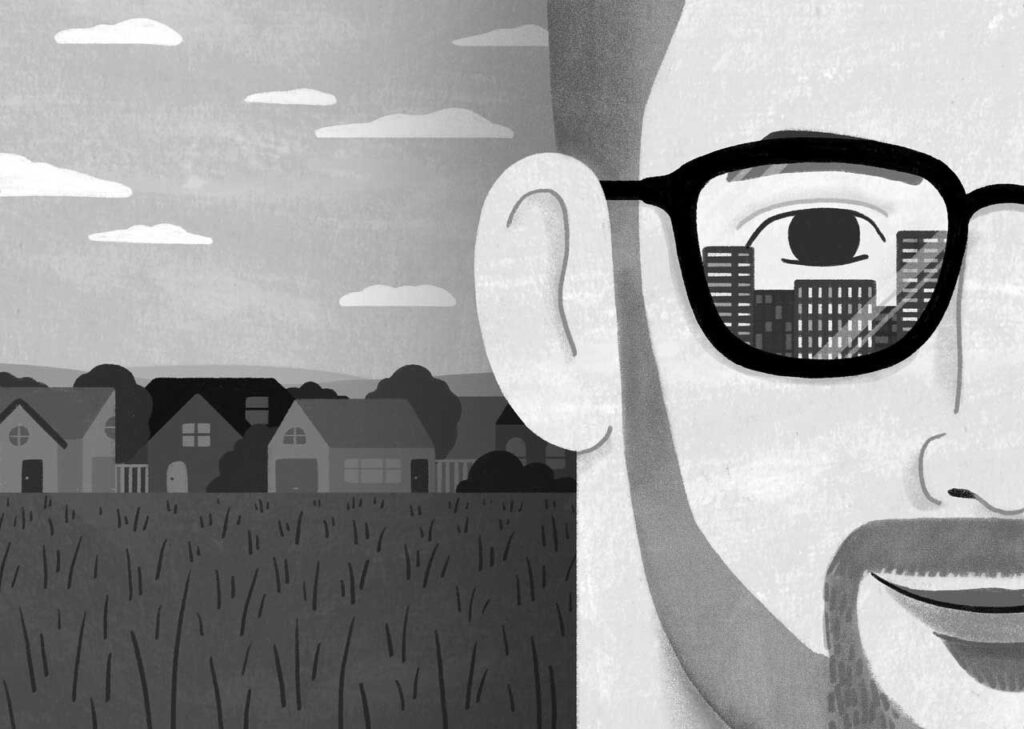
A Radio-Canada broadcaster who has spent decades transforming himself.
Paige Stampatori
Fear was omnipresent in Pleau’s childhood, as well as in his mother’s: fear of diseases, fear of kidnapping, fear of bullies, fear of the dark, fear of being left alone, fear of strange food (Chinese restaurants were said to serve cat and dog), fear of the big city, fear of humiliation. These fears were often transformed into mockery, especially of the snobs who went to fancy restaurants, read books, and listened to Radio-Canada.
Now forty-eight, Pleau has spent the last three decades transforming himself into someone quite foreign to his past milieu: a sociologist and a broadcaster who eats in fancy restaurants, reads books, and works for Radio-Canada. He became a “class traitor” or “defector”— the result of what he calls “cultural immigration.” Having “immigrated to this bourgeois world,” he describes himself as “an internal immigrant, a foreigner in my own country.”
First he had to shed those past biases. “It was only after having lived in Montreal for five years that I conquered my fear of going to eat in the Chinese neighbourhood,” Pleau writes. “It took years of deprogramming to no longer think of this prejudice of my parents when I eat in an Asian restaurant.” His parents’ class culture led them to reject certain forms of entertainment, like theatre and opera. “In changing my milieu, I took to visiting those spaces because they were worthwhile, but these acquired habits made me a class adversary of my parents,” he explains. “We have become at best cultural strangers, at worst cultural enemies.”
And as a foreigner in his own country, Pleau had to learn — or relearn — the language. He needed to drop some of the mangled words he had picked up from his father, and, at the insistence of Radio-Canada, he took a course to rid himself of his working-class accent. This brought another wave of embarrassment. When he bumped into an ex-girlfriend, she burst out, “Will you tell me what happened? Did you go live in France? What the Christ is this bloody bourgeois accent?” He reacted with shame: “For the first time, I had the impression of betraying my own people.”
Pleau’s father spent the bulk of his career working for a commercial sign maker, Pro6. His previous employer, also a signage company, had folded when the workers voted to create a union, forcing the elder Pleau to move from Quebec City to Drummondville and making him passionately anti-union. Eventually his views on the topic led to a shouting match with his son. In their denunciation of unions, he and a colleague, whom Pleau quotes, sounded remarkably like the comedian Yvon Deschamps, in his famous 1960s monologue: “Les unions, qu’ossa donne?” (What good are unions?) All that’s needed is “un job steady et un bon boss.” But when Pro6 was sold to a competitor, Pleau’s father walked away to run an unlicensed daycare centre with Pleau’s mother. For a proud craftsman, it was both a defiant act and a humiliating step down.
In November, the New York Times reported that Pleau experienced a turning point when he “began to feel ashamed of being ashamed” and that his story resonated with a group recently gathered at the Duceppe. “To a moderator’s question, about half said they had recognized themselves in Rue Duplessis, and a third identified themselves as ‘class defectors.’ ”
Pleau’s family has not responded so well. Several relatives have filed lawsuits over how the book portrays them. So Pleau was nervous when he accompanied the Times reporter to Drummondville, and tears came to his eyes when he visited his childhood house and learned that his father would sometimes drive by for a look.
Canadians tend to comfort themselves with the idea that significant class differences have disappeared. Pleau ran into this view regularly, as friends told him, “Come on, Jean-Philippe, social classes don’t exist anymore. Are you sure you want to take that angle in your book?” He did, with many graphic examples, including grocery chains that serve either the middle class or the working class. He has provided a dramatic reminder that class barriers do exist, that being upwardly mobile involves a series of betrayals and culture shocks, from table manners to cars. “The social classes still exist,” he writes. “Only the struggle has ended.”
Graham Fraser is the author of Sorry, I Don’t Speak French and other books.
Advertisement

Advertisement