
Phaedra “Fade” Luck wakes up under a gravestone to a series of urgent text messages from her mother, Doreen. Her aunt, Madeline, has gone missing. “You’re the only one besides me who knows the way to her house, Phaedra,” one reads. “And you’re probably the only person she would let in. Including me. Because she’s that stubborn. You have to go.”
The thirty-three-year-old pilots her car to Willow Sound on the North Shore of Nova Scotia and navigates through the “deep dark woods” to her aunt’s house. What she finds doesn’t quite match her memory. The cottage that seemed tiny to her as a child —“tidy and bright” with a purple front door and “stained glass windows glowing violet and orange, as if it was always sunset inside her house”— now stands in ruin, like a “nightmare.”
As Fade explores the seemingly vacant house, she comes across artifacts that only add to the mystery. Among them are paper scrolls, “apothecary bottles brimming with liquids to heal and clean and preserve,” and aging photographs, full of unfamiliar figures. On the backs of the pictures are cryptic notations that offer no further revelations about the identity of the people frozen in time. In the guest bedroom, Fade notices a door — one that had never been there — but before she can open it, she blacks out. After waking up in the kitchen hours later, she ventures to the cliffs just beyond the back gardens and discovers a suitcase containing a bloodied hospital gown, a bedpan, and a key. The suitcase is engraved with the initials M. L. L.: Madeline Lee Luck.
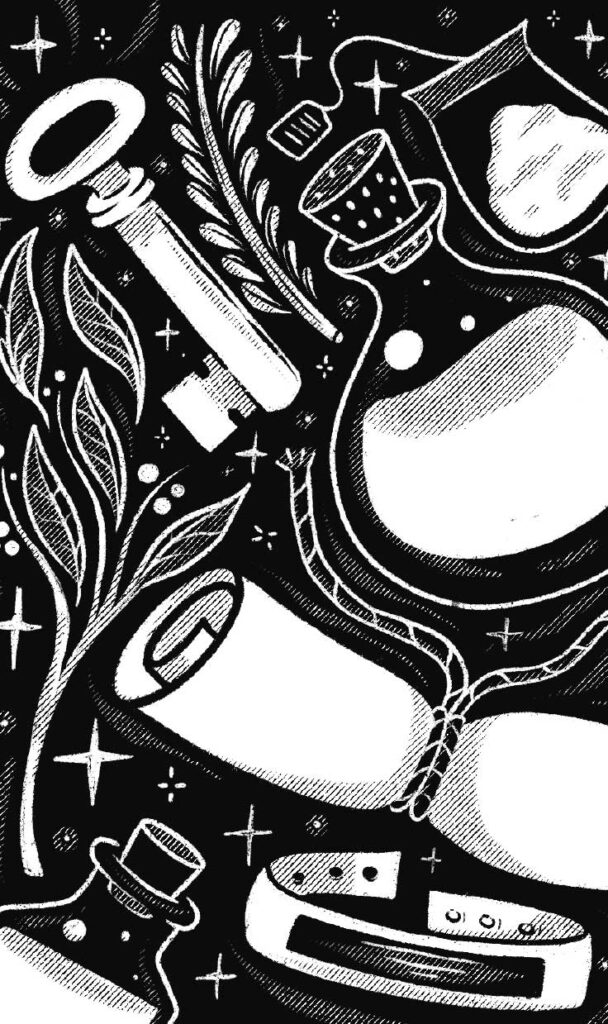
All the trappings of a classic fable.
Tessa Presta
With her fairy-tale-esque debut, Vanessa E. Penney keeps the pages turning, delivering the plot through punchy, compact sentences and chapters that can be read in a single exhale. The prose is carried by a remarkable eye for vivid detail. Early on, this pacing and world building suggest a narrative with all the trappings of a classic fable: a cliffside house, an impenetrable forest, trinkets and baubles imbued with magical potential. However, the author gradually shifts gears, and Fade, along with the reader, begins to feel the encroachment of something far more sinister and less fantastic: the real world.
Fade’s investigation brings her to Grand Tea, which sits directly under a “teacup-shaped rock” that was “once the top of a mountain range.” In her opinion, the nearby town is filled with nothing but “certifiable psychos,” and it seems that her insight is not far off. The locals trade stories and legends about Madeline, who almost everyone believes is an actual witch. No one besides Fade is too eager to dispute the notion, as it adds to the texture of the community’s tourism trade, which brings in visitors who snap pictures of the giant rock and spend their money on occult-themed wares. Monetizing the myth around Madeline is top of mind for the mayor, Dinwald H. Davish, who seizes on the opportunity of her disappearance to press ahead with his plans to repossess her land and build a museum in her name. Few residents seem interested in trying to locate the missing woman, and that includes the police officer, Corporal Quill, who is more concerned about managing her meddling niece — a difficult job since Fade is no pushover.
Living out of her car, Fade — tall, resourceful, quiet, ready for a fight — attracts the wrong kind of attention as she pokes into the town’s darkest secrets. But she happens on an ally in Nish Chaudry. Hailing from the United Kingdom, he has been hired as Grand Tea’s historian-in-residence. The “floofy-haired” man, a specialist in folklore, serves as a buoyant counterpart to Fade’s reflexive distrust and cynicism. Together, they join up the facts of Madeline’s life that will unveil the truth about her disappearance. That discovery quickly becomes a weapon, but one that has limited power against the ugly violence of history.
Penney’s story ultimately bumps up against the scars of Atlantic Canada’s heritage. Fade and Nish’s search leads them to the shrouded past of the demolished Havenwood Hospital and Asylum, a stand‑in for the poorhouses of Nova Scotia, most of which had hidden burial grounds whose secrets are yet to be reckoned with to this day. In this way, The Witch of Willow Sound is also a cry for the marginalized people — women, and people of colour specifically — who were institutionalized, brutalized, and disappeared, their existence an often fatal inconvenience.
Against this background, the setting takes on a more ominous tenor. The hanging rock echoes other Nova Scotia geological formations: the Balancing Rock, the Hammer Sea Arch, the Three Sisters, the Ovens, Cape Split. Such natural landmarks remain frighteningly impermeable to the region’s “hurricanes, blizzards, and relentless Atlantic tides.” It is in these surroundings that Fade and Nish sift through a past that is as unpredictable and unforgiving as the rugged coastal landscape.
“All stories about Nova Scotia must have some darkness in them, I say. Because of all the bones,” Penney writes in the afterword. Even as The Witch of Willow Sound makes playful references to Indiana Jones, Iron Man, and The Wizard of Oz, Fade and Nish eventually find themselves working through the legacies of racism and misogyny. They uncover two horrifying truths: that Fade’s maternal grandparents allowed bodies from Havenwood to be buried in their sprawling private gardens, and that they hid their own “insane” child, Madeline’s twin sister, Maryflower, in their cellar. Much like the victims of poorhouses, Nish laments, she was treated with “no dignity. No rights.”
As Fade and Nish grapple with the ways old injustices continue to manifest in the present, they learn that ancestral knowledge finds other, quieter ways to survive. Among Madeline’s papers is her paternal grandmother’s recipe for “Rosewater Wonders,” a deep-fried bread whose secret ingredients were “passed down through family lines.” They also turn up a note describing “Fade’s Tea,” which is Madeline’s own concoction of wild berries, bark, and flowers, that blooms “forget-me-not blue” when steeped. “This is my recipe for my niece’s favourite tea,” the note reads, a testament to the connection that guides Fade. It’s these deeply personal exchanges and pieces of family history that continue to speak through and encourage future generations, even if the graves remain unmarked.
Kevin Jagernauth is a culture writer and critic in Montreal. His debut novel comes out next year.
Advertisement

Advertisement