
It was an accident. I had no intention of reading The Catcher in the Rye again, let alone last summer. It came about because my wife and our adult children got this quaint notion about decluttering the bookshelves at our cottage. The question became: “Prize it or pitch it?”
One of the many decisions I faced was over a 1999 paperback of Salinger: A Biography, by Paul Alexander. I suppose I must have leafed through it at some point, but I had no recollection. So I opened it, hoping to refresh my memory. The farther I read, the more I deplored his attempts to unveil J. D. Salinger as a phony. Alexander reminded me just how vacuous I had found the few attempts at profiling Salinger. At least Ian Hamilton, in his 1988 book, In Search of J. D. Salinger, undertook the reclusive writer’s biography while in thrall to the protagonist of The Catcher in the Rye, Holden Caulfield — exploring a connection so many of us had already made.
Even though I’d had enough of Salinger — and had pitched it — I felt uncertain about my own convictions. After all, I had not read The Catcher in the Rye since October 1957.
During the fall of my first year at the University of Windsor, I raved to one of my classmates about the two used-book sellers I had come across on the other side of the Detroit–Windsor tunnel, on Michigan Avenue. He was unimpressed. Maybe those stores impressed a yokel like me from Stoney Creek, Ontario, but he insisted on taking me further inland, to the seat of the University of Michigan, to show me what a real book shop looked like.
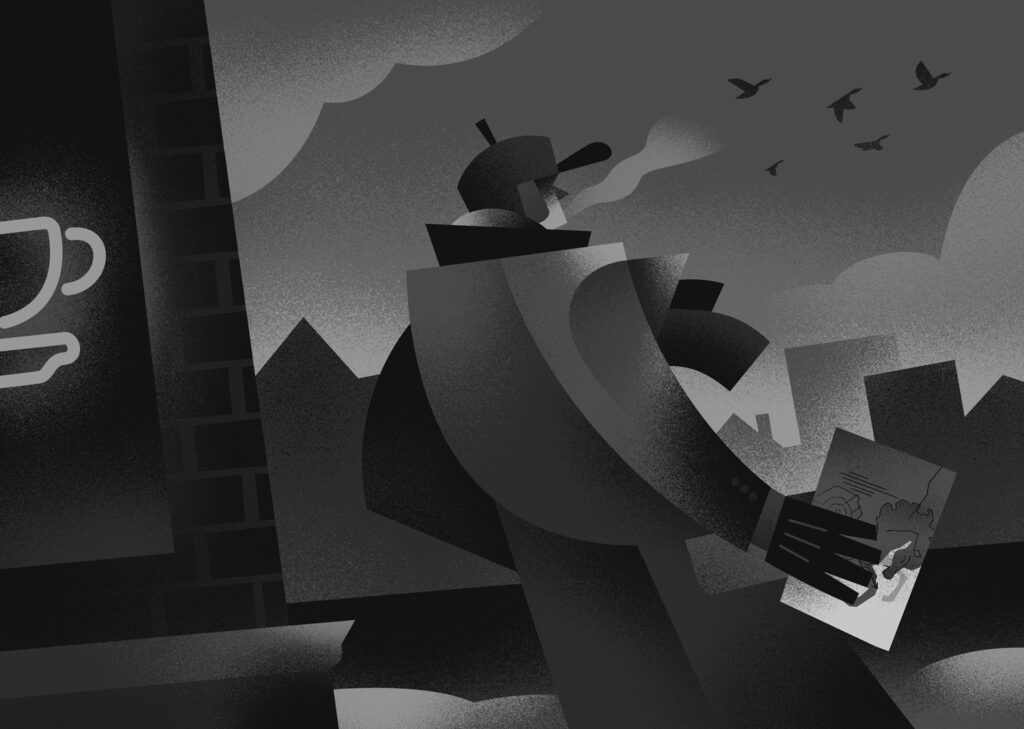
Even decades later, the thrill was still there.
Dave Murray
Whatever other titles I bought in Ann Arbor that day are obliterated by the memory of buying The Catcher in the Rye. The novel had already been out for six years. I plucked a paperback from a wire rack filled with copies of nothing but Salinger.
That night, I read the first paragraph. And then the second. At some point I must have put it down to change into my pyjamas. I think I finished it the next morning at a nearby coffee shop. It took hold of me, inspiring one of my term papers, “Where the Ducks Go in Winter,” about Holden’s obsession with what happens to the ducks in New York’s Central Park when the water freezes over.
Revisiting The Catcher in the Rye decades later, I found the scenes in which Holden evokes those dispossessed birds especially vivid. One cool night, he circles the pond hoping to catch a glimpse of the ducks but finds no trace of them. Instead, he discovers their fate alongside his own: when the city becomes inhospitable to him, he migrates to a warmer clime — ending up in a California institution for psychiatric counselling. In the end, the novel is presented as his recapitulation of his descent into depression.
I was unsettled to realize that some of the things that I thought were so hip as a nineteen-year-old now seemed disquieting at best. Many passages, like his verbal attack on his sometime girlfriend Sally, were just depressing. I now see that his history teacher, “old Spencer” (the only character truly deserving of the ubiquitous “old” epithet), is genuinely concerned for Holden’s well-being and future, whereas Holden can’t see past his rheumy demeanour and cloying concern. If I once shared Holden’s viewpoint about this authority figure, spending decades at the front of the classroom seems to have changed my mind.
I felt similarly when Holden explains to his former English teacher that he did poorly in an Oral Expression course because another student, “a very nervous guy,” got hooted down by his classmates for going off topic. His peer’s digression was more interesting than the original subject and, on that pretext, Holden claims that he could not participate in the class. My teenage heart once went out to Holden, but this time I couldn’t help but nod at Mr. Antolini’s advice: “Don’t you think there’s a time and a place for everything?” Now I saw it as his teacher did; the young misanthrope was simply looking for a reason to withdraw into his own world.
The two characters who escape Holden’s scorn are his dead younger brother, Allie, and his sister, Phoebe. “Old Phoebe” is the light of his life. When she presses her “Christmas dough”— eight dollars and sixty-five cents — on him, it causes him to sob. Phoebe is a kind of conscience. Where all the grown‑ups and age-mates who try to sort him out get only evasion, she gets a more honest if still delusional version of her brother. At one point, she challenges his outlook on life: “You don’t like anything that’s happening.” Holden blusters, denies, and she presses him further: “Name one thing.” He then falls into a kind of reverie and finally names Allie. “All right, name something else,” she insists. “Name something you’d like to be. Like a scientist. Or a lawyer or something.”
Out of desperation, and misquoting Robert Burns’s poem “Comin’ thro’ the Rye,” he comes up with a response:
I keep picturing all these little kids playing some game in this big field of rye and all. Thousands of little kids, and nobody’s around — nobody big, I mean — except me. And I’m standing on the edge of some crazy cliff. What I have to do, I have to catch everybody if they start to go over the cliff — I mean if they’re running and they don’t look where they’re going I have to come out from somewhere and catch them. That’s all I’d do all day. I’d just be the catcher in the rye and all. I know it’s crazy, but that’s the only thing I’d really like to be.
Crazy it is. Beautifully crazy. Benevolently crazy. And as readers, whether eighteen or eighty, who have followed Holden through all his adventures with joy and despair and sympathy and maybe even some kind of love, all we can do is hope he gets through it all and comes out of it with some measure of his goodness intact.
Salinger’s legacy is inescapably tied to The New Yorker. The magazine was the sacrosanct outlet for his short fiction. His first story accepted there was also his first featuring Holden. It was published in 1946 while the founding editor, Harold Ross, was still in charge. Ross’s successor, William Shawn, became, in effect, Salinger’s patron. Salinger dedicated his 1961 book, Franny and Zooey, to Shawn, calling him the “lover of the long shot, protector of the unprolific, defender of the hopelessly flamboyant.”
For those of us who came to love Salinger’s later work with the same unbridled and perhaps uncritical admiration that we had for The Catcher in the Rye, we have Shawn to thank. As Salinger’s style became progressively more idiosyncratic, less novelistic, perhaps even more loopy, his reviewers became ever more hostile. They railed about his eccentricities, affronted by his audacity in forsaking plot-driven fictions like those of Saul Bellow, John Updike, and other critical darlings of the time.
After The Catcher in the Rye, Salinger focused on the Glass family saga, a series of stories that consisted in part of characters from some of his earlier work. One by one they materialized in the pages of The New Yorker and brought different challenges of form. Each instalment was more unconventional than the one before it. These works drove reviewers nuts. Instead of revelling in their experimental nature, as millions of non-professional readers did, critics simply seemed bamboozled.
I wondered at the time — and still wonder — if the reviewers I read, most of them members of the literary fraternity to some degree or other, were punishing Salinger for eschewing that milieu. Not only did he defy the norms of style, but he also secluded himself in rural New Hampshire, refusing interviews and chasing away reporters. He rejected author profiles in his books, plot summaries, blurbs of any kind, and all other marketing material. After the illustrations on early editions of The Catcher in the Rye horrified him, he insisted that his covers be type-only designs on monochrome backgrounds. (This ban made my long-lost paperback from Ann Arbor, with its image of Holden wearing his red hunting cap backwards as he wends his way along a city street, a collector’s item.)
The cruellest stroke from a critic, for those of us who were paying attention, came toward the end of the century. In 1996, Orchises Press, a small press based in Alexandria, Virginia, let it slip that it would be publishing a new Salinger: Hapworth 16, 1924. Word of the forthcoming title, which would have been his first book in decades, made headlines. In early 1997, amid the hubbub, the books editor of the New York Times, Michiko Kakutani, dug out the 1965 issue of The New Yorker that consisted almost entirely of the 26,000-word novella as it originally appeared. Her retrospective review was not unfair, just unnecessary. She called it “a logical, if disappointing, culmination of Mr. Salinger’s published work to date.” For anyone coming anew to Salinger, she argued, Hapworth 16, 1924 would be enigmatic at best. To make sense of it, one would have to be familiar with some of his precursor stories. And even then, curiosity, a taste for eccentricity, and a tolerance of weirdness were probably needed.
What did Kakutani accomplish? Salinger withdrew Hapworth 16, 1924. Publication was postponed indefinitely. For the author who influenced at least a generation or two of readers, it was a blah ending. Despite all those hours that Salinger reportedly spent in his studio in his modest New Hampshire home on a winding country road, there were no more Holdens, no grown‑up Phoebes.
We make do with what he left us. As I reread The Catcher in the Rye, the thrill was still there. Although it was muted now, I was delighted that it was still there — but, most of all, delighted that it had been there in the first place.
Jack Chambers is a professor emeritus at the University of Toronto and the author of A Tone Parallel to Duke Ellington.
Advertisement

Advertisement