
In the opening scene of Starry Starry Night, four-year-old Anju struggles with Barlow, the household worker tasked with bathing her. “I scream, tug, and pull,” the child narrates. “The louder I scream, the sooner she gives up, and Ma comes in to take over.” Eventually Ma “holds out her arms,” allowing Anju to “fall into them, limp.” From this moment of safety and assurance, Shani Mootoo’s sixth novel proceeds into uncertainty as its young protagonist has her first brushes with neglect and alienation.
Set in 1960s Trinidad, Anju’s story has an unusual beginning: she is being raised by Ma and Pa, who she doesn’t realize are her maternal grandparents. When her actual mother and father return from Ireland, where he was studying medicine, they are initially strangers to her. Even so, the trajectory of Anju’s central dilemma — self-actualization — runs a familiar course, shaped by the gendered, heteronormative conventions of her time and place and, perhaps more interestingly, by her parents’ idealism.
Mootoo, who grew up in Trinidad, is superb at capturing the synesthetic consciousness of childhood, the tumble of association and physical sensation that characterizes Anju’s coming into language and interoception. Tickled by a washcloth, for example, her feet “curl in, just as if they were tasting a piece of lime without any honey.” Shrimp being cleaned in the kitchen are “the smell of the blue sky over the sea.” Sitting in a dark movie theatre, she remembers an apple that was a “colour” on her hands “like a red perfume.” This imagistic particularity is complemented by Mootoo’s rich rendering of the island’s food, music, landscape, and people.
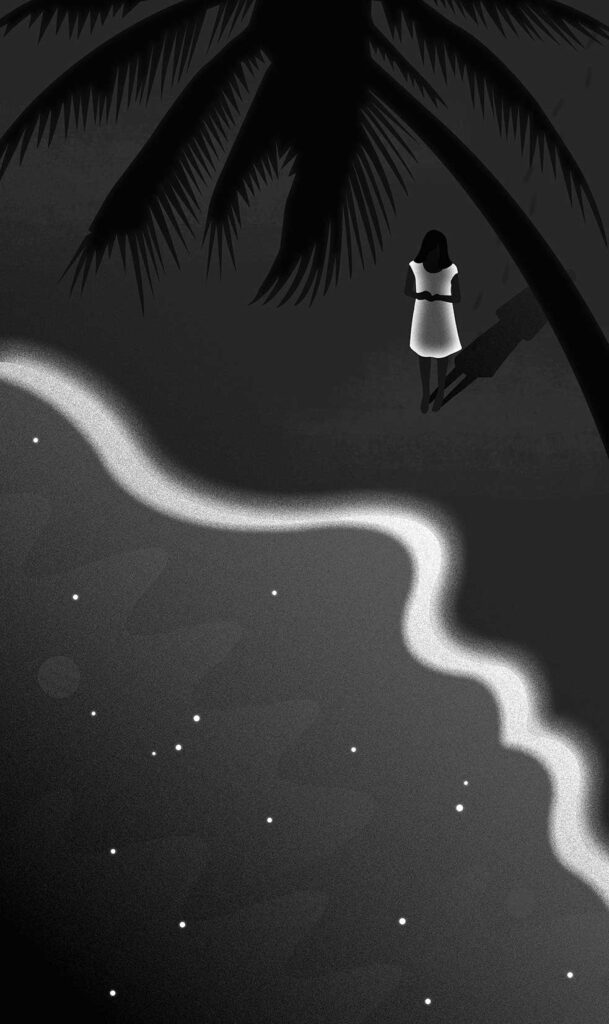
A tumble of childhood associations.
Neil Webb
These details have an especially strong effect when Anju grapples with concepts beyond her comprehension. The arrival of her parents causes confusion and pain, which manifests as a physical sensation: “I feel as if I don’t have ears and want to touch the sides of my head to check, but I can’t lift my hands off my lap.” In one passage, she gets locked in a room with her mother and father instead of napping, as usual, with her grandparents. She becomes entirely disembodied as she begs to be released. “I can’t breathe,” she says. “I hear myself calling Ma and Pa, but I don’t know if anyone else hears me. I bang and I shout. At least, I think I am shouting.”
Anju’s resulting alienation and self-doubt are reinforced, over and over, by the notion that girls and women hold inferior status to men, that kids should be quiet and not cause “trouble,” and that it is inappropriate to show emotions like sadness, anger, disgust, or fear. A gifted and sensitive child, she learns these lessons quickly and to her detriment. When she is sexually abused by an uncle, she submits to his violations because “nice girls and good children don’t make other people feel bad.” After finally confiding in her grandmother, she’s warned “never ever to say those words again.”
As her parents instill these truths in her, Anju is instructed in everything from proper place settings to Trinidad’s fight for independence by her progressive parents. Her father is particularly well drawn. A physician turned politician who advocates for abortion rights, he is also philandering and narcissistic, brushing off his wife’s concerns about the impact of his new career on their life. Regularly reminded by her family of her privilege, Anju comes to negate her own self-compassion. Here the novel raises its most interesting questions: At what cost do parents provide for their children’s futures? Does service to the greater good hold more value than commitment to the local, the personal? What are the differences between kindness, sacrifice, and martyrdom?
Starry Starry Night is best in this ambivalent mode, though it is largely engaged in a more conservative one that aims to provoke deep feeling and confirm values its readers likely already hold. In this sense it has as much in common with the tradition of the sentimental novel as with the Bildungsroman. This may well be the fate of the coming-of-age genre in an era when we have learned to pathologize and diagnose our own upbringings. The major emotive engine is a variety of dramatic irony: Anju’s repeated maladaptive responses to her experiences set against our trauma-informed contemporary perspective. To be sure, Anju is a sympathetic character, but her story is surprisingly forgettable. Mootoo strikes the same notes time and again, and by the end, not much complexity or mystery remains. Anju worries she is a bad person when she is just six years old as well as when she is twelve and finds the family dog dead. “But it doesn’t seem as if he is there, inside his body,” she thinks. “Where did he go? Is it bad, am I a bad person, for not hugging him?” There’s a sameness to the child’s inner life that creates a sense of artifice, of a consistent adult consciousness overlaid. Did Anju really think these things in those moments or just behave as if she did?
This uncertainty is compounded by some missteps in dialogue. Voice is difficult to articulate when a protagonist is precocious and eager to please, but just as Anju’s presence of mind sometimes rings false, Mootoo employs awkward devices at a few critical moments. For example, the family’s domestic situation is explained to readers in an overheard phone call, in which Anju’s grandmother informs her mother of things she surely already knows: “That is true, she had just turned one. Five years ago.” And when Anju wins her parents’ approval after standing up to her grandfather for his racist language, she stage directs her mother’s stilted response: “With a happy voice she adds, Clearly, we’ve taught you well.”
Near the end, Anju undergoes a marked change in the form of self-advocacy. On learning that a cousin is soon to undergo the same confusing familial separation, she asks her mother to intervene. “You must tell her not to leave Shylana in Trinidad,” she insists. “It won’t be good for her.” When Anju is reprimanded by her father for this interference, she apologizes but walks out of the room transformed. “I turn to leave, my back to them,” she says, “and I feel as if my back is bare, as if I am naked, for all the world to see.” This leads to an epiphany on how to bear suffering. “You can try to help other people, but that doesn’t mean you’ll be able to,” she realizes. It’s a bittersweet moment. Anju is entirely correct, her insights startlingly mature. Her forced self-reliance, for all its pain, is revealed as a source of competence and agency, a satisfying ambivalence that marks a hard‑won coming of age.
Vanessa Stauffer is a writer, editor, and book designer in Windsor, Ontario.
Advertisement

Advertisement