
Vrbo, the vacation rental marketplace, likely did not expect the uproar it caused when it used the iconic Newfoundland folk song “I’se the B’y” in its 2024 Super Bowl ad. The commercial features a group of people arriving at a barn overrun by pigs and chickens as the jig gradually speeds up to a manic chipmunk tempo. There are no typical Newfoundland and Labrador visuals, and the lyrics featured make no direct reference to the province. But many people, including Deborah Bourden, who chaired the province’s tourism association, Hospitality NL, urged Vrbo to take the ad down, “given the importance of this song to us.”
Whether the ruckus was an overreaction or not, Bourden wasn’t wrong when she identified the tune’s significance to local culture. “Singing is part of the language here,” Alan Doyle explains in The Smiling Land. “If you want to learn about Newfoundland and Labrador, just listen to twenty folk songs from here and you’ll get a pretty good picture.” Arguably the Rock’s most successful musician, Doyle should know. As a solo artist and a former member of Great Big Sea, he has achieved international acclaim playing traditional Irish-Newfoundland music. In the late 1990s, it was surreal to find videos of “Ordinary Day” slotted between those of the Backstreet Boys and Soundgarden on MuchMusic. What’s even more impressive is that Doyle has consistently managed to sail between the Scylla and Charybdis of the “goofy Newfie” stereotype and reactionary humourlessness. Newfoundlanders and Labradorians from that era found it refreshing to see an authentic expression of traditional culture that didn’t feel like a top-down government initiative needling us to eat our vegetables. In addition to his career on stage, Doyle has written four books. His latest is a lighthearted tour across the province.
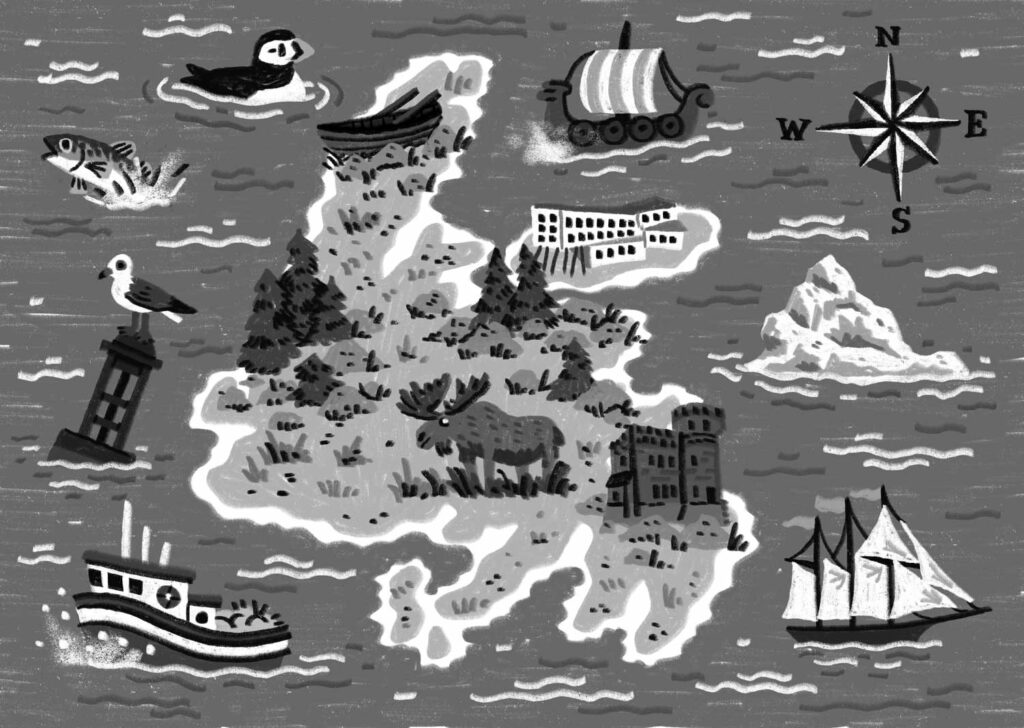
One Newfoundlander’s personal map of wonders.
Alexander MacAskill
Doyle fittingly begins in Farewell, near “the circle” of Fogo, Twillingate, and Moreton’s Harbour that’s referenced in “I’se the B’y” and the book’s subtitle. Readers are soon introduced to his jocular tone. “As a fella with an arts degree,” he’s baffled that a ferry made of metal can float on water and deliver him to his first destination, Twillingate. Doyle is an eager cheerleader for the province and its entrepreneurs, never restraining his enthusiasm. While the Fogo Island Inn is undoubtedly a crown jewel of the province’s tourism industry, for instance, Doyle’s breathless praise can feel more like a podcast ad, going so far as to compare the building to Barcelona’s Sagrada Família. However, it would be unfair to dismiss The Smiling Land as mere marketing copy for tourism officials. Doyle’s overzealousness is often tempered by self-deprecating humour, aimed at both himself and his home.
In addition to having fun with place names like Dildo and Spread Eagle and, of course, the signature dialects, he makes a very astute point: that because most rural communities were meant to be accessed by water long before roads were in operation, “if you are in a vehicle, you are almost always arriving through the back door.” Doyle may be reluctant to “dispel any romantic notions folks might have about driving across the Trans-Canada Highway,” but he’s correct when he advises that “if it is ocean vistas you are after, take the side roads, because there is hardly a harbour to be seen for a whole day driving in Newfoundland on the TCH.” One exception is the Clarenville Irving Big Stop, where you can get one of the best views on the island from the men’s bathroom.
Doyle covers a lot of territory in less than 270 pages. The book moves from Twillingate to his native Petty Harbour and St. John’s to the western Tablelands, “down on the Labrador” and “up” the Southern Shore, which is sure to confuse visitors trying to get their bearings. Then it’s on to Saint-Pierre and Miquelon, France’s territorial collectivity off the southern coast of Newfoundland. He breezes through so many locations that readers will soon empathize with his wife, who lives with “ADHD” (Alan Doyle and their son Henry). Readers looking for a nuanced take on Newfoundland and Labrador’s history may be left wanting. But Doyle makes no promises of being a subversive or a scholar. The Smiling Land reads more like an invitation to come from aways (people from outside the province) and townies (people living in the St. John’s metro area) to go exploring. Doyle’s greatest gift as an author is his ability to relate his wealth of experience with an engaging voice. However, no one is going to confuse him with Michael Crummey any time soon. After the fourth variation of “like a set from Game of Thrones,” readers will begin to wonder if an editor was asleep at the wheel while Doyle made his journey. But it is nice that so many of the pictures he took on his trip are included in a colour insert, along with a shot of the “Newfoundland Labrador Welcome” road sign that travellers see when coming off the ferry in Port aux Basques.
Ultimately, Doyle continues to do an admirable job as an unofficial ambassador for my home province, and The Smiling Land is a serviceable travelogue for tourists daydreaming of making a road trip to Canada’s most easterly region. Those seeking to truly immerse themselves in the province’s spirit, however, would be better off following Doyle’s own advice and listening to some of its music.
Brad Dunne is a writer and editor in St. John’s. His latest novel is The Merchant’s Mansion.
Advertisement

Advertisement