
In Ways of Seeing, from 1972, John Berger wrote, “To look is an act of choice.” Based on his BBC television series with the same name, the collection of essays sought to demystify the process of viewing visual art while emphasizing the context inherent in each glance.
Rollie Pemberton adapts both Berger’s title and his framework (though without explicit reference) in Ways of Listening. The Toronto writer and musician, who published Bedroom Rapper in 2022 about his career as Cadence Weapon, conceptualizes this book as a contemporary guide to engaging with music. “I wrote Ways of Listening as a love letter to the more intentional and deeper way of listening to music that I grew up on, one that is slowly being forgotten,” he says in the introduction. We listen only to what we hear, and to hear is an act of choice. Increasingly, he suggests, we are making the wrong choices.
Where Ways of Seeing considered how mass reproduction robbed visual art of its authority, Ways of Listening tackles how the platform economy is ruining recorded music. The methods of destruction are myriad: algorithmic playlists prioritize sameness; short-form videos deploy music as scenery; robot accounts falsely boost the popularity of artists. All this has led to what Pemberton calls “lean-back listening.” Because of it, he worries, “we might eventually lose our own skill of discernment.”
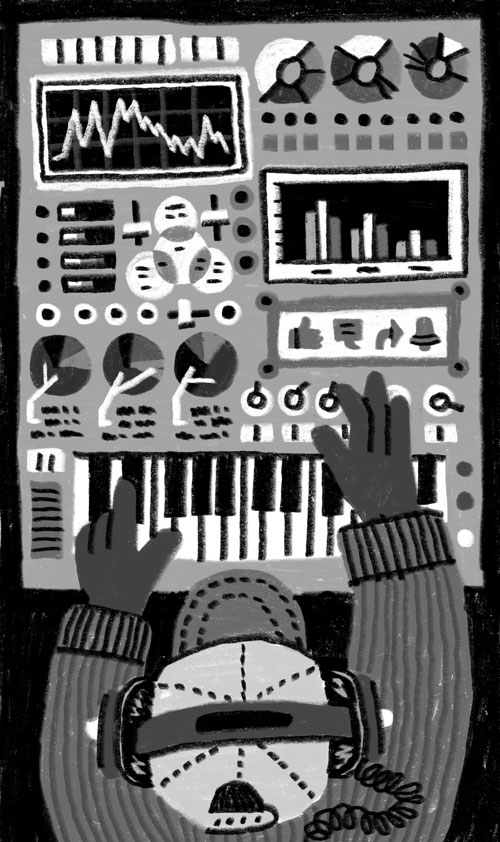
Dial down the algorithmic sameness.
Alexander MacAskill
As a musician and music critic, I have been reading essays about this anxiety since 2019. I spent three of those years talking through this problem with a former roommate — another musician prone to late-night debates — and we always seemed to circle back to the same conclusion: recorded music and the widespread appreciation of it had peaked, and we were now living through its long, ugly decline.
Pemberton is a sharp chronicler of that decline. In one chapter, “Taking the Scenic Route,” he recounts a studio session in which he watched, dumbfounded, as a producer generated an AI beat for him to rap over. “Bro, your job description is beatmaker,” he thought to himself, neatly summing up what happens when we sacrifice artistic exploration for tech-sponsored efficiency. In “Listening to Music with a Calculator,” he describes the pitfalls of both artists and fans treating album releases as a zero-sum game, a race to the bottom of chart placements and growth metrics. Pemberton points to the singular psychological torment of Spotify’s “monthly listeners” feature, which provides artists with yet another metric for quantifying their worth. To keep those numbers high, the streaming service encourages musicians to release work more frequently, which Pemberton evocatively compares to “topping up a draining bathtub with a carafe of water.”
So what’s to be done? Do we go silently into the age of slop? Pemberton makes an explicit argument for deep listening. “Be curious about what electrifies you,” he writes in the opening chapter, as he describes his own approach to record collecting. Digging through crates of albums or searching through producer credits on the Discogs database takes a lot more time than clicking play on a mix generated for you. And this is his main point: listeners should stop going in for ease of access and spend time cultivating their own sense of taste. He demonstrates the value of such an approach with close readings. Pemberton’s impassioned accounts of the high-stakes Drake and Kendrick Lamar beef of 2024 and his enamoured reflections on the enigmatic producer Jai Pail are some of the book’s best writing. Although I don’t wholly agree with his rapturous assessment of Charli XCX’s Brat, from 2024, I’m compelled by his love for the puke-coloured world that the British singer unleashed on us and by his analysis of the creative freedom that made it possible: “Brat is what happens when an auteur is given a budget and the catbird seat in the boardroom.”
Pemberton’s writing is less effective when he tries to cover too much ground. In the final chapter, “Redemption Songs,” his survey of the past century of protest music consists largely of examples that will already be familiar to any enthusiast. But even this cursory section serves his broader aim of reintroducing context to musical consumption. The bottomless pit of the corporate internet has severed music from its historical and material conditions. Albums that once existed in libraries now float in search bars. Music commentary — in newspapers, liner notes, fanzines — has been replaced by tail-chasing debates online. Ways of Listening is a worthy intervention into the vacuum and comes with clear instructions: “This is about training yourself to care about the people behind the music.”
The argument is compelling. The problem is that it’s not always clear who Pemberton is arguing with. For a writer concerned with the reception of music, he spends relatively little time considering the vast differences among listeners. Instead, he speaks to a universal one and pleads with them to change their ways. But there isn’t just one kind of listener. There are still music obsessives who are embedded in local scenes (who are perhaps most likely to pick up this book); devotees of physical media who refuse streaming; habitual enthusiasts who buy merch from artists and keep tabs on year-end lists; subcultural diehards who ride for one particular genre; pop fans who shell out for the occasional stadium event; and plenty of others. Eliding such distinctions, Pemberton leans a little too hard on his own perspective. In an attempt to argue that music still captivates the masses, he cites his personal social media feed as evidence.
“Music is as powerful as it always has been,” Pemberton concludes, despite having spent 200 pages pointing out that — well, it might not be. Maybe the engagement with recorded music in the twentieth century was the result of a set of historical conditions that have simply changed. Maybe the form has lost some of its cultural primacy. Pemberton is clear-eyed about the pressures of our fast-paced moment. But he doesn’t fully reckon with the complexity of this fragmented landscape, in which one’s listening practice is no longer an easy stand‑in for identity. Exhorting readers to challenge their passive habits isn’t going to change that. Yes, listening is an act of choice, and more people should make that choice with intention. But there’s so much noise, so little time, and so many other reasons why personal taste has fallen out of fashion. It may take a systems-level change for us to really tune back in.
Rosie Long Decter edits Maisonneuve and is half of the Montreal duo Bodywash.
Advertisement

Advertisement