
On November 1, 1902, a telegram landed at Rideau Hall, asking Lord Minto to “receive globe encircling message via England, South Africa, Australia and Pacific Cable congratulating Canada and the Empire on completion of the first segment state controlled electric girdle the harbinger of incalculable advantages, national and general.” The sender of this staccato rhapsody was Sir Sandford Fleming, from just down the road. The completion a day earlier of his pet project, a telegraph cable from Vancouver Island to Australia, had allowed his words to loop the world before returning to the governor general in Ottawa. John Boyko’s sturdy new biography, In Pursuit of Tomorrow: The Inventive Life of Sandford Fleming, shows that the Pacific Cable was but one episode in a life devoted to consolidating Canada and the Empire. If Fleming’s stated desire to “build up Canada” is reminiscent of Mark Carney’s commitment to “build Canada strong,” then his controversial career suggests how hard it has always been to disentangle economic patriotism from lower calculations of profit and loss.
Scotland, where Fleming was born in 1827, was a society that exported its brightest and most restless people. Thomas Carlyle had been a schoolmaster in Kirkcaldy before landing in London as a writer. Wider vistas opened up to Fleming as a young man in that same town a generation later. A local member of Parliament, who was also a director of the Hudson’s Bay Company and the Canada Company, arranged eighteen-year-old Fleming’s emigration to Peterborough, Canada West. Boyko diligently uses his diaries to show how hard it was to get settled in this hardscrabble and fragile land. Quebec City was smouldering from a destructive fire when Fleming landed in June 1845. Four years later in Montreal, he was caught up in a riot against the British (he ducked into the blazing Parliament Buildings to rescue a large oil portrait of Queen Victoria). Despite his training, no one would give Fleming work as an engineer; he had to toil as a store clerk. Like many an immigrant to Canada, he was forced to make his own job. He produced meticulous and profitable engravings of boom towns, which eventually gave him the wherewithal to qualify as a surveyor.
Fleming worked on plans for public buildings in Toronto, where he relocated in his early twenties, including an exhibition hall on King Street West modelled on London’s Crystal Palace, but the railway gave him his real start. Statesmen who fretted that the United States might gobble up their ill-assorted colonies decided to lay down an economic infrastructure for their political integration. The Intercolonial Railway would join Montreal with Halifax, and a second, wildly ambitious scheme would extend to the Pacific. The railways would enable authorities to shuttle troops across the country, encourage Canadians to trade with one another, and coax British Columbia into Confederation. Fleming — who had gained experience surveying the Ontario, Simcoe, and Huron Railway, between Barrie and Georgian Bay — had been among the first to float these visionary lines. Soon he was surveying for both.
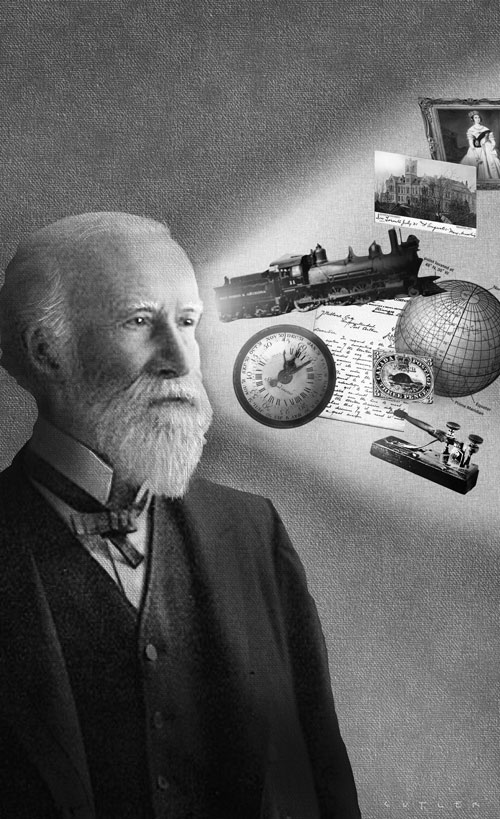
Engineer, inventor, stamp designer.
Dave Cutler
Even more vexing than the scanty meals and ravenous bugs Fleming endured in the backcountry were the squabbles intrinsic to nation building. Vested interests in Halifax forced him to abandon what he considered the most rational terminus for the Intercolonial: a new seaport on the banks of the St. Lawrence in Shippagan, New Brunswick. The decision had lasting consequences. Because of it, Fleming had to rule out an extension of the Intercolonial to Newfoundland, which took away its incentive to participate in Confederation: it did not join until 1949.
Boyko presents his hero as besieged by cost cutters and naysayers. Yet accusations of corruption dogged Fleming. Pamphleteers picked over the two branch lines he built in Nova Scotia as a favour to Charles Tupper, elected premier in 1864, alleging that he had inflated his bills. Fleming vindicated himself at length, but that does not mean the charges were unfounded. Building big things was a shady enterprise in Canada, because promoters hunting for capital needed to pitch public goods in terms of corporate and personal enrichment. In 1873, John A. Macdonald’s government collapsed, and the Canadian Pacific Railway project wobbled when it emerged that its chief backer had illicitly funded the prime minister’s re-election. Fleming’s understanding of the line between public service and private profit was no less serpentine. After becoming a director of the Hudson’s Bay Company, in 1881, for example, he fiercely admonished another of its directors — an old enemy of his — for what was essentially insider trading. Yet Fleming himself had snapped up 200 acres in Collingwood, on Georgian Bay, after learning it was to be the terminus of a railway he was surveying.
The CPR’s spiralling costs gave some of Fleming’s underlings, who had obsessively championed alternative routes to the Pacific, the pretext to push him out. His defenestration in 1880 did not end his connection with the CPR, however. Three years later, the company summoned him from an English vacation to check that trains could traverse the Rockies at Kicking Horse Pass. He concluded that they could, though the first engine to try the journey picked up so much speed that it plunged into a ravine, killing six men. In November 1885, Fleming was one of the guests who watched Donald A. Smith drive in the last spike at Craigellachie, British Columbia, and then rode the first train to its western terminus.
Free of the CPR, Fleming could chase dreams of international comity and imperial unity. He became an advocate of a “Cosmic” clock: world trade, he believed, meant that messy local calculations of time must give way to longitudinal time zones calculated from a prime meridian. These zones still structure our lives, making it now three hours later in Toronto (where this sentence was edited) than in Vancouver (where I wrote it). Yet because most commercial shipping set its watches by the Greenwich observatory in London, Fleming’s plan to locate the prime meridian in the Pacific seemed to threaten Britain’s dominance of time. Even his willingness to adopt Greenwich as his prime meridian could not convince officials to endanger the status quo. The royal astronomer stifled discussion of his proposals, causing Fleming to feel like a nobody from the “Outer Empire.”
Yankee capitalists did more than the empire to advance “Cosmopolitan time.” The railway boom had exposed the limitations of setting clocks locally. Because each company issued timetables based on watches set in its own headquarters, chaos ensued: each of the six railways passing through St. Louis, where the General Time Convention of the American Railroad Association met in 1883, ran on its own clock. When the railway barons decided it would be efficient to adopt the longitudinal zones proposed by Fleming, they began a “noiseless revolution” that ultimately made them universal.
Fleming’s other great venture involved even more bruising clashes with British officialdom. He saw steam and electricity as “twin sisters of civilization” in Canada and had put up telegraph poles along all the lines he surveyed. The electrification of information enabled it to travel faster than people or goods and promised to consolidate distended political units like Canada and the British Empire. Fleming felt that the imperial state had been mistaken to hand off the construction and operation of telegraphs to joint stock companies. Communication between Britain and India depended on cables running through the shallow waters of the Mediterranean, the Red Sea, and the Indian Ocean, which made landfall in neutral countries and could be severed or stopped in wartime. Australasian colonists had to pay these monopolists exorbitant sums to send messages westward to the mother country.
A state-funded Pacific cable that would link those colonies with British Columbia — and so to telegraph lines across Canada and under the Atlantic to London — was his answer to such anxieties. It would complete an “All‑Red Route,” carrying information west from London to Australasia and India on lines that made landfall only on British territory. His proposal promised political as well as strategic benefits: facts about the empire could travel the world at cut-price rates and be printed in newspapers, generating the imagined community that keeps polities together. An electrified Canada would become the “keystone of the colonial arch.”
Sir John Pender, a Mancunian merchant whose companies had built most of the cables used by Britons around the world, lobbied hard against this menace to his profits. He convinced the Royal Navy’s top hydrographer to argue that the Pacific was too deep and treacherous to make a submarine cable practicable — a fib sustained by the navy’s refusal to assign survey ships to such a project. Fleming struck back forcefully at Pender. Although a rich investor himself, he asked colonial conferences whether the “permanent policy of England” should come second to the “profits of a company.” But he faced opposition from other powerful quarters. The General Post Office and the City of London worried that connecting Asia to North America might help New York to supplant London as a clearing house for financial information.
Their foot-dragging drove Fleming to go rogue. In May 1892, he dispatched a retired sailor from Vancouver to Honolulu to plant a British flag on Necker Island, a tiny but crucial station for his cable that he feared the Americans would annex along with Hawaii proper. His presumption enraged the British prime minister, Lord Rosebery, who had no desire to annoy the United States and quashed the stunt.
Fleming got his cable in the end. The Australasians lobbied for it, Canadian officials who wanted new pathways for trade offered to fund it, and competition among great powers persuaded British politicians it was necessary. It never became the “electric girdle” of empire, however, securing only 40 percent of the Australian market. International telegrams remained too costly for ordinary people. By the time Fleming died in 1915, at his summer cottage in Halifax, Marconi’s invention of radio broadcasts over open water had begun to render submarine cables redundant. In 1960, the federal government closed and burned down the grand telegraph station at Bamfield Creek, on the west coast of Vancouver Island, where Fleming’s cable had made landfall.
Boyko constantly celebrates Fleming’s prescience, but the most instructive sections of the book concern his wrong turns in pursuit of tomorrow. His twenty-four-hour clock, which switched from numerals to letters after midday, was a dud. The flag he designed for Canada, with a seven-pointed white star to symbolize its Christianity, vanished into the archives. He subsidized a crank’s ludicrous campaign to rationalize the calendar (it required an extra month called Sol). His technocratic imperialism required a blank slate and ignored existing contours of economic activity.
Fleming’s empire is gone, but talk of building up Canada is once again all the rage, with the state focused on pipelines and data centres rather than gutta-percha cables. His career prompts us to ask how feasible such “sovereign” infrastructure is and whose interests it really serves.
Michael Ledger-Lomas writes about history and religion. He lives in Vancouver.
Advertisement
Advertisement