
The Anne of Green Gables Museum, in Park Corner, Prince Edward Island, is a quaint clapboard farmhouse surrounded by a modest garden and lush grounds. Its website invites nearly 200,000 annual visitors to marvel at Anne’s Enchanted Bookcase, view her Crazy Patchwork Quilt, and take pictures by the fictional Lake of Shining Waters. But surprisingly, Lucy Maud Montgomery — the author of the 1908 novel responsible for the whole operation — does not appear by name in the online introduction, where she is referenced only as “the Author.”
The understated substitution is striking, given that, as Carole Gerson observes, “in the realm of public memory, it can be difficult to separate writers from their creations and to distinguish the homes that they once occupied from the sites of their fictions.” In Literary Life After Death, Gerson explores Green Gables as part of a comprehensive survey of local, provincial, and national commemorations of primarily anglophone authors. (She does mention several Québécois writers, such as Anne Hébert and Félix Leclerc, but limits her discussion to those who have “received attention in English-speaking Canada.”)
A professor emeritus of English literature at Simon Fraser University, Gerson covers a range of tributes, from stamps and coins to machine guns and yachts. Homes, whether the ones that authors lived in or the places that inspired their work, receive particular attention. Gerson quotes the Romantic scholar Nicola J. Watson, who has argued that such structures “assert the ongoing ‘liveness’ of the writer by locating him or her in a specific domestic time and space, so enabling personal encounter between writer and reader.”
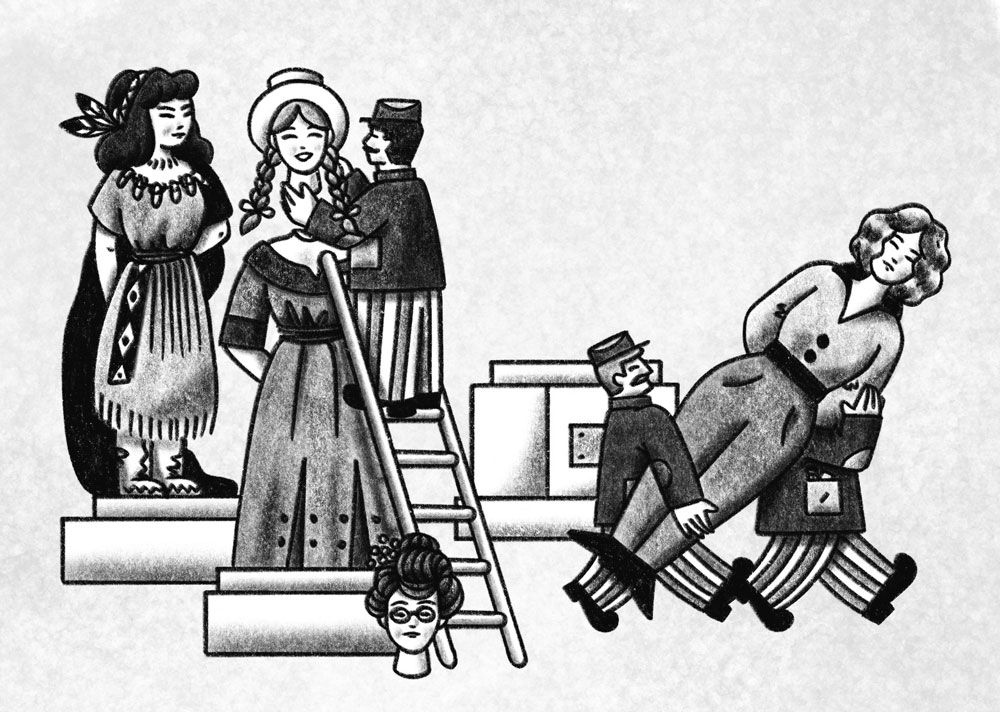
Much can be lost when literary figures become museum pieces.
Gwendoline Le Cunff
Gerson makes the point that there is nothing neutral about commemoration. The ceremonies and services organized to honour a particular writer are forever bound to the socio-political landscape in which they occur. With this principle front of mind, Gerson has “consciously and implicitly adjusted the historical gender imbalance” in her book, “by devoting extensive space to women writers.” Shifting her focus away from widely celebrated men — those she calls “members of Canada’s masculine literary elite”— she dedicates two chapters to how we remember Montgomery and the Mohawk poet Pauline Johnson.
Through these writers, Gerson examines a tendency that afflicts many others: the collapse of literary personhood, over time, into a fiction. Johnson, whose paternal heritage was appropriated by late nineteenth-century audiences who likened her to an “Indian princess,” was later misrepresented in a 1961 commemorative stamp, which pictured her in braids and a tribal costume, though “she was never photographed in conventional Indigenous dress.” Montgomery faced similar mythologization, as her authorial self became synonymous with her intrepid darling through marketing efforts. Even today, as its website betrays, the Anne of Green Gables Museum is a type of “materialized fiction,” touting a variety of red-haired dolls, mugs, and other tchotchkes with only a passing reference to the woman behind the famed character.
Gerson brings levity to her book through the strange and unexpected tributes that resist easy categorization: the author and painter Emily Carr’s name, for example, was given to one of Venus’s many craters, part of an astronomical effort to celebrate famous women. (She may also be the only Canadian writer with a string quartet named in her honour.) And Gerson points to chocolate as a go‑to commemorative vehicle. Laura Secord aside, Pauline Johnson Chocolates, so called for their “pure and wholesome” qualities, appeared in Vancouver in 1921, and Anne of Green Gables Chocolates debuted on Prince Edward Island in 1999 (today the company’s website makes no mention of Montgomery). The connection between confections and women is surpassed in tastelessness only by a dedicated line of underwear released in 2018 by the department store chain Simons, which claimed to celebrate female “trailblazers” like the novelist and former Supreme Court of Canada justice Beverley McLachlin and the award-winning writer Gabrielle Roy.
What’s behind the desire to enter the spaces (or delicates) associated with a beloved author? “The closer they can physically engage with the lived experience of favourite writers via residences, associated places, writing implements, clothing, furniture, birthplaces, graves,” Gerson says of certain fans, “the more they can understand about that person’s creativity.” She intends Literary Life After Death as a critical study of “the long-term reception and posthumous canonization” of historic individuals — a phenomenon we readily associate with authors like Shakespeare, Dickens, and Hugo but less often with our own.
Especially at the federal level, “the common Canadian trope of self-congratulatory benevolence” guides many posthumous tributes, which in many cases seek to rectify historical wrongs, racial and otherwise, as well as to recognize shifts in values that can cause certain authors to fall out of favour (see the annual Alice Munro Festival of the Short Story, which was abruptly cancelled in 2024). Given that more biographical interpretations and authorial commemorations are sure to come, Gerson helps us focus “not on how writers preserve memory but on how memory preserves writers.”
Caroline Noël is the magazine’s assistant operations manager.
Advertisement

Advertisement