
The last ice age ended about 11,500 years ago — recently enough that its effects are still plainly visible. Take drumlins, for example. Whenever I fly from Toronto to my hometown of Halifax, I see them from the airplane window: low, elongated hills, roughly teardrop shaped, the “tail” pointing in the direction in which the ice retreated, millennia ago. I probably first heard about drumlins from one of the interpretive guides at Kejimkujik National Park, but I later learned that our own house was not so far from a whopping big drumlin: Citadel Hill.
For the science writer and adventure traveller Edward Struzik, the most recent ice age did much more than just reshape the landscape. In Animal Diaspora, he explores its effects on the animals that share the planet with us, examining in detail how they responded to extreme and often sudden changes in climate — how they relocated or, in many cases, died off. While the book details a myriad of migrations and mass extinctions, it is much more than a natural history lesson. There’s an urgency to these stories: as we speak, animals are being displaced or killed off as a result of human activity, and understanding what happened “the last time” can help us better fend off disaster in the years ahead.
Struzik is a born storyteller. He’s like the fisherman at the lodge who can talk about a trout that was this big and make it interesting — and then some. (When he says he once portaged twenty-five miles, enduring two snowstorms along the way, we believe him.) He is not just our guide but our teacher, having learned from dozens of scientists over the years and from the Inuit and other Indigenous peoples who have lived for countless generations on these vast swaths of land. (Some of the scientists we meet ought to be better known — like Dick Harington, the Canadian paleontologist who collected more than 40,000 fossils.)
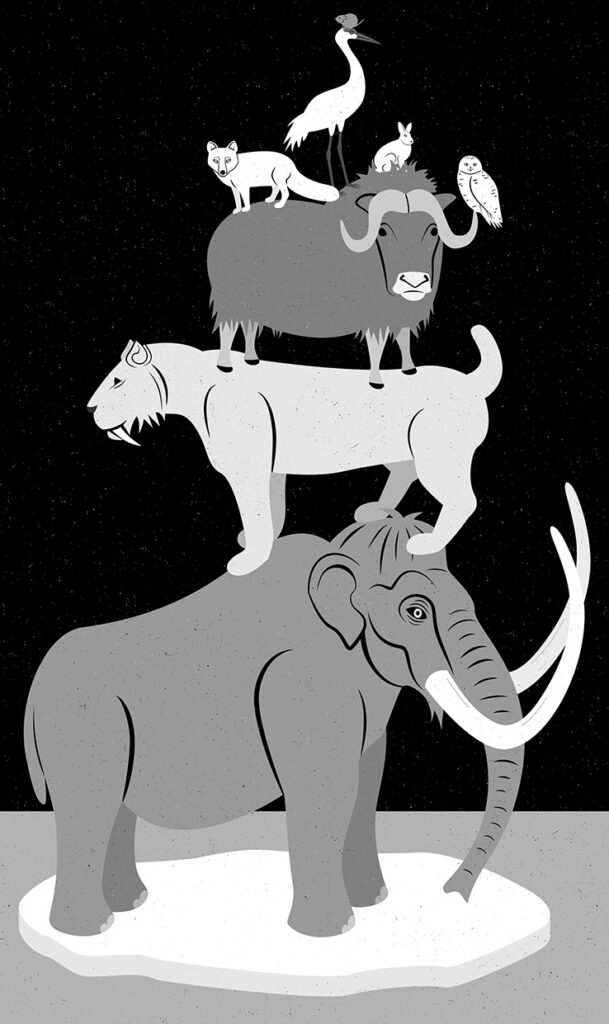
Creatures on the move — then and now.
Blair Kelly
Struzik’s greatest skill is his ability to transport his readers into Canada’s vast Arctic spaces. Here, for example, he describes trudging through the wetlands along the estuary of the Brock River in the Northwest Territories, during a ten-day hike one summer:
The gravelly, ice-scoured riverside was animated by yellow potentilla, lavender-blue Jacob’s ladder, purple saxifrage, and lemony white Arctic poppies that emerged after the ice retreated from this part of the world around seven thousand years ago. I could hear but not see the sandhill cranes, whose loud, rattling bugles echoed through the canyon, just as rolling thunder rumbled in the distance. But I could see the tracks of many of them in the mud that had been stirred by rain that had come down hard earlier in the day.
At another point on the hike, he injured his ankle and fell to the ground in pain. “When I finally got up to take inventory of my condition,” he writes, “I caught sight of what we had come to see. Spread across the tundra in a verdant valley below were between three hundred and four hundred caribou grazing on lichen, sedges and grasses, shrubs, and mushrooms. The sight was soulful, a glimpse into the new world that emerged when the ice sheets began retreating around twelve thousand years ago.”
Struzik focuses on the effect those retreating ice sheets had on the animals that once thrived in the Arctic and beyond. Some two-thirds of the planet’s large mammals disappeared as the climate swung through periods of rapid warming and short-term cooling. Mighty mammoths and mastodons were the most famous of these casualties, but Struzik also tells us of the sabre-toothed cats and giant short-faced bears that were once found across the continent. He tackles a common misconception: the notion that early humans hunted these species to extinction. Humans certainly killed thousands of them, but it was most likely the changing climate that spelled their doom, he argues. (While popular science writing has recently trended toward pumping up our ancestors — Neanderthals were smarter than you thought, that sort of thing — Struzik, somewhat refreshingly, acknowledges their limitations. Early North Americans were surely skilled hunters, but they simply did not have the capacity to decimate whole populations of large animals.)
By now we’re so used to the phrase “climate change” that we perhaps lose sight of what it means. At the end of the last ice age, in Struzik’s telling, it meant, among other things, raging wildfires and floods of “biblical proportions.” Anyone watching the news will suspect there may be a message for the humans of 2026, and indeed there is:
What’s happening now may well be a proxy for what happened at the end of the last Ice Age. Fires are burning bigger, hotter, and more often. There’s no sign that this is going to get any better. In 2023, 2024, and 2025, 7 percent of Canada’s forests, the second largest in the world, burned. Three consecutive years of catastrophic burning like this has never been recorded in modern times. All signs point to an even more fiery future, much like the one that helped drive so many animals to extinction.
The last ice age forced migrations far and wide, with new environments and new challenges along the way. For Struzik, a key argument is that, as the world heats up in the twenty-first century, animals are once again migrating in staggering numbers as human activity triggers not only wildfires but also drought, warming oceans, rising sea levels, permafrost thaw, and more. Struzik is not naive; he understands that some of these changes may be unstoppable. But he adds: “What we can do is learn more about extinctions of the past to make better decisions in the future. We may be able to mitigate the impacts of extinctions or facilitate animal recoveries.” His focus is not on how much trouble we’re in (it’s obviously a lot) but on the practical work that we can do to make things at least somewhat better. “What is really needed,” he writes, “apart from reducing carbon emissions, is to maintain the permafrost-rich areas we now have, expand the borders of the wilderness refugia that exist for caribou and other animals, and restore travel corridors that will allow them to move out of trouble.”
Were Struzik writing the book today rather than (presumably) a year or two ago, he would likely have adjusted at least one section. He discusses at some length the controversial Monte Verde archeological site in southern Chile. For decades, archeologists pointed to the artifacts unearthed there as evidence that early humans not only crossed the Beringia land bridge from Asia into North America but made their way southward to the very tip of South America by around 14,500 years ago. Struzik writes that the scientific community at first hesitated to accept the evidence, as it seemed to push back the date of human activity in the Americas by at least 1,000 years — the implication being that the community should have been more open-minded.
Well, perhaps the skepticism was appropriate after all: in March, a team of archeologists published a paper in Science arguing that Monte Verde may be less than half the age previously thought, possibly dating to just 8,000 to 6,000 years ago. (They suggest that it had been misdated as the result of soil erosion, which placed more recent archeological evidence in older geological strata.) Of course, it’s just one paper, and even if it holds up, it doesn’t change the big picture: scientists still believe that the first Americans came from Asia, across a land bridge, about 13,000 years ago (and perhaps earlier), even if they didn’t zip down to southern Chile right away.
Speaking of dates, there’s something funny about the terminology that Struzik introduces in his second chapter. In discussing excavations at the Old Crow archeological site in northern Yukon, he says that artifacts dug up in the 1960s “yielded evidence of continuous occupation from 1,200 BP (before present) to around 100 BP” by the ancestors of the Indigenous people who live there today. Around 100 BP? Is Struzik really referring to the 1920s here? Is it a typo? Equally weird is that he appears to immediately abandon this usage; in the remainder of the book, he reverts back to “years ago.”
I wish this were a one-off oddity, but there are other eyebrow raisers. In university, first-year science students learn about significant figures. If you’re told that Bob weighs 190 pounds, don’t assume that he weighs exactly 86.1826 kilograms. Yes, the conversion factor is known precisely, but Bob’s weight is not. Just say that he weighs 86 kg (keeping two significant figures throughout). Yet Struzik writes about a layer of ice being “1,829 meters (6,000 feet) thick.” What’s going on? I surmise that he was given the thickness in feet, converted it to metres, and inadvertently gave his readers four significant figures where only one or two were warranted. Elsewhere he asks how muskoxen and the wolves that prey on them were able to “thrive in a world where darkness prevailed six months of the year in temperatures that dipped to forty degrees below freezing (Fahrenheit) for weeks on end.” That’s fine, except that minus forty is the same in Fahrenheit and Celsius, so the scale needn’t be mentioned. Two paragraphs earlier, a site on Ellesmere Island is described as being “east of northern Greenland and due south of the North Pole.” But Ellesmere Island is west of northern Greenland — and every spot on the planet is due south of the North Pole. (One wonders how an editor didn’t catch some of these.)
With luck, the reader will forget these stumbles and remember Struzik’s vivid descriptions of the otherworldly landscapes that are found in Canada’s Arctic and the abundance of living things they contain. The stories often spotlight the region’s natural beauty, though sometimes they take an unexpected darker turn. He recounts a tale told by the Canadian scientist Frank Miller of a remarkable incident in the ’90s. Miller was conducting an aerial survey along the coast of Bathurst Island when he spied a group of muskoxen gathered in a circle — something they’re known to do when threatened. Miller asked the pilot to land a short distance away, so he could get a closer look. Surprisingly, they didn’t bolt. “Even as he approached on foot,” Struzik recounts, “none of the animals flinched. He was stumped.” Miller cautiously drew closer. “Only when he got to within a few yards did it dawn on him: they were all dead. The animals were frozen stiff, leaning against each other like statues that had been knocked over by the wind.” Miller told Struzik it was “one of the strangest and saddest things he had seen in his thirty years of fieldwork in the Arctic.”
Some 90 percent of Canadians live within 240 kilometres of our border with the United States, according to the Department of Finance Canada; the Arctic is something many of us see only on television. In Animal Diaspora, Struzik paints a vivid picture of this remote but vital region, including the innumerable species of flora and fauna that live there. Those plants and animals may be facing a bleak future. But we can act to make it less bleak, and our actions can and should be guided by the lessons from the past.
Dan Falk is a science journalist based in Toronto. His books include In Search of Time and The Science of Shakespeare.
Advertisement
Advertisement