
In late January 1986, on the stormy California coast, a colony of murres feeding for their breeding season rode and dove through high waves as a faulty hatch cover on the Apex Houston was sent scuttling across the deck. The water was anything but pacific: ten-metre swells battered the unmanned tank barge after its tug had pointed it south past the Golden Gate Bridge. Nearly 26,000 gallons of oil would be spilled before the Apex Houston reached Long Beach forty-eight hours later. Some 10,000 seabirds would die.
This is a region of high drama: Iconic big surf. Trees twisted by wind. Jutting rocks and sharp headlands. For murres and other seabirds with millennia of adaptation under their wings, the dynamic environment is home. For oil companies less than 200 years old, it’s a dangerous path to profit. For the renowned Canadian seabird biologist Harry Carter, this churning place where worlds can collide with deadly consequence became a proving ground for a devoted scientist looking to change lives and legal precedent.
Briony Penn’s The Seabird Trials: How a Scientist Took Big Oil to Court and Won follows the landmark Apex Houston court case. An eventual settlement, reached in August 1994, funded both oil spill cleanup and habitat acquisition, as well as an uncertain, but ultimately successful, colony restoration effort, all based on scientifically measured loss of life. “In a world of largely bad news stories for seabirds,” Penn writes, “few could deny it was a major victory.”
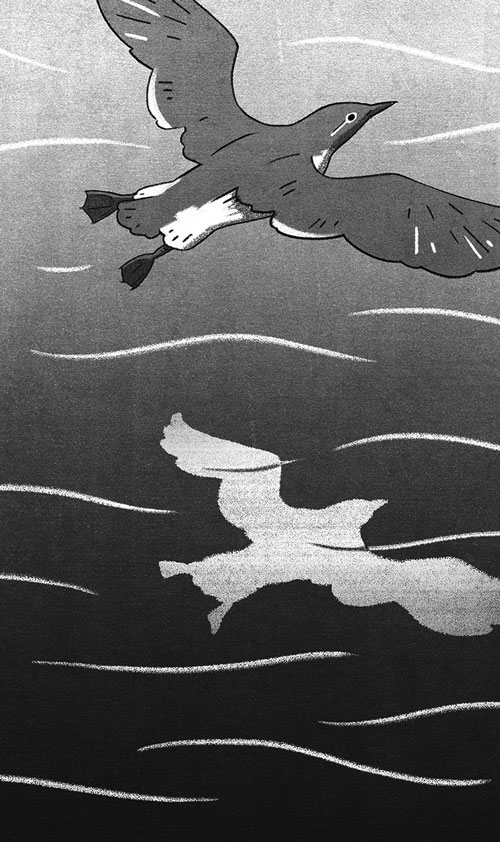
The oil spilled killed thousands.
Jori Bolton
Key to this victory was Carter’s diligent pre-spill survey work, his years of on-the-ground post-spill documentation, and his role as an expert witness for the United States Department of Justice’s brilliant prosecutor Valerie Lee. It’s a case that speaks to the value of scientists being able to do their work and of having rigorous, reliable data. Indeed, the implications of the case stretch far beyond seabird colonies: “It constituted a sea change in the Western legal world view that the natural world possibly mattered.”
Penn is a seasoned environmental writer and educator, and whether in a classroom, boardroom, or boat, she centres her work on nature and those driven to protect it. After Carter’s death in 2017, his family asked her to write his biography, which would fit well alongside her award-winning The Real Thing: The Natural History of Ian McTaggart Cowan, from 2015, and Following the Good River: The Life and Times of Wa’xaid, co-authored with Cecil Paul five years later. Both books focused on unsung conservation heroes from British Columbia.
As she delved into Carter’s papers and lengthy deposition transcripts, Penn found a way to honour his work, life, and principles by focusing on one of his fights that still resonates today. A combination of biography, environmental history, and nature writing, The Seabird Trials isn’t a linear life story or plot-driven legal thriller. It is divided into short chapters (sometimes a single page) under nine recurring headings: “The Spill,” “The Evidence,” “The Experts,” “The Counsel for the Plaintiff,” “The Defendant,” “The Elements,” “The Influencers,” “The Chronicle of Spills,” and “The Correspondence.” This framework allows Penn to zoom in and out on various places, people, and times.
At first, the structure feels somewhat choppy and, in a few spots, repetitive. But like cinematic jump-cuts, the juxtapositions build meaning. For instance, a chapter about the nineteenth-century rise and reach of insurance companies is followed by one of Carter’s many letters to a ten-year-old girl doing a school project on puffins: “Every population of animals, including humans, evolve ways to protect themselves against loss when they are having their chicks.” Penn’s organization of the parts highlights how inextricably connected the whole actually is.
Linking these structural leaps is the thematic undercurrent of shifting value systems — scientific, social, political. Why bother trying to restore a decimated murre colony? Is nature a community to which we can belong or a resource to be used? How important is it to fund scientific surveys, and where should that funding come from? Are scientists allowed to admit that emotion can fuel their interests, or is emotion a liability that can skew findings?
The Apex Houston case, with all its rivalries, represents a larger “collision of ideologies” within our zealously oil-dependent culture. Penn charts the evolution of environmental awareness through the growth of citizen organizations, including a secret society of North American wildlife biologists. She also considers how government action reflects ever-changing priorities: whether to pass endangered species legislation and create ecological reserves or to reopen offshore drilling, roll back environmental protections, and plan new pipelines.
Through Carter’s eyes and letters, Penn maintains a clear focus on birds — alcids like common murres, marbled murrelets, Cassin’s auklets, pigeon guillemots — and the ongoing trials they face to survive. Seabirds and oil float freely across borders, and Carter’s story is an example of what cross-border collaboration can look like. As I watched the season’s first V of geese head south, I reflected on how this timely book lands in today’s political landscape, where American scientists are fired, data is scrubbed, and even phrases like “clean energy” and “climate crisis” are in the crosshairs.
I’d never have imagined Penn agreeing with Richard Nixon, but she describes the president visiting a devastating blowout off the coast of Santa Barbara, California, in 1969. The head of Union Oil said at the time, “I am amazed at the publicity for the loss of a few birds.” But Nixon recognized what was — and still is — at stake: “What is involved is the use of our resources of the sea and the land in a more effective way, and with more concern for preserving the beauty and the natural resources that are so important to any kind of society that we want for the future.”
Ultimately, that’s the question at the centre of the gyre: What kind of world do we want for ourselves and those to come? The Seabird Trials is a compelling blend of a journalist’s dogged curiosity, a naturalist’s intimate observation, and an activist’s fire. A story of caution and hope, it looks back but also forward, reminding us that so much is still in motion. Carter and Penn stand firm for the birds and for a world view where science and nature matter. How we determine the direction that society’s collective values will drift in is a drama still to unfold.
Amy Reiswig is working on a memoir about love, loss, and glass sponges.
Advertisement

Advertisement