
The current media lens insists on a polarized vision of the social order. This is especially true for those who live in the United States, the world’s tech and media epicentre. The vision is contagious, and its effects register globally. Institutions, corporations, and governments are not immune. Individually, we see evidence of infection in our everyday lives. Tongues are wagged until sufficiently lubricated or angered. We notice a disparity between the way people present themselves in real life and how they wish to be perceived online. In extreme cases, a Jekyll-and-Hyde scenario unfolds. The lens becomes a mirror of manufactured desires, and when we stare into it for too long, our perceptions are distorted. We become delusional. In politics and other areas of social life, this warping of reality can develop into mass deception. Few are unsusceptible. Those who have lived long enough to see other revolutions (both technological and social) and their accompanying social panics should have some resistance, but youth seem especially vulnerable to online harms.
In What Gentlemen Do, Todd Babiak considers how our technological and political environments complicate the business of growing up. The child of a methamphetamine addict, Waylon Gans was adopted as an infant. Now in his early twenties, he lives in Belly, a poor section of the fictional prairie city Walleye. His adoptive father, Stan Gans, a former rocker, is now a custodian at the local university. He’s a kind man with a weakness for alcohol and self-pity — the latter trait shared with his son. Waylon’s mother, Tracy, is also an adoptee, from Cambodia, and a hard-working server at the Olive Garden. Waylon’s best friend Derby, whom he secretly loves, is half Persian and progressively minded. His other best friend, Solomon, is an aspiring musician who is under pressure from his middle-class parents to attend law school. Solomon is also Blackfoot. Both Solomon and Derby live in the good part of town, come from well‑off families, and appear to have bright futures, though not necessarily in Walleye. In Waylon’s view, they are “too blessed to be on the chans.”
In the opening chapters, we learn that in his mid-teens Waylon was rejected romantically by Derby and subsequently became estranged from her and Solomon. It’s a blow that debilitates him for a time. In his depressed state of mind — feeling alone, poor, and with few prospects — Waylon looks for answers. He thinks he finds them in a right-wing provocateur, Josh Modley, and pays a monthly fee to subscribe to his website: “Josh Modley and the Gentlemen had helped me see, during the lockdown, that Derby’s rejection was about more than a kiss. It was the no, no, no that rumbles beneath our lives, that makes people like us who we are.” When Modley comes to Walleye to speak ($79 a seat), Waylon somehow incites a riot. In the ensuing stampede, a young woman, a student from Nigeria, is killed. The event draws national and international attention and is written up in places like the New York Times and the Guardian. Afterwards, Waylon (though never charged) is seen as a fascist and a social pariah.
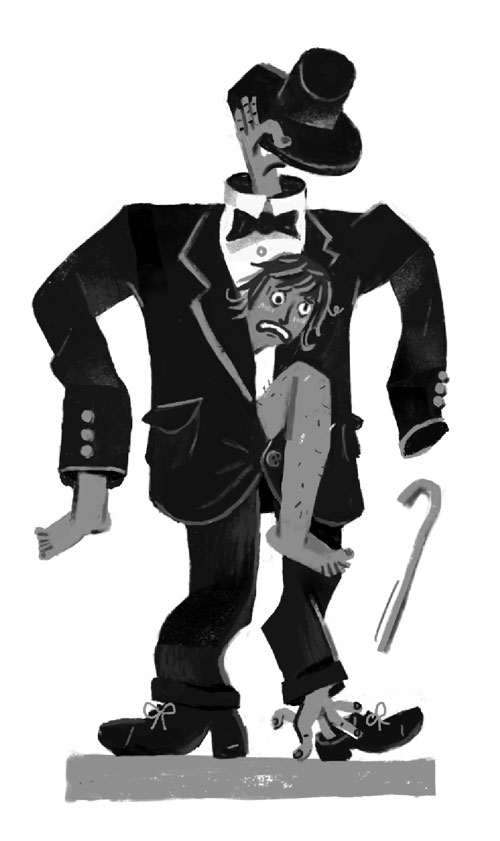
Take a red pill and call him in the morning.
Mark Zheng
Is there a way back for Waylon — a path to redemption? This is the question Babiak poses in What Gentlemen Do. The story is told through short chapters and moves swiftly. Babiak offers Waylon’s first-person point of view, and we follow him through a comical series of mishaps and adventures. Waylon is stuck between the disapproval of his former friends and the manosphere, hilariously parodied by the boorish Chmielewski Three — the twins Jack and Cheese, along with their cousin Alistair. The Chmielewski Three might be described as incels, though in their own terminology (borrowed from video game culture) they are NPCs: non‑playable characters. Meanwhile, Waylon, flunking out of one community college program after another and working part-time in a used-book store owned by Derby’s parents, finds that his fortunes are further damaged when his father borrows against the family home to invest in some get-rich-quick scheme and loses everything. Shortly after, Waylon’s mother abandons her husband. Waylon hits rock bottom. He decides he is trash. To add insult to injury, his counsellor, Reese, insists that he still benefits from white privilege. Try as he might, Waylon can’t see it, especially when he compares his life with Derby’s or Solomon’s.
What Gentlemen Do is most successful as it weaves its way between the horns of Waylon’s dilemma, neatly skewering both the manosphere and progressive positions, gently pointing out that there are half-truths and major falsehoods to be found in either camp. Help finally appears when Waylon drifts into a philosophy class, an introduction to Stoicism, and is impressed by the Stoics’ practical and hands‑on approach to life. Their school of thought will become his path to virtue. More hilarity ensues. But seriousness also creeps in as Waylon practises radical honesty. Increased agency comes for him as he reckons with what he did and what he has become. In a neat parallel, the more his self-esteem improves, the more value he finds in Walleye. It’s a truth he sets out to proselytize. One of the funnier scenes in the book finds Waylon quoting from the Stoics to the Chmielewski Three. Later he makes an unlikely run for mayor.
This enjoyable book ends with Babiak quickly tying up the many narrative strands he has deployed throughout. Whether he lands the ending will be up to individual readers to decide. I found it a little too tidy. Comedy is better at tearing down than at building up. In its blackest form, it is a useful last stand against absurdity — and it often begins precisely where philosophy fails. In contrast, the popular novel might be said to shore up convention by integrating new ideas in a user-friendly format. By the end of What Gentlemen Do, comedy is sacrificed to the demands of contemporary fiction. The last few chapters have a romcom feel. Babiak’s final insistence on a redemption that includes a new media narrative for Waylon muddies his point that the path to virtue is both a middle way and a private struggle with older and deeper truths. The path is performative but not in the contemporary pejorative sense. In the words of Epictetus: “Do not call yourself a philosopher. Instead of talking to the masses about your ideas and theories, go out and embody them. Do not tell people how to eat, just eat as you ought.”
Patrick Warner is novelist and poet in St. John’s.
Advertisement

Advertisement