
It is barely believable now, but there was a time in the early 2010s when you could saunter into a weekday evening Toronto Blue Jays game and snag just about any empty seat your heart desired. Stadium attendance was dismal; the team was experiencing record lows since its initial move from Exhibition Stadium to SkyDome (now distastefully branded the Rogers Centre).
During those halcyon days, a 500-level ticket would set you back a mere $11 or $14, but it was common practice, at least among my circle of ne’er‑do-well friends, to sneak down to field level and sit much closer to the action. (A similar seat now is priced around $350, and the section is consistently sold out.) Back then, the Jays were almost as disappointing as their turnout, but I was a delirious devotee regardless. From my stolen premium perch, I endured long stretches of disappointment, hoping to witness a rare, fleeting moment of glory.
It’s bizarre to be nostalgic for a time when my beloved team finished fourth in the American League East, but I can’t help but pine for the sweet accessibility of that era. Those were the years of the now mythical Ballpark Pass, a physical season ticket the size of a credit card that cost about a hundred dollars. Except at the home opener, a swipe secured you nosebleed entry to every game of the regular season. Every single one of those eighty games. By today’s standards, that seems like an urban legend.
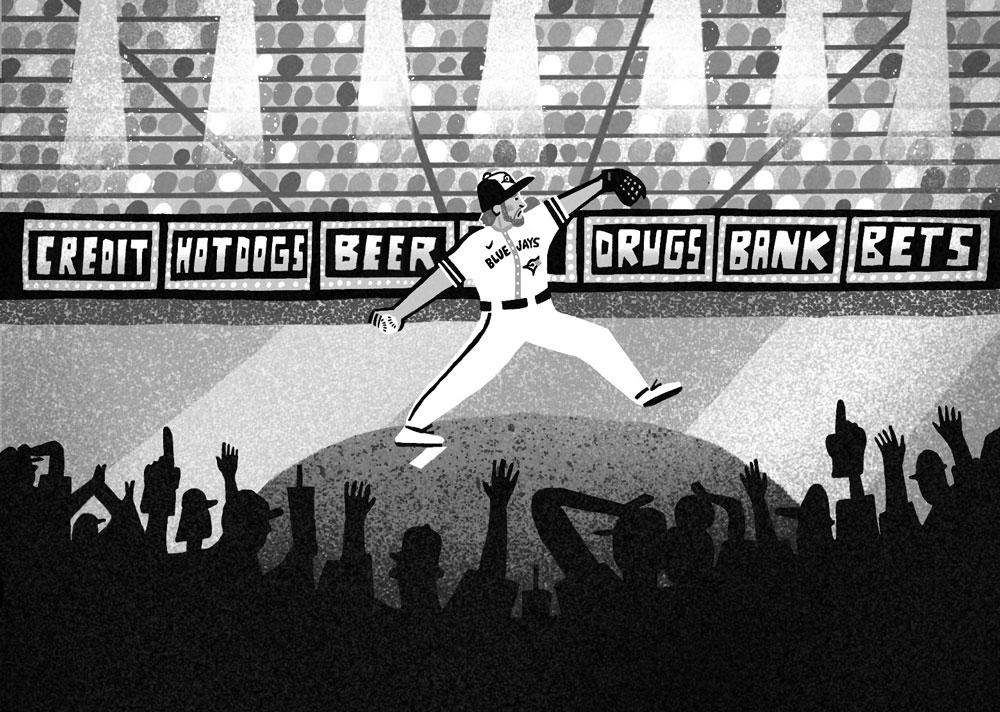
Pay no attention to the commercialization behind the digital hoarding.
Sandi Falconer
The Jays’ incredible 2025 run, capped off with a World Series appearance, was great for the city, but it definitely wasn’t great for our bank accounts. When 2026 tickets were released, I let out an audible sigh of fiscal despair, shocked at the sticker price of even a very bad seat to a subpar matchup. With frenzy and devotion come skyrocketing prices that, despite our unwavering affection for Vladimir Guerrero Jr., have many of us crying into our $19 beers.
It’s not just the prices that rub veteran fans the wrong way but everything those increases seem to be paying for. Why is there a DJ and an arcade on the very loud concourse? Why sell blue cotton candy fries and mini-pancakes when surely a ballpark dog will do? With all these ceaseless renovations, exclusive lounges, and schemes to add excitement, it feels as if no one is actually engaging with the game itself. Anyone who saw Trey Yesavage pitch last fall knows that kind of performance doesn’t need a soundtrack or laser light show to confirm its otherworldly beauty.
When I hear myself complain about the price of my mega-sized refillable soda in its branded reusable cup, or the slew of newly implemented rule changes, or the fact that I’m advertised to at every sponsored turn, I realize I’ve become something I never thought I’d be.
I’ve become a sports curmudgeon.
If you’re a sports fan for long enough, it’s inevitable that you’ll become a curmudgeon. One day you’ll wake up and find yourself yearning for a better time that exists only in your mind, the one when the dominant sounds were the call of the beer vendor and the low hum of the crowd’s anticipation. You’ll grow weary of flashing lights and gut-churning bass, the food gimmicks and relentless giveaways. You’ll long for the days when there weren’t so many costly diversions, when people simply sat down and enjoyed each inning, along with one another’s company. You’ll feel all this not because you hate fun but because you love your team so goddamn much.
The journalist and novelist David Macfarlane understands that being a curmudgeon comes from a place of love. “There’s magic in sports,” he writes in On Sports, “as if games are a gift from an insecure god who wants to remind mortals from time to time that there is such a thing as divinity.” With a welcoming, conversational, and charmingly self-deprecating tone, he walks us through the enduring conflict between loving a sport and hating the inherent frivolity of its culture.
“The list of reasons to not like sports is so long,” he writes, “it has boxes that even devoted sports fans can check: the gambling, the salaries, the ticket prices, the endless playoffs, the horrible stadiums, the loud digital commands to cheer and clap and make some noise, the fucking wave.” (Oh God, the wave.) Despite Macfarlane’s disdain for excess, his complaints remain rooted in a lifelong respect for a wide variety of athletic pursuits. His praise — accompanied by his childlike awe — makes all the more valid his principal gripe: namely, that hyper-commercialism has marred the innate grace of our cherished pastimes. “All it takes to be a sports fan is the capacity to be amazed at how good a human can be at something,” he explains, “and at how much work — how much relentless, lonely, determined, exhausting, tedious crazy work — it takes to get that good.”
With unabashed love, Macfarlane articulates a tension between the admiration for raw human ability and all the noisy, idiotic fuss around it. He questions why marketing departments feel the need to plaster so much technicolour gloss on something so marvellous. He touches on the many contradictions that arise while he is spectating: “I am conflicted. I bounce from fascination to disdain, joy to outrage, excitement to boredom, sometimes in the same game.”
The cruel irony is that when I was younger and slipping into the 100s to watch a favourite pitcher from behind home plate, I had a much higher tolerance for the cash grabs and the chaos. Now, in middle age, I feel exhausted by the spectacle. Apparently I’m in good company. According to Macfarlane, the groundbreaking sportswriter Alison Gordon, with whom he shared a friendship, once proposed to Blue Jays executives an “Old-Fashioned Day”— just one night annually when the ballpark would sound the way it used to. They, of course, declined.
At least the Louisville Bats, a Triple‑A affiliate of the Cincinnati Reds, yielded to the increasing desire for a quieter baseball experience. This May, they hosted their fourth “Nothing Night,” an evening with no ad reads, videos, or on‑field promotions. “Just baseball in its purest form,” they promised, and old-school fans celebrated. I can only hope my own ballpark brass notes the enthusiasm and turns the volume down for a single game.
I want to be absolutely clear: I am in no way averse to a crop of new fans. I adore the bandwagon with my whole heart. But I do lament the stressful and frenzied atmosphere, the drunken thrall, the pull away from simplicity and magic. I wonder about the community and connection that we could foster if the volume weren’t cranked so high and the price weren’t so exclusionary. I miss what brought me into the fold in the first place: believing in and caring for something bigger than myself.
“A lost art — killed by the kiss‑cam. Drowned-out by ads and promotions,” Macfarlane opines. “But there was a time when the expression of deep baseball insight from someone a couple of rows over was part of the general fun of a ball game.”
Using examples from hockey, football, tennis, cricket, and beyond, On Sports eloquently asks us what we might be losing when we smother the finer details, when we are distracted, when we can’t even hear the voices of our fellow fans. I may have once scoffed at this kind of “remember when” mode, but I now understand the appeal of thinking about stadiums as places to bask in the power of anticipation, focused attention, and even boredom.
“There are people,” Macfarlane reminds us, “who think that the noble status we bestow on sport is all hooey — that the sports industry is, at heart, a bonanza of commercial contrivance.” And as much as diehards like myself have romanticized the ethereal passion and poetry of a game and the godliness of its players, as much as we have lived and died by every play, it’s hard not to acknowledge that contrivance when every moment of action (or inaction) is sponsored.
So why be so unapologetically devoted? Why let your wallet be unceremoniously stripped by the latest gauche marketing ploy? Why fall for professional franchises at all? These are complex, deeply human questions that Macfarlane does an excellent job of answering.
“The curious thing about sports money — the gambling revenue, the broadcast profit, the ticket prices, the merchandise — is that it so often feels antithetical to the essence of what a sport is,” he admits. “Consider a horse at full gallop. It is a beautiful sight because it has nothing to do with anything other than strength and speed and grace.”
More than that, games offer a rare chance for communion. I’ve had my heart ripped out and shed tears for the miracle of what was being enacted in front of me, but mostly I have been moved by the way people come together in the stands. Nine innings (or more) can suspend time and reality, inexplicably soothing the wound of whatever is happening at home or out in the world. That unifying feeling is priceless. It can’t be bought or sold.
“Just as religion helps us avoid the terror of being meaninglessly alive, sports help us forget about catastrophe, impending and immediate,” Macfarlane writes. “An afternoon of televised football or a hockey game in a bar are reasonably effective diversions from worrying about the mess we are leaving our grandchildren.”
Looking back, it often felt as if the people most moved by last year’s World Series run were those mired in stress — either by their own personal woes or by the terrible state of the world in general. Macfarlane notes, quite rightly, that the sports industry is “an entertainment business, not a counselling service,” but it’s hard not to see its therapeutic value, especially now. I may have a half-dozen of those commemorative post‑season plastic cups in my kitchen cupboard, but my deepest memories of last October are of the people who were healed by the hope and joy our boys of summer generously gave them.
Macfarlane muses on how even literary greats like David Foster Wallace have failed to capture the feeling of witnessing a great play or a history-making performance, but he refuses to dismiss the appeal of trying. The potential for those moments may be what keeps us in the thrall of sports: “Simone Biles in double-layout, half-twist defiance of gravity; Nadal versus Federer in the Men’s Singles final at Wimbledon. How can anybody be that good?” Incredible athletic feats resonate despite the cotton candy on the fries, not because of it.
As for that galloping horse, the one that is strong and fast, the one that should be enough? “For some reason — a reason to do with the fucked‑up nature of human beings — it never is.”
Stacey May Fowles is the author of, most recently, The Lost Season.
Advertisement

Advertisement