The Literary Review of Canada

Happy anniversary to us! This past December, the LRC turned 20.

Get free email updates!

Magazine Issue ›› Jan/Feb 2012

Editor's Note

"Does the Past Have a Future?" That's the intriguing question posed in Kenneth Dewar's LRC feature essay this month. This Mt. St. Vincent historian wonders whether the modern personality-focused and pop-culture approaches to history are going to supercede traditional academic methodologies. "It seems that many readers want to experience the past," he writes, "rather than to assess competing interpretations of it."

Now that our fighting forces have left Afghanistan, the questioning begins. Two recent books, Chris Alexander's The Long Way Back: Afghanistan's Quest for Peace and Terry Glavin's Come From the Shadows: The Long and Lonely Struggle for Peace in Afghanistan, are evaluated in our pages by retired CF Colonel Michael Capstick, who has stayed on in that war-torn country advising the government and working with an international NGO based in Kabul.

One of the most talked-about books of the season has been Conrad Black's A Matter of Principle which documents, among many other things, the author's epic battles with the U.S. justice system. Our reviewer is Philip Slayton, whose own books on the Canadian legal system have caused much discussion in recent years.

Some bracing fare for mid-winter reading.

Bronwyn Drainie

Editor

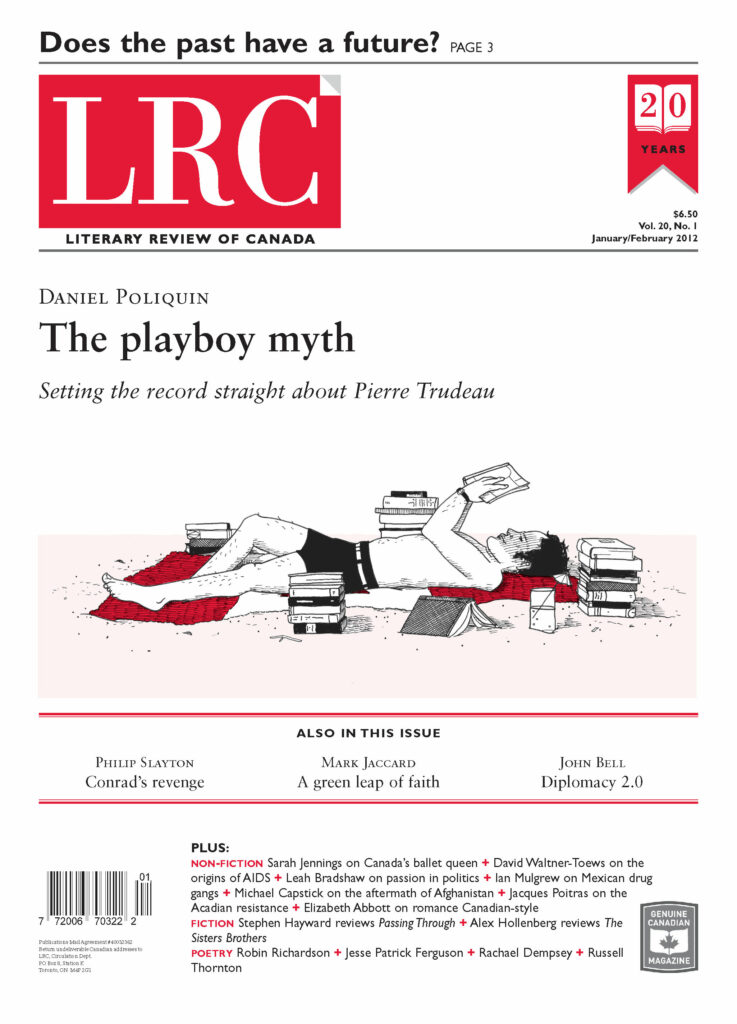
In the Jan/Feb 2012 Issue

  • Does the Past Have a Future?

    It turns out h-i-s-t-o-r-y can be spelled many different ways.

    Kenneth Dewar
  • Waves of Contempt

    A review of A Matter of Principle, by Conrad Black

    Philip Slayton
  • The Afghan Decade

    A review of The Long Way Back: Afghanistan's Quest for Peace, by Chris Alexander, and Come from the Shadows: The Long and Lonely Struggle for Peace in Afghanistan, by Terry Glavin

    Michael Capstick
  • The Pierre We Hardly Knew

    A review of Trudeau Transformed: The Shaping of a Statesman 1944-1965, Volume Two, by Monique and Max Nemni, translated by George Tombs

    Daniel Poliquin
  • Love and Marriage Canadian-Style

    A review of Hearts and Minds: Canadian Romance at the Dawn of the Modern Era, 1900-1930, by Dan Azoulay

    Elizabeth Abbott
  • The Ties that Bind

    A review of Rebecca Kingston's Public Passion: Rethinking the Grounds for Political Justice

    Leah Bradshaw
  • A Very Modern Pandemic

    A review of The Origins of AIDS, by Jacques Pepin

    David Waltner-Toews
  • The New Bogeymen

    A review of Gangland: The Rise of the Mexican Drug Cartels From El Paso to Vancouver, by Jerry Langton

    Ian Mulgrew
  • Artistic Autocrat

    A review of The Pursuit of Perfection: A Life of Celia Franca, by Carol Bishop-Gwyn

    Sarah Jennings
  • Monday Morning

    Jesse Patrick Ferguson
  • Terrorist

    Rachael Dempsey
  • Lead

    Russell Thornton
  • Ship's Prow Is the Cubist Slate They Call a Face

    Robin Richardson
  • Endearing Assassins

    A review of Patrick deWitt's The Sisters Brothers

    Alexander Hollenberg
  • Dubai Glitz to Hardware Retail

    A review of David Penhale's Passing Through

    Steven Hayward
  • Up in the Air

    A review of Diplomacy in the Digital Age: Essays in Honour of Ambassador Allan Gotlieb, edited by Janice Gross Stein

    John Bell
  • Heroism and Villainy

    A review of Heroes of the Acadian Resistance: The Story of Joseph Beausoleil Broussard and Pierre II Suette, 1702-1765, by Dianne Marshall

    Jacques Poitras
  • Full Steam Ahead?

    A review of The Leap: How to Survive and Thrive in the Sustainable Economy, by Chris Turner

    Mark Jaccard
  • Letters and Responses

    Ken Greenberg, Allan Fotheringham, David Berlin, William Marsden, Susan Felsberg

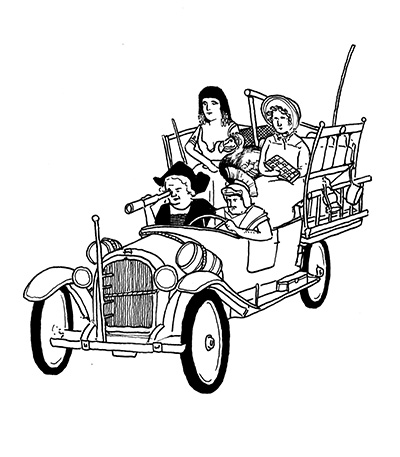
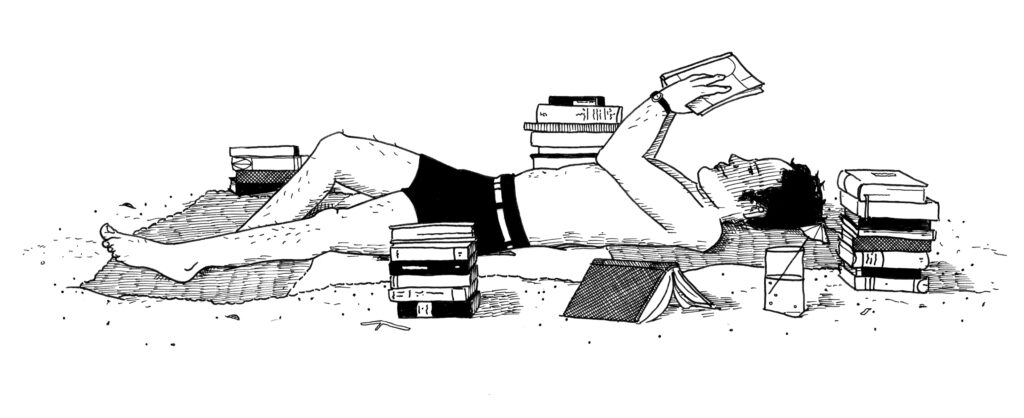
  • Cover art and pictures throughout the issue by Ryan Dodgson.

    Born in Hong Kong in 1984, Ryan Dodgson has in recent years been living and working across from various chocolate factories in Toronto. His work has won a number of awards and appeared in Eye Weekly, McSweeney’s, The Believer and The New York Times among other publications. He is currently at work on a book-and-record set with musician/friend Moshe Rozenberg.

Letters for Jan/Feb 2012

  • Re: "Waves of Contempt," by Philip Slayton (Jan/Feb 2012)

    I could not really accept the LRC’s invitation to reply to its review of my book A Matter of Principle without, in effect, pleading that my book was not “a bombastic and narcissistic mess.” I can only write that no other reviewer, and there have been many in several countries, as it chugs into its third hardcover printing, remotely suggested any of that. But if any reader writes me at cbletters@gmail.com that his or her decision to buy or read this book has been negatively influenced by this review, I will ask the publishers to send more representative reviews, including, if it has reviewed it, from any publication the reader specifies.

    I can’t help wondering, briefly, where Canlit finds crabby, obscure reviewers like this; perhaps there is a home for hobbit ogres with literary pretensions somewhere in Canada. Or maybe this is a Mr. Hyde to an otherwise house-trained Dr. Jekyll who can be induced to come snorting out of the undergrowth snapping and gibbering on special occasions.

    Whoever this reviewer is has serious cognitive problems and apparently suffers from a merciless personality disorder as well. I have, he writes, forfeited his sympathy (which is the last thing I ever sought), but assure him that he has mine.

    Conrad Black
    Miami, Florida

    Response to Waves of Contempt

  • Re: “Does the Past Have a Future?” by Kenneth Dewar (Jan/Feb 2012)

    After reading Kenneth Dewar’s thoughtful essay I offer some optimistic thoughts, despite my living at the perilous intersection of history and television.

    First of all, we are living the golden age of the written word—it’s just published electronically. Every young person types like the wind, and more “letters” are being written every hour than used to be in a decade; they’re just called emails. Everything is not a Tweet, all bloggers are not living in their parents’ basements (some of them are risking their lives as citizen journalists in the Middle East) and more people are reading newspapers than ever (they’re just not paying for them). Future historians will not be starved for primary sources—they’ll probably still be sifting through WikiLeaks for decades.

    Admittedly, Ice Road Truckers, American Pickers and Pawn Stars are not quite the direction I had hoped History Television would take. We should remember, however, that it was ever thus with “reality” adventures. More war crimes against history were committed by Victorian authors writing about the glory of Empire than we care to remember.

    None of this should be confused with the growth in popularity of “narrative history,” which, as Dewar observes, has gained some ground on television, but a lot more in books. I had two daughters graduate from university recently. Their history professors were, on the whole, excellent. The academic literature—those spiral-bound volumes of photocopies—was so incoherent and badly written as to border on disdain for any reader. Narrative history has had an uphill battle since 1938, when proponents such as Allan Nevins, a Pulitzer–prize-winning historian, wrote his famous attack on historians whose heavy, stolid prose “is responsible for the fact that today a host of intelligent and highly literate Americans will open a book of history only with reluctant dread.” People are now opening well-written narrative history books.

    A narrative history is more than oral history or a collage of quotes from diaries and letters. As a narrative, it is unified by the perspective of the writer, the flow of events and the arc of the story. Good narrative history, however, is usually rooted in the work of other historians who have prepared the way and excavated the ground with primary research and analysis, allowing the narrative historian to bring all the elements together.

    C. Vann Woodward (The Strange Career of Jim Crow; Oxford History of the United States) said: “Narrative history … is the end product of what historians do. The narrative is where they put it together and make sense of it for the reader. Other types of history—analytical, quantitative, comparative history—as important as they are, are mainly for other historians.” The best history, he said, “is always informed by art.”

    Mark Starowicz
    Toronto, Ontario

    Response to Does the Past Have a Future?

  • Re: “The Ties that Bind,” by Leah Bradshaw (Jan/Feb 2012)

    While passion can often be identified with very intimate experience, the suggestion that this form of characterizing emotion is only appropriate for the private sphere is a symptom of a broader reluctance to take emotion in politics seriously, a disposition that I try to challenge in my book, Public Passion: Rethinking the Grounds for Political Justice. If we look at historical examples, in fact, there is no reason to think that people always feel more intensely in intimate as opposed to public matters. Indeed, the lives of some extraordinary individuals in our own century, such as Aung San Suu Kyi, demonstrate a devotion to the public good that can only be described as a public passion, indeed one that tragically led this opposition leader to turn her back on her own family in England. Or think of the actions of one fruit vendor in Tunisia—Mohamed Bouazizi—whose despair in turn fuelled outrage that changed history. These acts demonstrating out-of-the-ordinary political commitments and passion for public matters often lead us to recognize these individuals as great figures or heroes.

    Of course, my own discussion of emotion in my book focuses less on the lives of extraordinary individual political actors (that’s my next project). Rather, I suggest that a muted intensity, but much more broadly shared form of emotion, can be said to work in all forms of political regime. The intensity of passion in the individual analysis is replaced in my understanding by the unusual breadth of shared emotion at the social and political level and that is why it bears the label of public passion. My suggestion is not that this form of publically shared emotion will always trump private priorities and concerns, but that it does play a constant role in helping to orient citizens in social and political networks. It also means that what was once pejoratively called emotional “contagion” (as if shared emotion was akin to a deadly virus)—a description that was in reality just fuelled by a fear of democracy—can actually have positive consequences in social and political life. For example, it could be said that citizens of contemporary liberal democracies expect and desire to be treated fairly, that we show moderate consideration and concern for others—particularly in distress—in the same way that we desire consideration and concern in return, but without entering too intimately into the lives of strangers. So emotion, as I conceive it here, works not as a function of a cultural or country-specific nationalism, but as a mode in which citizens relate both to one another and to public matters differing more generally by type of political regime. We can contrast these liberal democratic desires and need for reciprocity with life in a political tyranny, where fear and suspicion often dominate interactions with public officials and among subjects. So public passion exists as a real and living (although often unacknowledged) facet of our collective lives. The challenge, as I attempt to work out in this book, is how we come to a new understanding of justice based on this acknowledgement, for it does not mean that all manifestations of collective emotion can be judged to be good or just.

    Rebecca Kingston
    Toronto, Ontario

    Response to The Ties that Bind

The LRC welcomes letters. We reserve the right to publish such letters and edit them for length, clarity and accuracy. E-mail editor[at]lrcreview[dot]com.


Online Originals